Island Spear Co.

Regulations Puerto Rico

Spearfishing Regulations in Puerto Rico

Checked against the primary source (DRNA) on July 4, 2026territory

Governing agency: Departamento de Recursos Naturales y Ambientales (DRNA). Last verified July 5, 2026 by independent primary-source check incl. Reglamento 7949 full-text extraction.

Summary

Spearfishing (pesca submarina) is legal in Puerto Rico's marine waters using a hand-powered or band/rubber speargun while free-diving (apnea) only — using a speargun together with a dive tank (SCUBA) is prohibited. Recreational fishing, including spearfishing, does NOT require a license in Puerto Rico: the 2010 Reglamento de Pesca 7949 created a recreational license on paper but the DRNA never activated it via the public notice the regulation itself requires, so none has ever been issued or enforced (only commercial fishers need a license). The regulation still governs gear, closed seasons (vedas), protected species, and no-take reserves.

License

What you need to be legal

Not permittedNo license specifically required
License
None required for recreational fishing (incl. spearfishing). A commercial license is required only to sell your catch.
Who needs it
Recreational fishers — including spearfishers — do NOT currently need a license in Puerto Rico. The 2010 Reglamento de Pesca 7949 (Art. 16) created recreational 'agua interior' (inland) and 'mar' (marine) licenses, but the same article makes them available only once the DRNA issues an 'aviso al público' (public notice) — and that notice has never been issued, so the recreational license has never been offered or enforced (confirmed directly with the DRNA). Only COMMERCIAL fishers (anyone selling their catch) must be licensed by the DRNA.
Resident cost
Not applicable — no recreational license is issued. (For reference, Reglamento 7949 Art. 16.1(d) set on-paper fees of $20/yr resident age 22–60, but the license was never activated.)
Non-resident cost
Not applicable — recreational fishing requires no license in Puerto Rico. Federal waters (beyond 9 nm) likewise require no PR license, though federal size/bag/season limits still apply.
Where to buy
Nothing to buy for recreational fishing. Commercial fishing licenses are issued by the DRNA's Oficina de Permisos (Vida Silvestre y Pesquerías).

The full story

Puerto Rico's recreational license: required on paper, never real

The short version for a spearfisher: you do not need a license to spearfish recreationally in Puerto Rico. If you're diving for the table and following the gear, species, closed-season, and protected-area rules on this page, you're legal. A license only comes into play for commercial fishing — anyone who sells their catch must be licensed by the DRNA.

Where the confusion comes from: the 2010 Reglamento de Pesca 7949 (Article 16) did create recreational fishing licenses — two of them, an 'agua interior' (inland) license and a 'mar' (marine) one — and even set fees for them 1. Read literally, the regulation says every recreational fisher must hold one. That literal reading is why many websites, and a first pass of this page, wrongly say a license is 'required.'

But Article 16 contains its own off-switch: the licenses only become available once the DRNA issues an 'aviso al público' — a formal public notice announcing that they can be obtained. That notice has never been issued. More than a decade after the 2010 regulation, the DRNA has never made a recreational license available to buy, and Natural Resources officers in the field do not ask recreational fishers for one (s_lic_practice). A requirement you cannot comply with because the government never opened the counter is not a real requirement.

The bottom line, confirmed directly with the DRNA by a Puerto Rico resident: recreational fishing — including spearfishing — needs no license here. This is one of the ways Puerto Rico differs from most U.S. mainland states, where a recreational saltwater license is standard. Only sell your catch and the rules change: that's commercial fishing, and it does require DRNA licensing. Regulations can change by administrative order, so if you ever intend to sell, confirm current commercial requirements with the DRNA first.
The full story

The lionfish 'written authorization' — same story, smaller scale

Article 22 of Reglamento 7949 created a lionfish-control program: volunteers with written DRNA authorization may exceptionally use SCUBA or hookah together with a spear to cull invasive lionfish (pez león) — the only carve-out from the spear-plus-tank ban.

In practice, the written-authorization system follows the same pattern as the recreational fishing license: local divers report the DRNA does not actively issue or check these papers, and lionfish removal is broadly encouraged rather than policed (confirmed by Puerto Rico residents). The species is invasive, venomous, and destructive to the reef — every jurisdiction in the Caribbean wants it gone.

What this means for you: culling lionfish is welcomed, and enforcement of the paperwork requirement is not a practical reality — but the authorization requirement is still the law as written. If you plan to regularly cull on SCUBA, asking the DRNA for the written authorization is the by-the-book path. Free-diving spearos taking lionfish need nothing special: spearing lionfish 'en apnea' is legal like any other permitted take.

Where it's legal

Saltwater & freshwater

Saltwater

Legal

Spearfishing in marine waters is permitted using a spear (arpon) while free-diving (apnea) only. Recreational fishers may fish 'usando arpon en apnea' (Art. 18.9); it is illegal to use a spear together with a dive tank at the same time (Art. 18.2). Spearing is prohibited at night (sunset to sunrise), within 100 ft (30.48 m) of the coast, and in reserves/swimmer areas (Art. 8.5, 8.6).

Freshwater

Not permitted

Spearfishing is prohibited in Puerto Rico's inland (fresh) waters. Art. 8.2 allows only rod, reel, line and hook in aguas interiores and expressly lists arpones (spears) among the gear that may NOT be used there. Art. 8.5 also bans spearing in reservoirs (embalses), rivers, and estuaries.

Gear

What you can carry

Speargun
Allowed for marine recreational fishing while free-diving (apnea) only. 'Arpon' is defined (Art. 4.6) as a fishing gear that launches a pointed projectile underwater by manual or mechanical force, covering spearguns. Prohibited: with a dive tank (Art. 18.2), at night (Art. 8.5), within 100 ft (30.48 m) of the coast where it must remain unloaded/discharged (Art. 8.6), and in reserves/artificial reefs/swimmer areas (Art. 8.5).
Pole spear
Covered by the same 'arpon' definition (manual or mechanical projectile device, Art. 4.6) and subject to the same rules as spearguns. Not called out separately by name in Reglamento 7949.
Hawaiian sling
Recognized by name in the regulation ('hawaiian sling', Art. 22.1(g), in the lionfish-control provisions). Treated as a spear/pointed device (arpon/objeto punzante) and subject to the same spearfishing restrictions.
Spearfishing on SCUBA
No. It is illegal for a recreational fisher to use a spear (arpon) and a dive tank at the same time (Reglamento 7949, Art. 18.2). Recreational spearfishing is limited to free-diving/breath-hold ('en apnea', Art. 18.9). The ONLY exception is lionfish (pez leon) control by volunteers holding a written 'Autorizacion Especial para Voluntarios de Captura de Pez Leon', who may use scuba or hookah with a spear/Hawaiian sling but may keep only lionfish that day (Art. 22).

Gear restrictions

  • No spearing at night, from sunset to sunrise (Art. 8.5)
  • No spearing within 100 ft (30.48 m) of the coast; within that zone the spear must always be kept unloaded/discharged (Art. 8.6)
  • No spearing in docks (muelles), reservoirs (embalses), rivers, estuaries, swimmer-reserved areas, designated areas or Marine Reserves, and artificial reefs (Art. 8.5)
  • No spear + dive tank simultaneously (Art. 18.2)
  • Spearing lobster is prohibited (no bicheros de anzuelo or arpones for lobster, Art. 8.18)
  • Lionfish exception: Art. 22 on paper requires a written DRNA volunteer authorization to use scuba/hookah with a spear — but in practice the DRNA does not actively issue or check these authorizations (confirmed by local divers; same pattern as the never-activated recreational license). Lionfish culling is actively encouraged. Still the law as written — verify with DRNA if you want papers

What you'll see

Target species

A field guide to the fish a spearo may actually encounter around Puerto Rico, with the local Spanish names divers here use. This is not an exhaustive list, and it is not a legality ruling — always confirm the current DRNA and federal rules, and be aware that many tropical reef fish carry ciguatera risk before you take or eat anything.

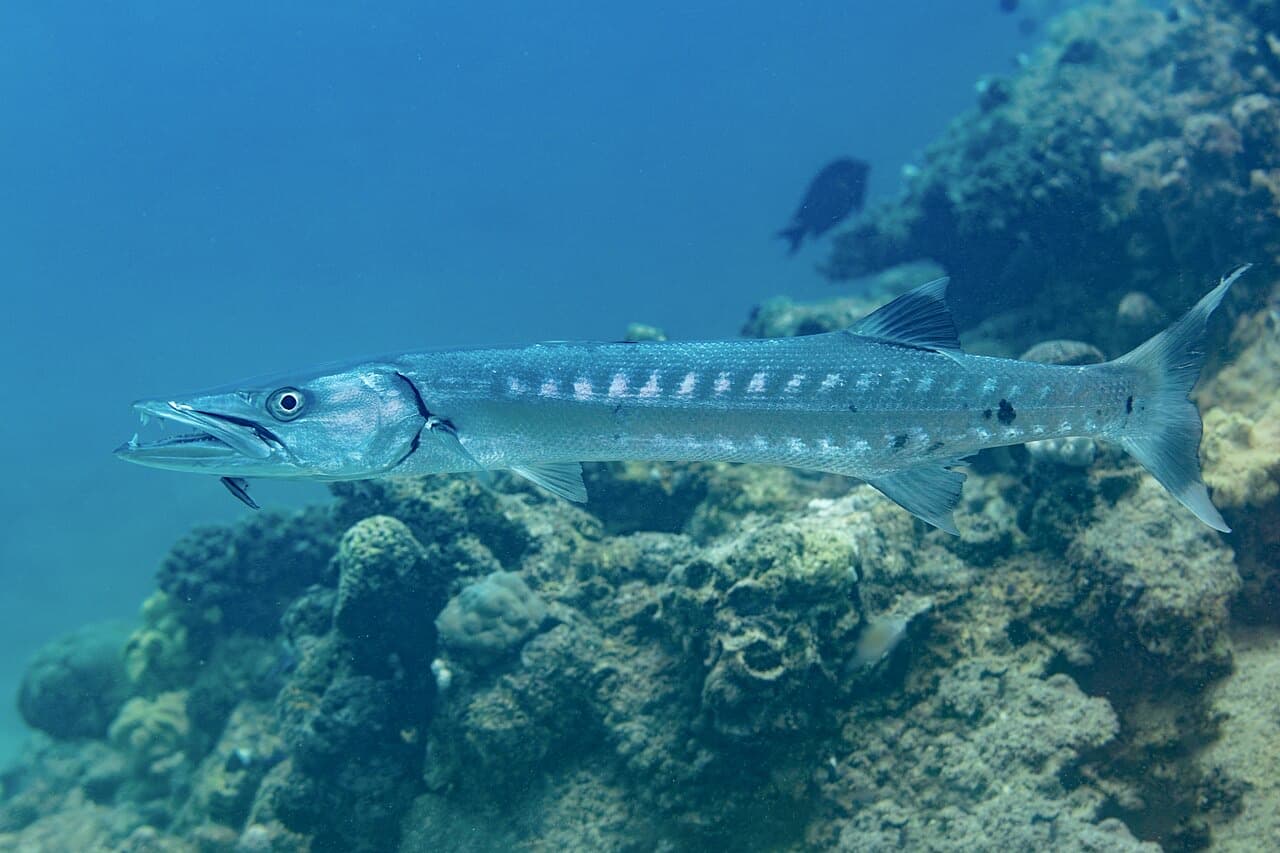
Great Barracuda (Sphyraena barracuda)
Photo: Diego Delso / CC-BY-SA 4.0

Great Barracuda

Picúa

Sphyraena barracuda

Restricted — verify
reef60-180 cmCiguatera: high
Edibility & ciguatera
HIGHEST ciguatera risk in Puerto Rico — the strongest statistical predictor of poisoning in local studies; sale has been banned in PR since 1981. Commonly not eaten, especially larger fish.
Where you'll see it
Ubiquitous over reefs and along drop-offs; curious and often approaches divers.
Legal status
Legal to spear, but SALE IS PROHIBITED in PR and the ciguatera risk is severe — most divers do not eat it.
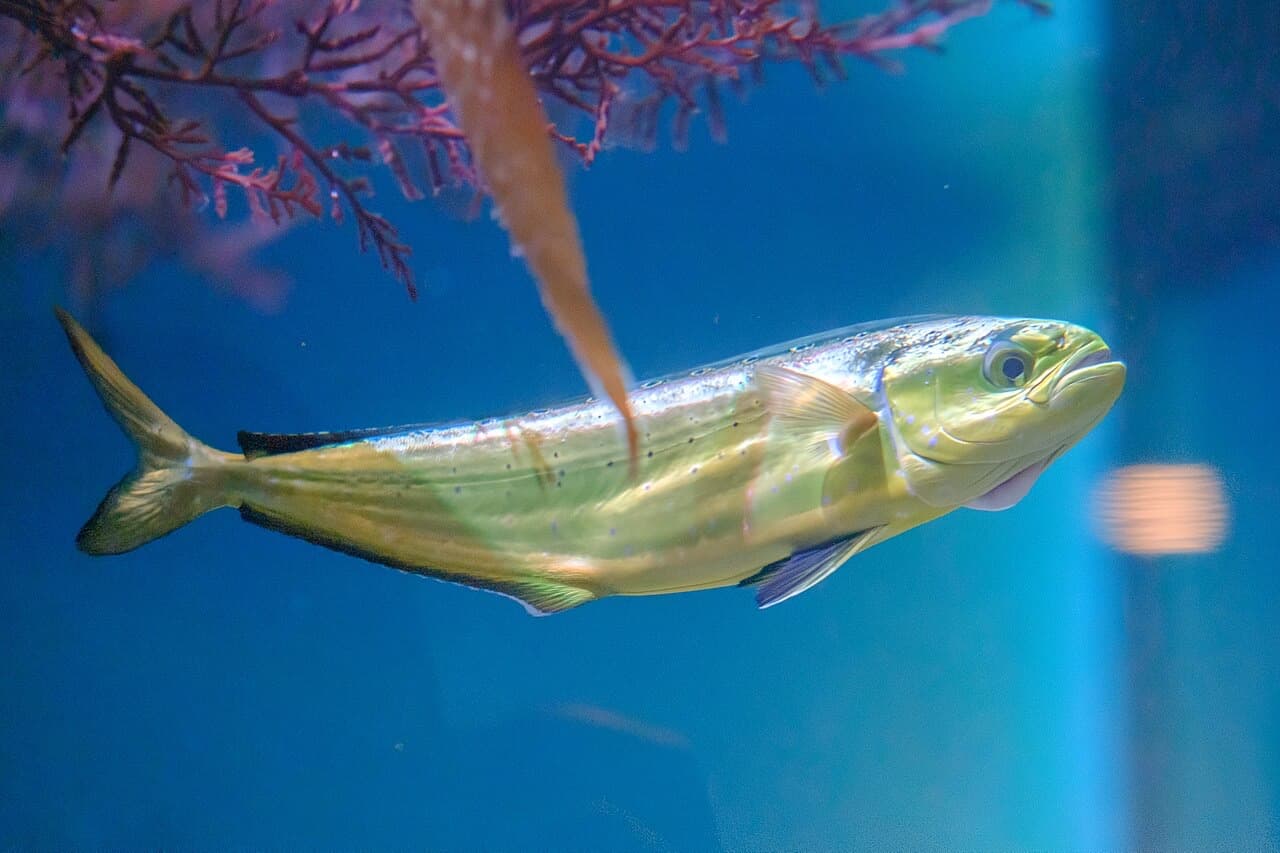
Mahi-mahi (Dolphinfish) (Coryphaena hippurus)
Photo: gendereuphorbia / CC0

Mahi-mahi (Dolphinfish)

Dorado

Coryphaena hippurus

Legal to spear
pelagic1.5-7 kg, up to ~40 kg
Edibility & ciguatera
Excellent eating; low ciguatera risk (open-water feeder, not on FDA's reef-toxin list). Ice quickly to avoid scombroid/histamine.
Where you'll see it
Offshore bluewater around weedlines, FADs and floating debris — a bluewater target, not a reef fish.
Legal status
Legal to spear. DRNA lists no size restriction; recreational quota applies.
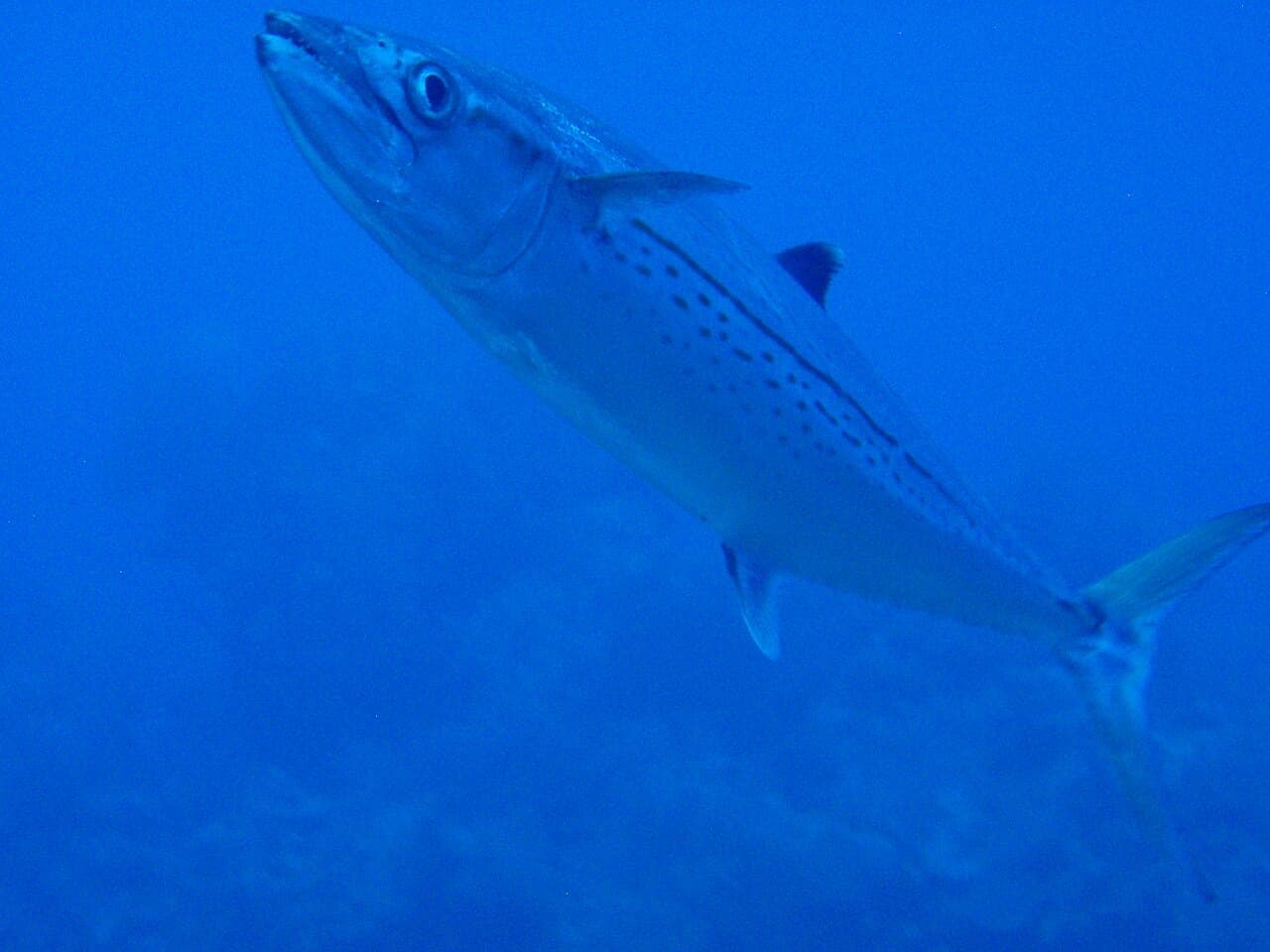
Cero Mackerel (Scomberomorus regalis)
Photo: Andy Blackledge / CC-BY 2.0

Cero Mackerel

Sierra?

Scomberomorus regalis

Restricted — verify
nearshoremin 40 cm (16 in), up to ~5 kgCiguatera: moderate
Edibility & ciguatera
Good eating; moderate ciguatera risk (on FDA's reef-toxin list).
Where you'll see it
Nearshore over reef edges and wrecks, usually in the water column.
Legal status
Legal to spear with a minimum size of 16 in (fork length); DRNA quota applies — verify current rule.
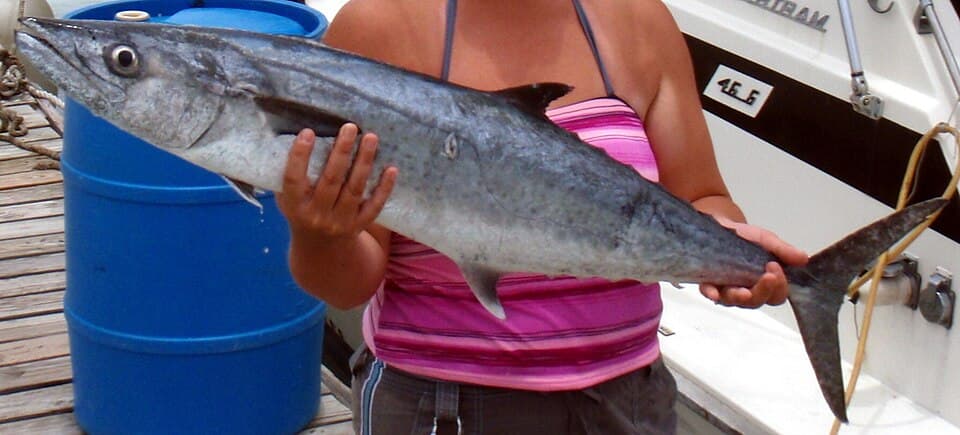
King Mackerel (Scomberomorus cavalla)
Photo: ScubaBear68 / CC BY 2.0

King Mackerel

CariteSierra

Scomberomorus cavalla

Restricted — verify
pelagicmin 51 cm (20 in), up to ~1.6 mCiguatera: high
Edibility & ciguatera
Good eating; HIGH ciguatera risk in large fish (named in FDA guidance).
Where you'll see it
Nearshore to offshore over reefs and wrecks, fast-moving in the water column.
Legal status
Legal to spear with a minimum size of 20 in (fork length); DRNA quota applies — verify current rule.
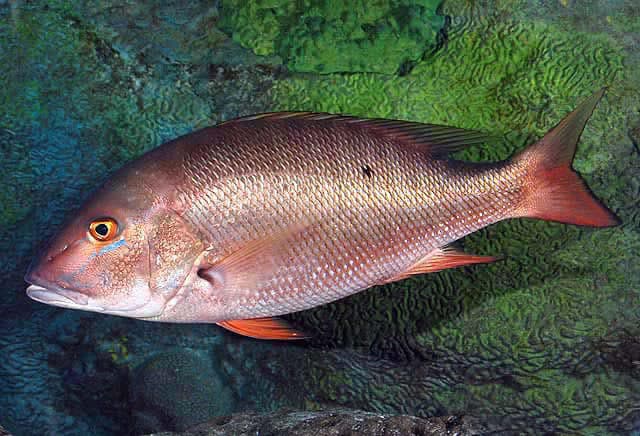
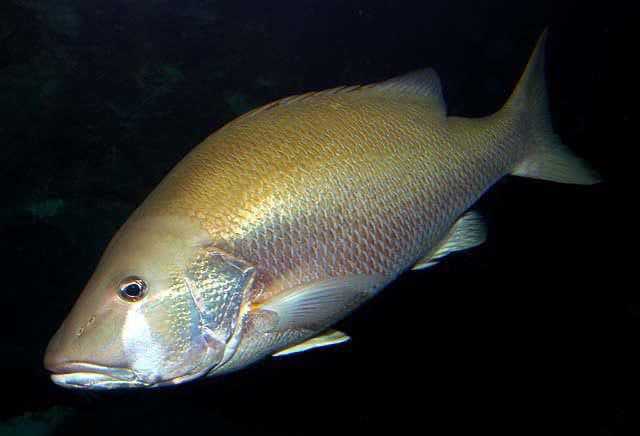
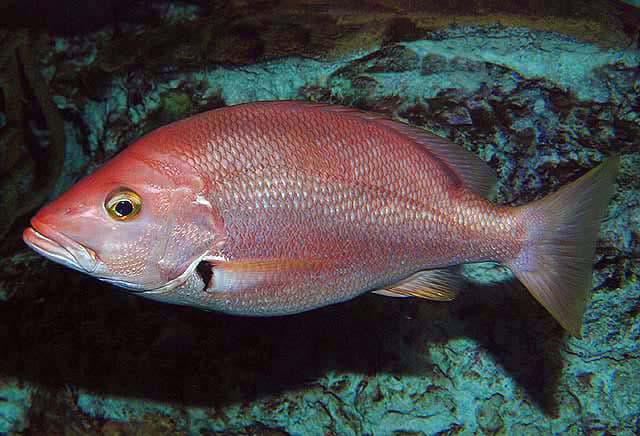
Mutton Snapper (Lutjanus analis)
Photo: D Ross Robertson · Public domain

Mutton Snapper

SamaPargo criollo

Lutjanus analis

Restricted — verify
reefup to ~58 cm (23 in)
Edibility & ciguatera
Excellent eating; low ciguatera risk. A prized food fish.
Where you'll see it
Reefs, sand holes near reef edges and wrecks; wary and often holds off structure.
Legal status
SEASONAL CLOSURE — closed in territorial waters Apr 1-May 31 and in the federal EEZ Apr 1-Jun 30 (spawning). Counts toward the federal snapper/grouper aggregate. Verify which closure applies where you dive.
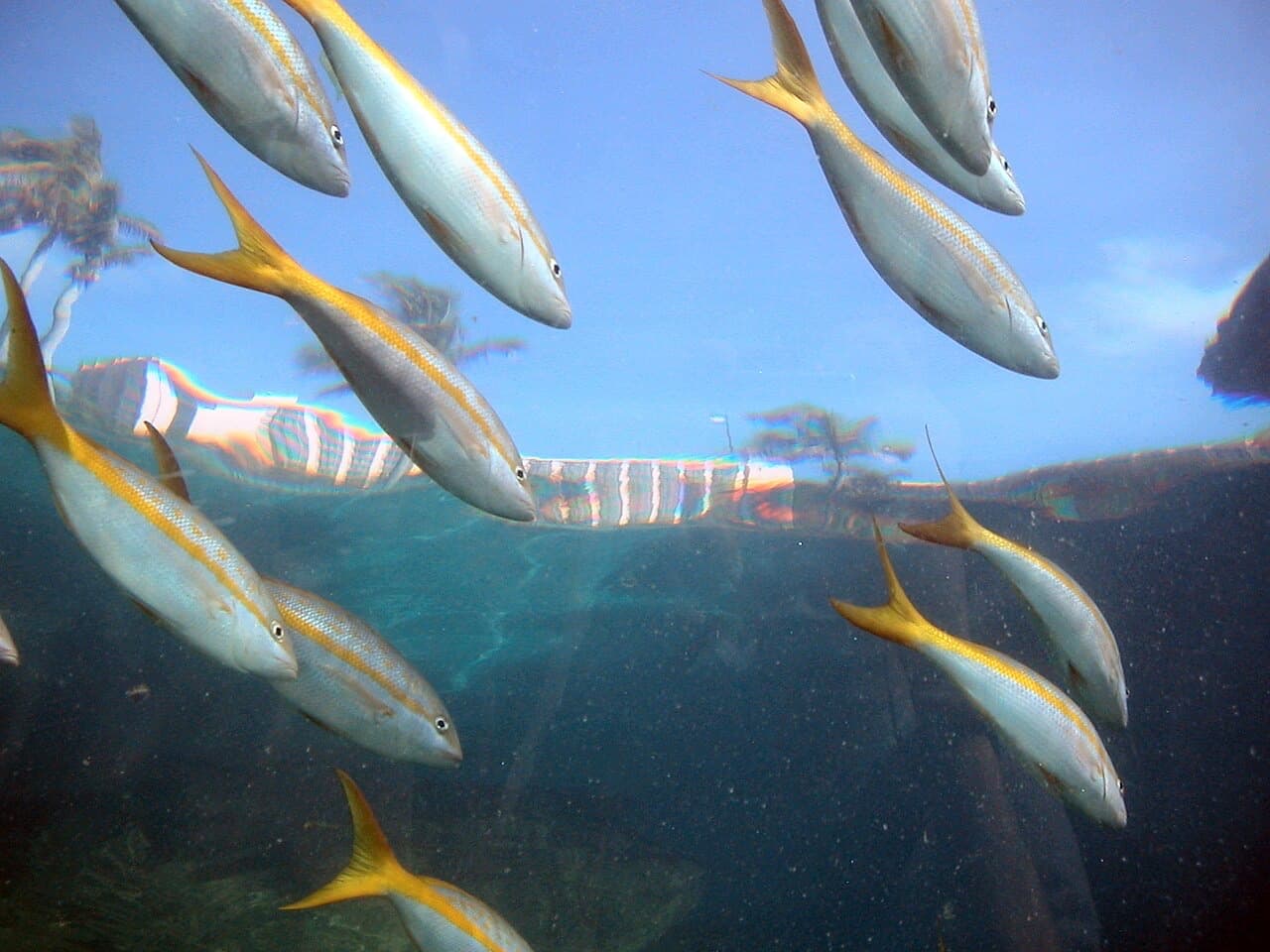
Yellowtail Snapper (Ocyurus chrysurus)
Photo: Fred Hsu / CC-BY-SA 3.0

Yellowtail Snapper

ColirrubiaRabirrubia

Ocyurus chrysurus

Restricted — verify
reefmin ~27 cm (10.5 in), up to ~76 cm
Edibility & ciguatera
Excellent eating; low ciguatera risk.
Where you'll see it
Reefs, often up in the water column over coral; skittish and a harder spear target.
Legal status
Legal to spear. Minimum size 10.5 in (fork) in territorial waters, 12 in (total length) in the federal EEZ. Counts toward the snapper aggregate.
Lane Snapper (Lutjanus synagris)
Photo: NOAA

Lane Snapper

ManchegoArrayado

Lutjanus synagris

Restricted — verify
reeftypically under 38 cm (15 in)
Edibility & ciguatera
Very good eating; low ciguatera risk.
Where you'll see it
Reefs, hard bottom and grass edges; common and approachable.
Legal status
Legal to spear in territorial waters; the federal EEZ is CLOSED Apr 1-Jun 30. Counts toward the snapper aggregate.
Dog Snapper (Lutjanus jocu)
Photo: D Ross Robertson · Public domain

Dog Snapper

JocúPargo colorado

Lutjanus jocu

Legal to spear
reefup to ~90 cmCiguatera: high
Edibility & ciguatera
Good eating, BUT a HIGH ciguatera risk — larger fish especially. One of the snappers most implicated in Caribbean poisoning.
Where you'll see it
Reefs and wrecks; a large, wary snapper.
Legal status
Legal to spear (no closed season or size limit); counts toward the snapper aggregate.
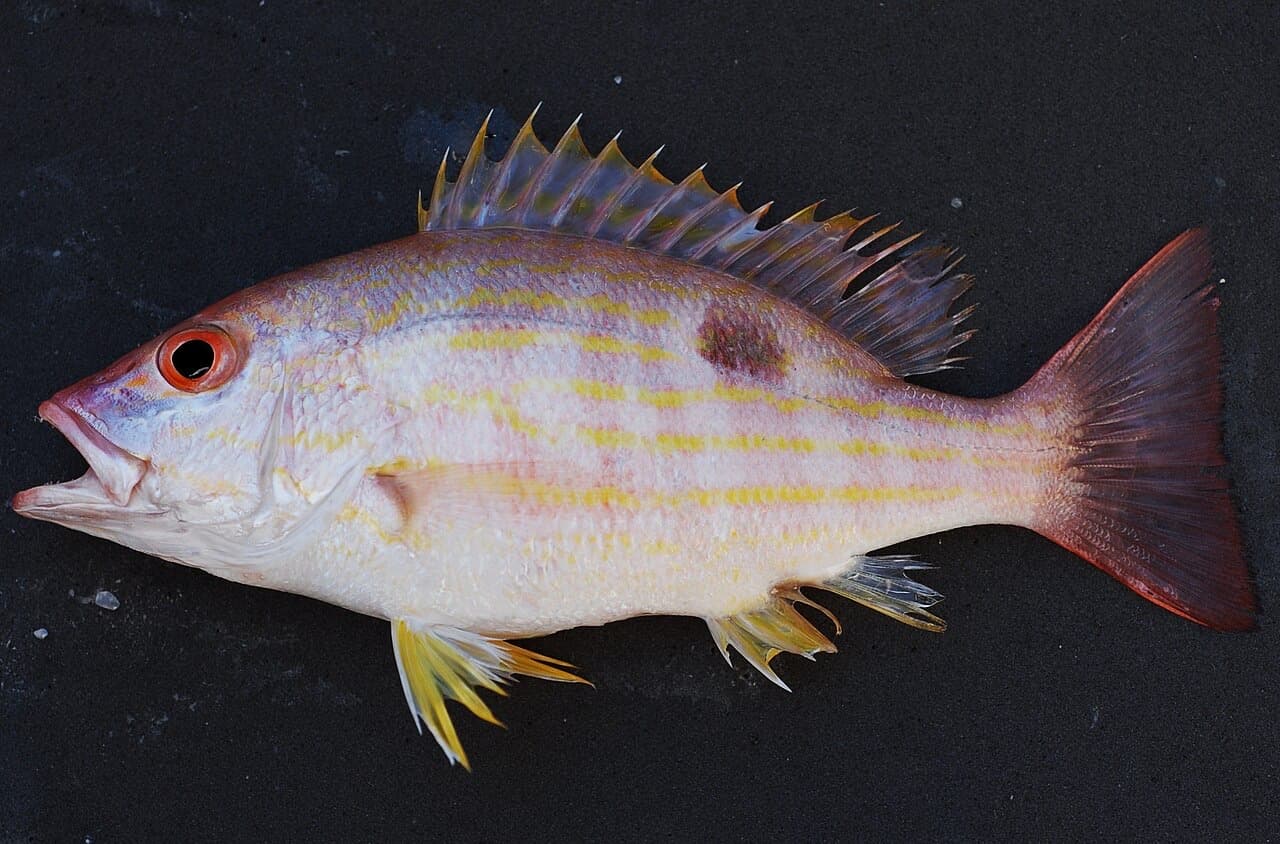
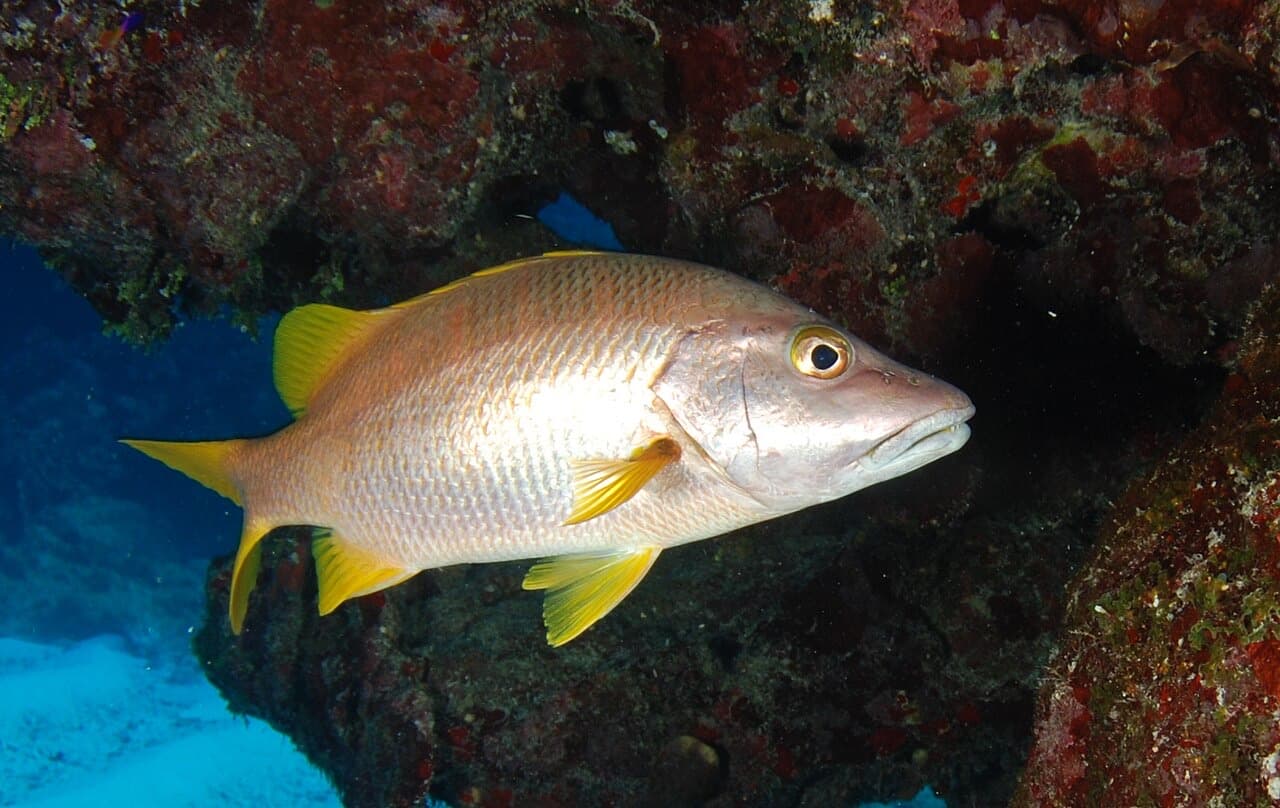
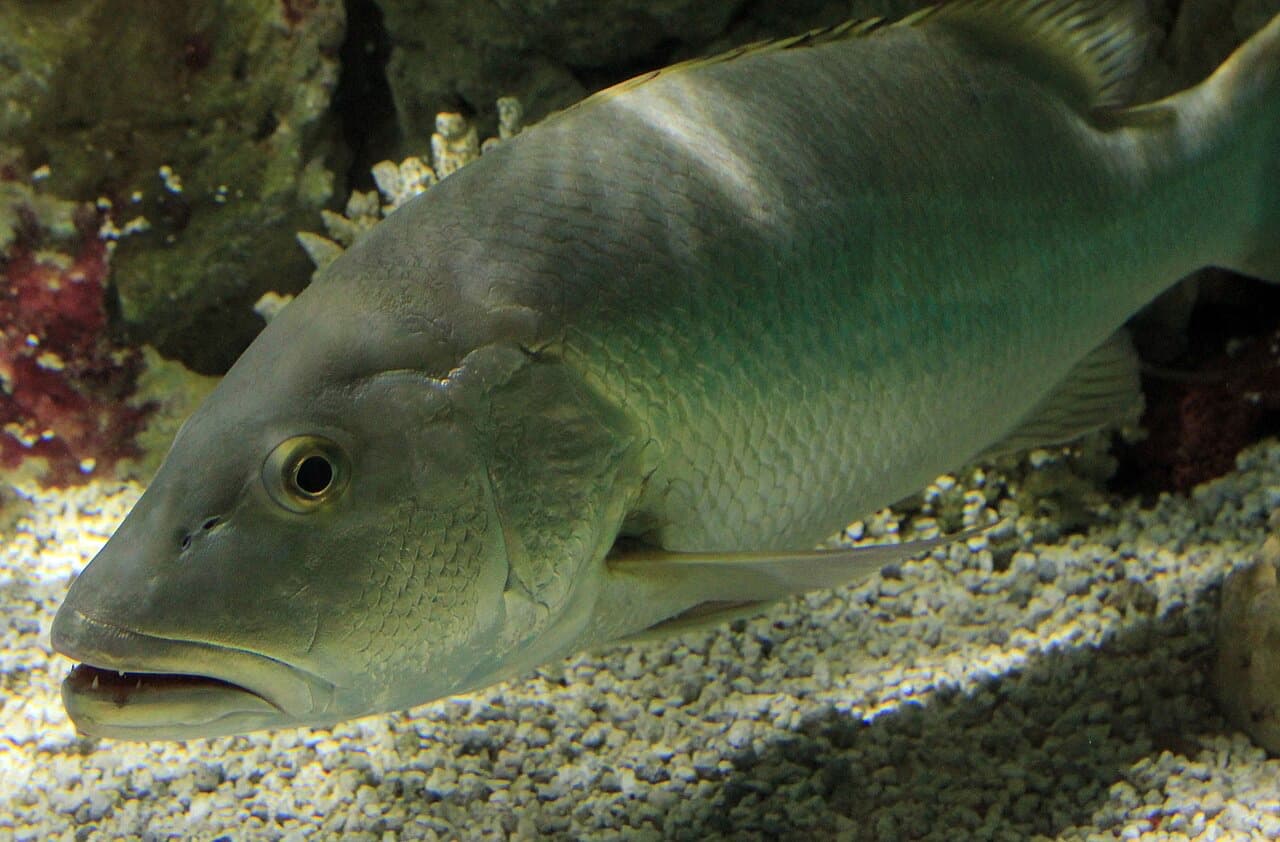
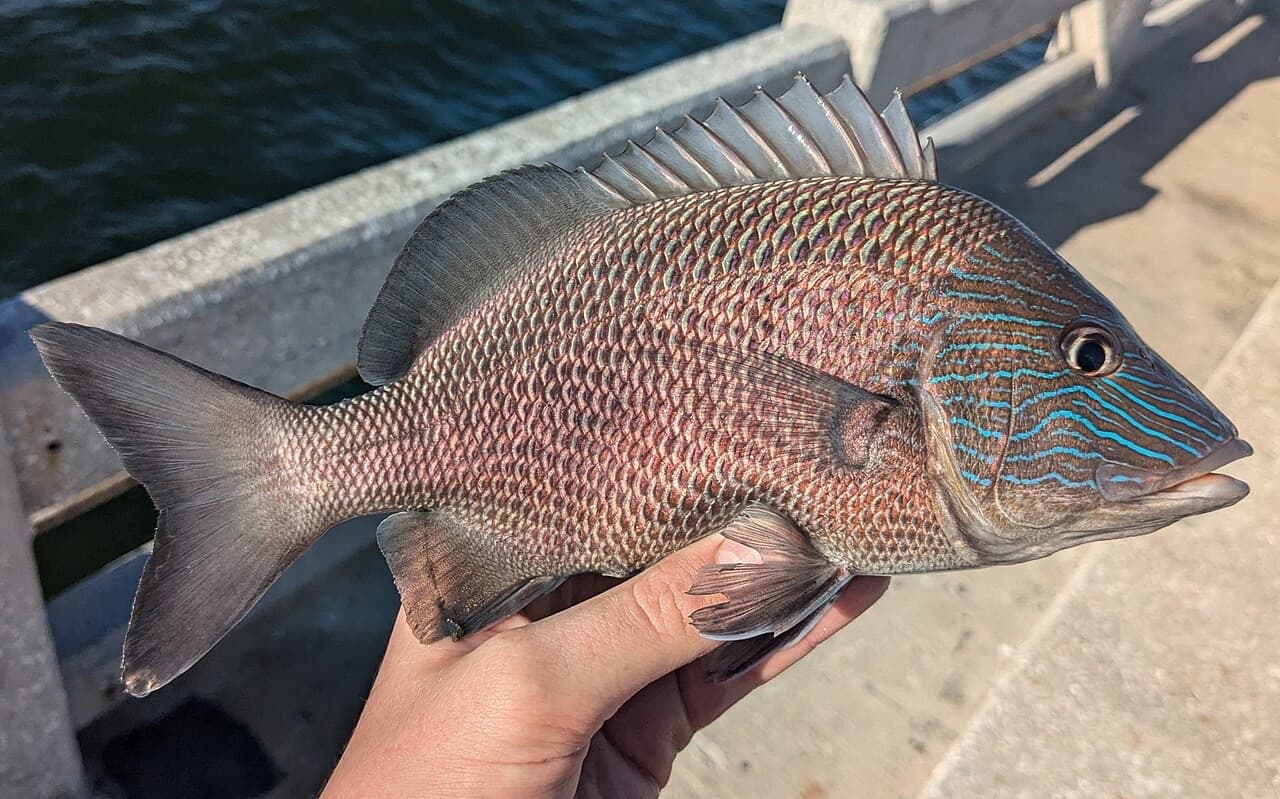
Schoolmaster Snapper (Lutjanus apodus)
Photo: albert kok / CC-BY-SA 3.0

Schoolmaster Snapper

Caji?Cajisote?

Lutjanus apodus

Legal to spear
reefup to ~60 cmCiguatera: moderate
Edibility & ciguatera
Good eating; moderate ciguatera risk.
Where you'll see it
Mangrove edges and patch reefs, often in loose schools around structure.
Legal status
Legal to spear; counts toward the snapper aggregate.
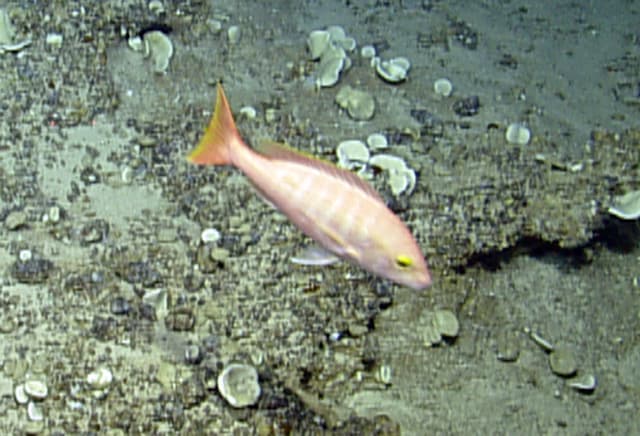
Silk Snapper (Lutjanus vivanus)
Photo: Unknown author Unknown author · Public domain

Silk Snapper

ChilloChillo ojo amarilloColorado

Lutjanus vivanus

Restricted — verify
bottomup to ~80 cm
Edibility & ciguatera
Excellent eating; low ciguatera risk (deep-water fish).
Where you'll see it
Deep bottom (usually 60-240 m) — generally deeper than most freedive spearos reach.
Legal status
SEASONAL CLOSURE — closed Oct 1-Dec 31 in both territorial and federal waters. Counts toward the snapper aggregate.
Blackfin Snapper (Lutjanus buccanella)
Photo: D Ross Robertson · Public domain

Blackfin Snapper

AlinegraNegrita

Lutjanus buccanella

Restricted — verify
bottomup to ~75 cmCiguatera: moderate
Edibility & ciguatera
Very good eating; moderate ciguatera risk.
Where you'll see it
Deep reef and bottom; deeper than most freedive range.
Legal status
SEASONAL CLOSURE — closed Oct 1-Dec 31 in both territorial and federal waters. Counts toward the snapper aggregate.
Cubera Snapper (Lutjanus cyanopterus)
Photo: Yinan Chen · Public domain

Cubera Snapper

Guasinuco?Pargo cubera

Lutjanus cyanopterus

Legal to spear
reefup to ~1.5 m / 57 kgCiguatera: high
Edibility & ciguatera
Good eating, BUT large cubera carry meaningful ciguatera risk — the snapper most associated with poisoning. Flag big fish.
Where you'll see it
Wrecks, deep ledges and channel structure; the big apex reef snapper.
Legal status
Legal to spear (no dedicated closed season or size limit); counts toward the snapper aggregate. Federal catch limit is very low.
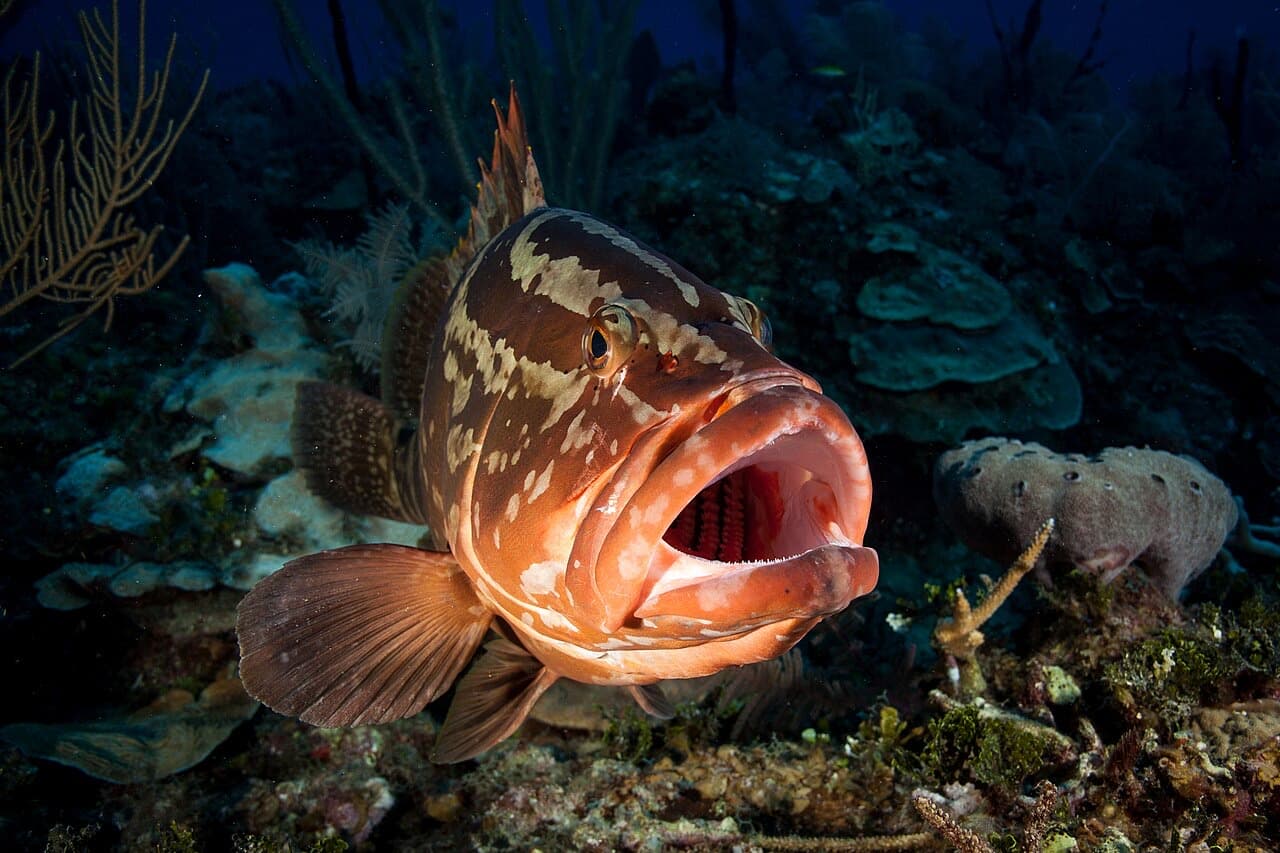
Nassau Grouper (Epinephelus striatus)
Photo: q phia / CC-BY 2.0

Nassau Grouper

Mero chernaCherna

Epinephelus striatus

Protected — do not take
reefup to ~1.2 mCiguatera: high
Edibility & ciguatera
Historically prized, but do not take — protected.
Where you'll see it
Reefs and ledges; curious and easily approached, which is part of why it was overfished. Note 'mero' alone is ambiguous in PR — this is 'mero cherna'.
Legal status
PROTECTED — DO NOT TAKE. Capture, possession and sale are prohibited by DRNA; federally protected and ESA-listed as threatened. Must be released.
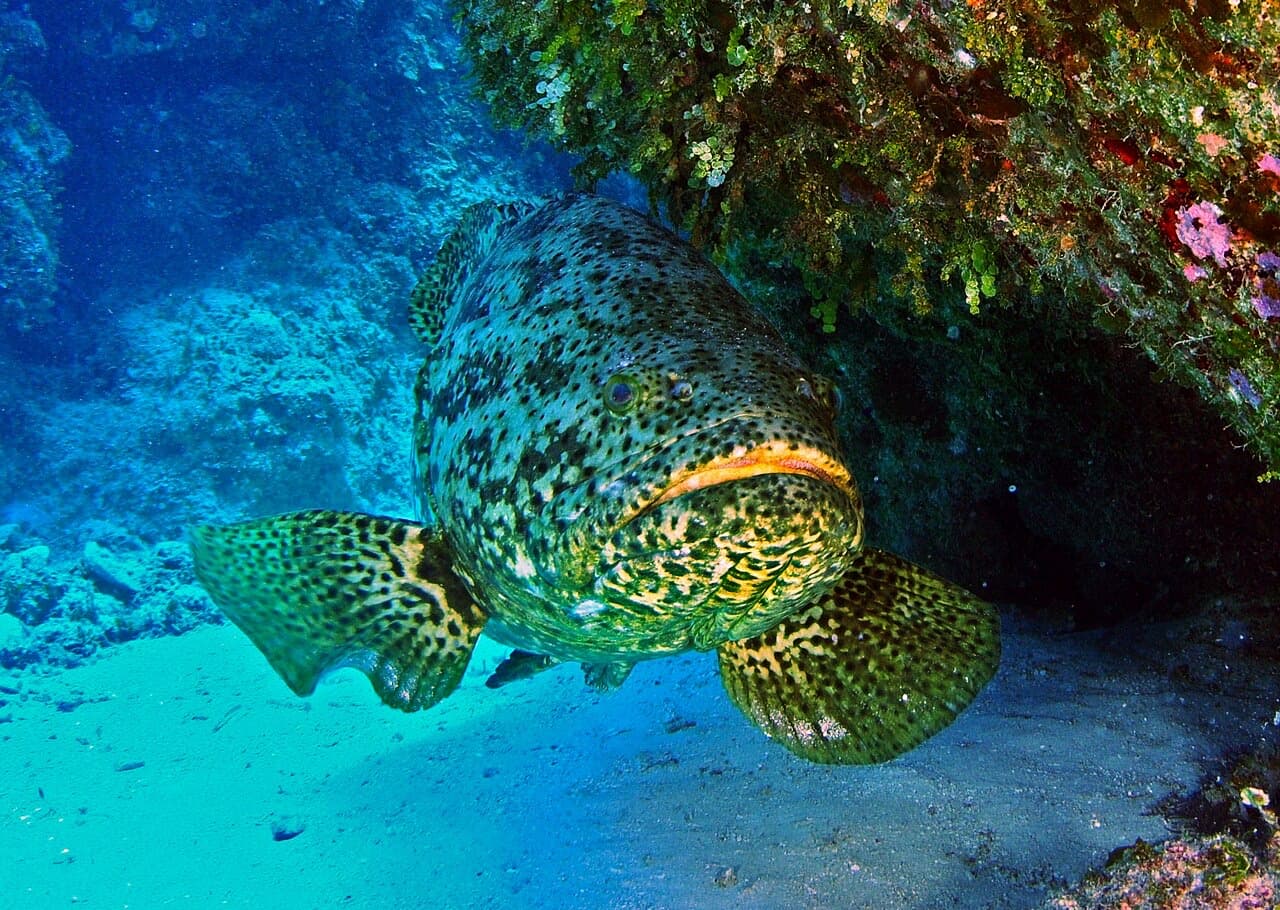
Goliath Grouper (Epinephelus itajara)
Photo: Albert kok / CC-BY-SA 3.0

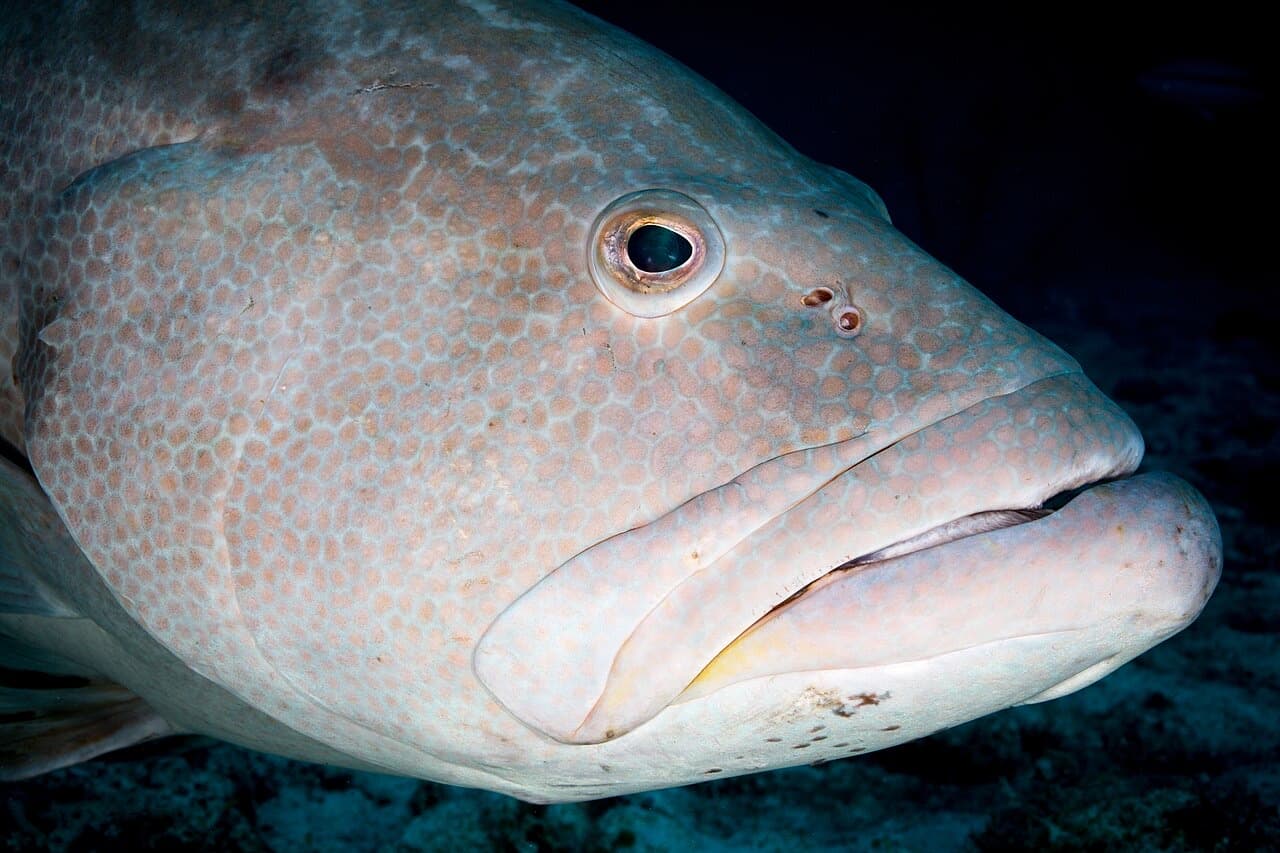
Goliath Grouper

Mero batataMero grande

Epinephelus itajara

Protected — do not take
reefup to ~2.5 m / 360 kgCiguatera: high
Edibility & ciguatera
Do not take — protected.
Where you'll see it
Wrecks and large reef structure; a giant that often shadows divers. In PR the goliath is 'mero batata' — 'guasa' refers to a different grouper here.
Legal status
PROTECTED — DO NOT TAKE. Capture, possession and sale are prohibited by DRNA; federally prohibited since 1990. Must be released.
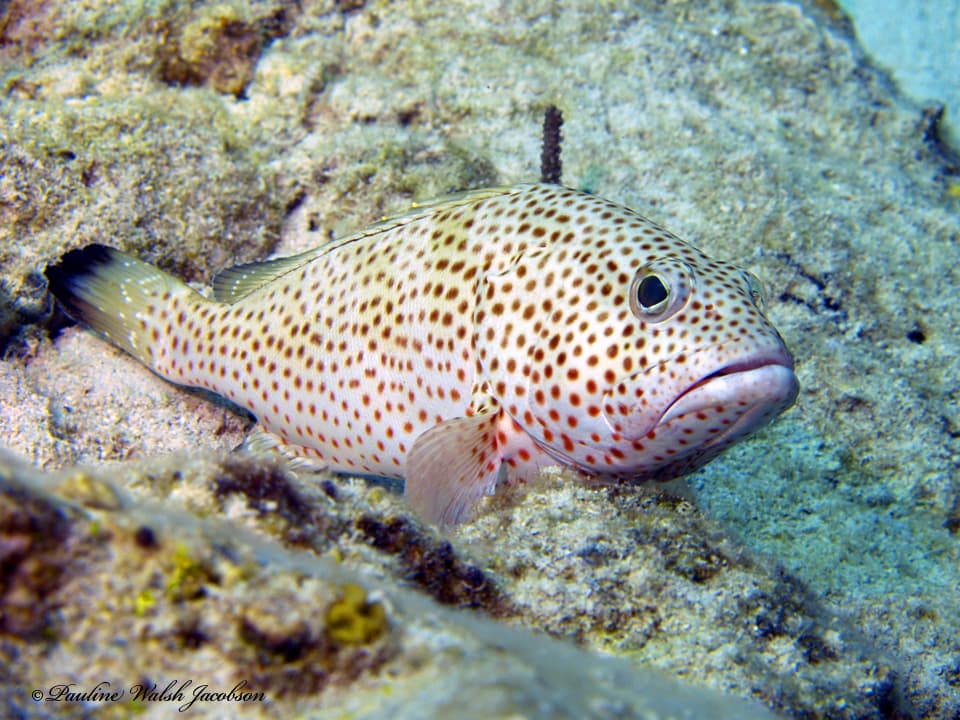
Red Hind (Epinephelus guttatus)
Photo: Pauline Walsh Jacobson / CC BY 4.0

Red Hind

Mero cabrillaCabrilla

Epinephelus guttatus

Restricted — verify
reefup to ~50 cmCiguatera: moderate
Edibility & ciguatera
Very good eating; moderate ciguatera risk.
Where you'll see it
Reefs and hard bottom; a common, approachable small grouper. Sometimes sold as "strawberry grouper," but that market name is ambiguous — it is also used for the protected Speckled Hind (Epinephelus drummondhayi, a no-take species in US South Atlantic waters) and an Indo-Pacific grouper. We label this fish by its precise PR name (Mero cabrilla / Cabrilla) to avoid ID confusion.
Legal status
SEASONAL CLOSURE — closed island-wide Dec 1-Feb 28/29 (spawning). Additional federal spawning-aggregation area closures apply off western PR (e.g. Bajo de Sico, Abrir La Sierra, Tourmaline Banks). Legal to spear outside the closed season.
Yellowfin Grouper (Mycteroperca venenosa)
Photo: q phia / CC-BY 2.0

Yellowfin Grouper

GuajilMero pinto

Mycteroperca venenosa

Restricted — verify
reefup to ~1 mCiguatera: high
Edibility & ciguatera
Good eating, BUT a HIGH ciguatera risk (the species name venenosa means 'poisonous') — larger fish especially.
Where you'll see it
Reefs and ledges; a wary mid-to-large grouper.
Legal status
The federal EEZ is CLOSED Feb 1-Apr 30 (with black, red, tiger and yellowedge grouper). Counts toward the grouper aggregate. Verify the territorial rule where you dive.
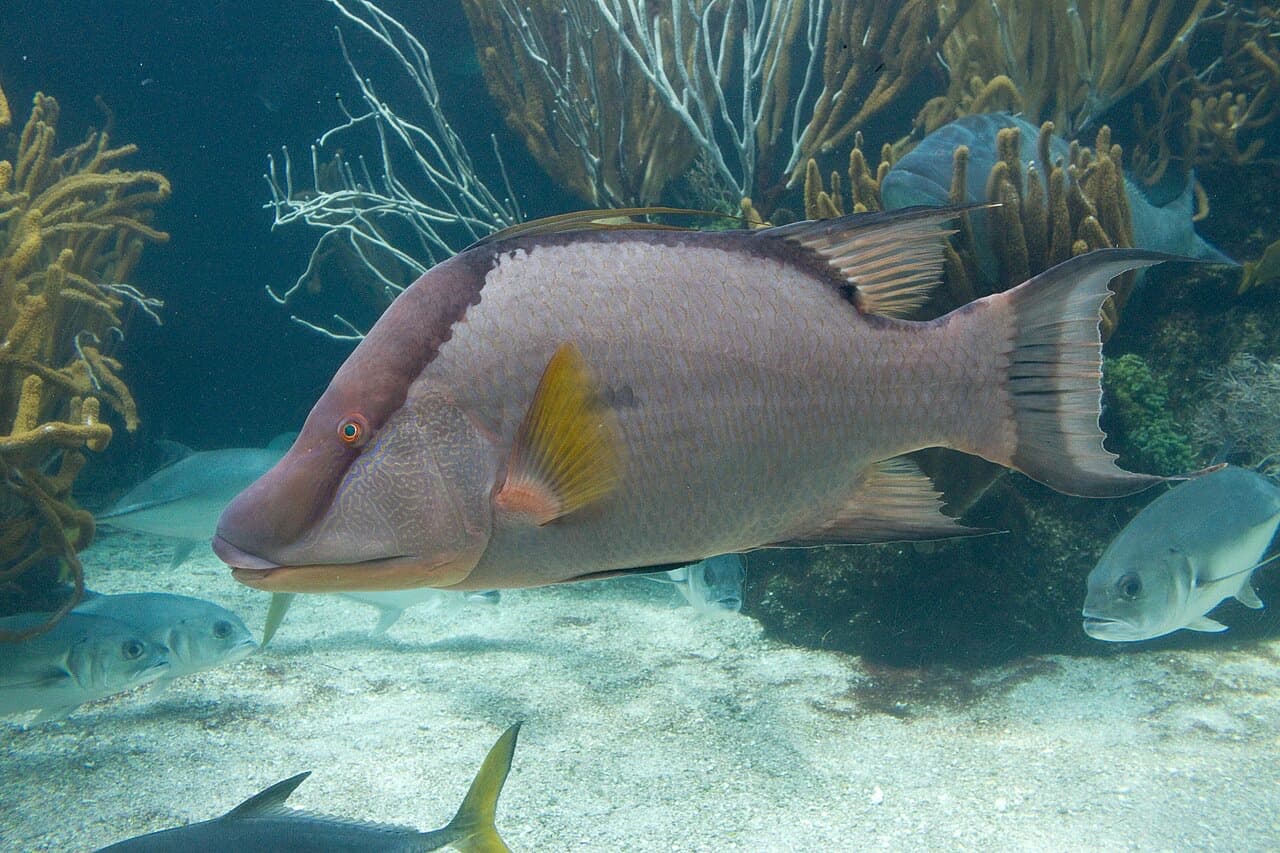
Hogfish (Lachnolaimus maximus)
Photo: Brian Gratwicke / CC-BY 2.0

Hogfish

Capitán

Lachnolaimus maximus

Legal to spear
reefup to ~90 cmCiguatera: high
Edibility & ciguatera
Excellent eating, BUT a HIGH ciguatera risk in PR (the second-most implicated species in local poisoning studies).
Where you'll see it
Hard bottom, reef and rubble; a prime spearfishing target that is sight-hunted along ledges. In PR the local name is 'Capitán' ('pez perro' is the Cuban name).
Legal status
Legal to spear. No current DRNA or federal size limit (the 18-inch rule people cite is a Florida rule). Falls under federal aggregate bag limits.
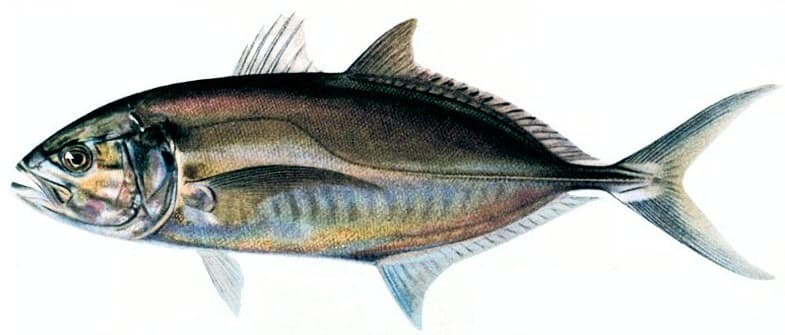
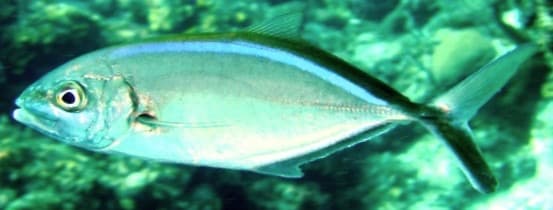
Blue Runner (Caranx crysos)
Photo: NOAA

Blue Runner

Cojinúa?

Caranx crysos

Legal to spear
nearshoreup to ~70 cmCiguatera: moderate
Edibility & ciguatera
Good eating; moderate ciguatera risk (on FDA's jack list).
Where you'll see it
Nearshore over reefs, often in fast-moving schools in the water column.
Legal status
Legal to spear; falls under the federal jacks aggregate bag limit.
Bar Jack (Caranx ruber)
Photo: Fernando Herranz Martín / CC-BY-SA 2.5

Bar Jack

CibíCojinúa?

Caranx ruber

Legal to spear
reefup to ~60 cmCiguatera: moderate
Edibility & ciguatera
Good eating; moderate ciguatera risk (on FDA's jack list).
Where you'll see it
Reefs and drop-offs, frequently shadowing rays or other fish.
Legal status
Legal to spear; falls under the federal jacks aggregate bag limit.
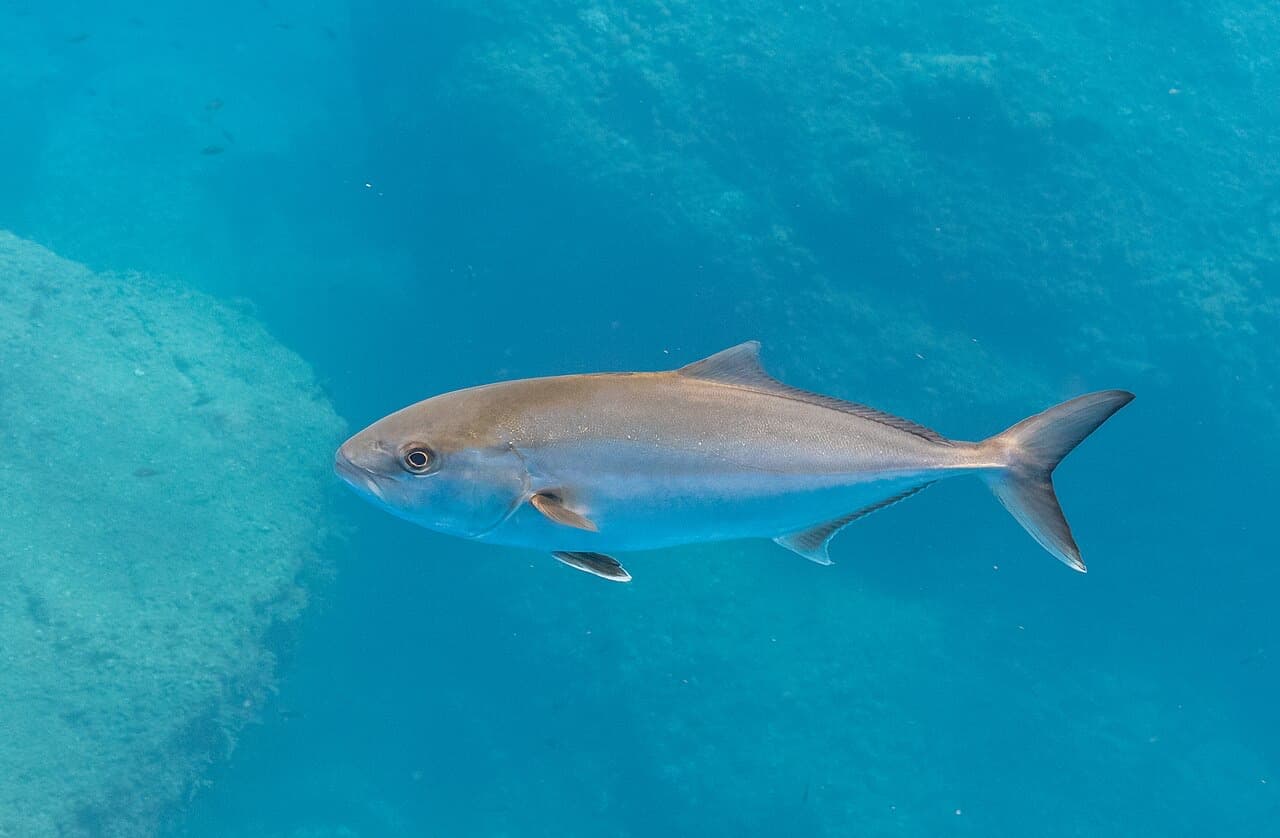
Greater Amberjack (Seriola dumerili)
Photo: Diego Delso / CC-BY-SA 4.0

Greater Amberjack

Medregal

Seriola dumerili

Restricted — verify
reefup to ~1.9 mCiguatera: high
Edibility & ciguatera
Good eating, BUT a HIGH ciguatera risk — sale has been banned in PR since 1981. Note: 'yellowtail' in PR is the snapper (colirrubia); the amberjack is 'medregal'.
Where you'll see it
Wrecks and deep reefs in aggressive schools — a hard-fighting spear target.
Legal status
Legal to spear, but SALE IS PROHIBITED in PR and large fish carry a high ciguatera risk.
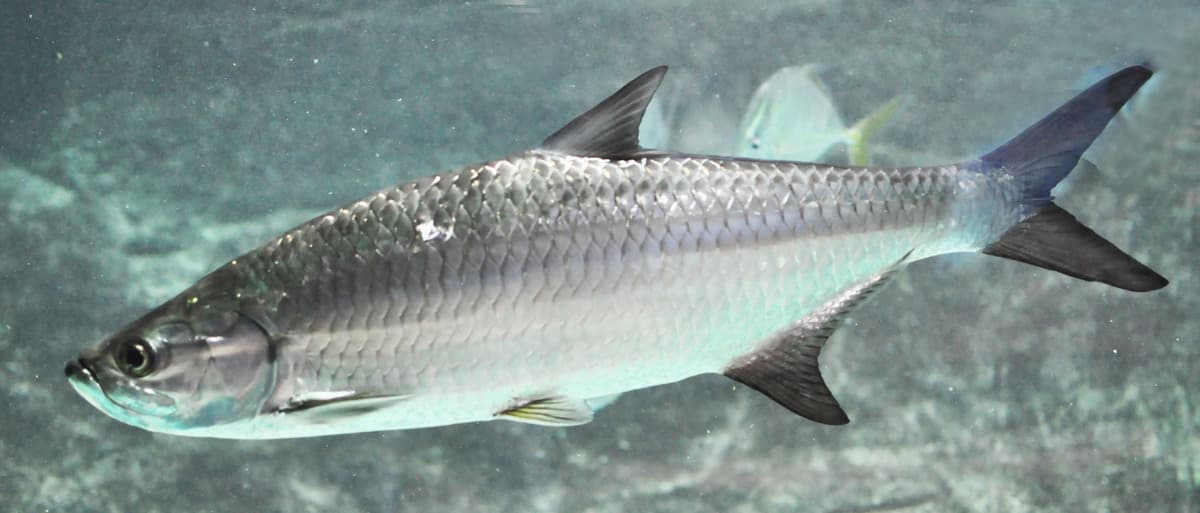
Tarpon (Megalops atlanticus)
Photo: Citron / CC-BY-SA 3.0

Tarpon

Sábalo

Megalops atlanticus

Protected — do not take
inshoreup to ~2.4 m
Edibility & ciguatera
Not eaten; a catch-and-release gamefish.
Where you'll see it
Inshore bays, lagoons and harbours; large, silver and unmistakable.
Legal status
DO NOT SPEAR — DRNA allows recreational tarpon only as catch-and-release; retention is prohibited, which effectively bars spearing (a speared fish cannot be released alive).
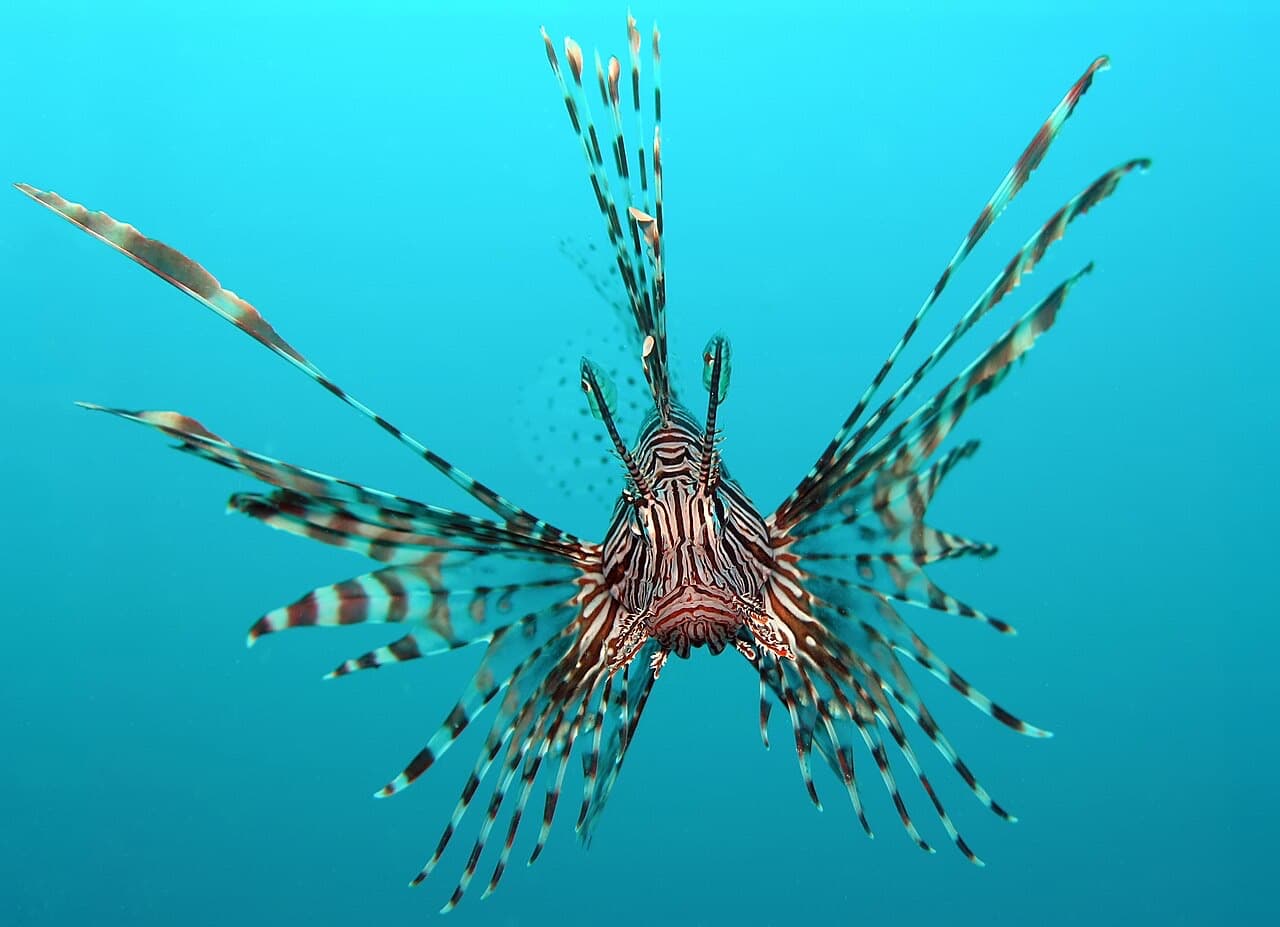
Lionfish (Pterois volitans)
Photo: Jens Petersen / CC-BY 2.5

Lionfish

Pez león

Pterois volitans

Legal to spear
reef15-45 cm
Edibility & ciguatera
Excellent, delicate white flesh once the spines are removed. The spines are venomous but the flesh is not — handle with care.
Where you'll see it
Reefs, wrecks and ledges — an invasive species. Removal is encouraged.
Legal status
TAKE ENCOURAGED (invasive). DRNA uniquely allows SCUBA/hookah plus spear for lionfish, and taking them even inside marine reserves — but only with a written DRNA special-volunteer permit. Confirm the permit requirement before diving.
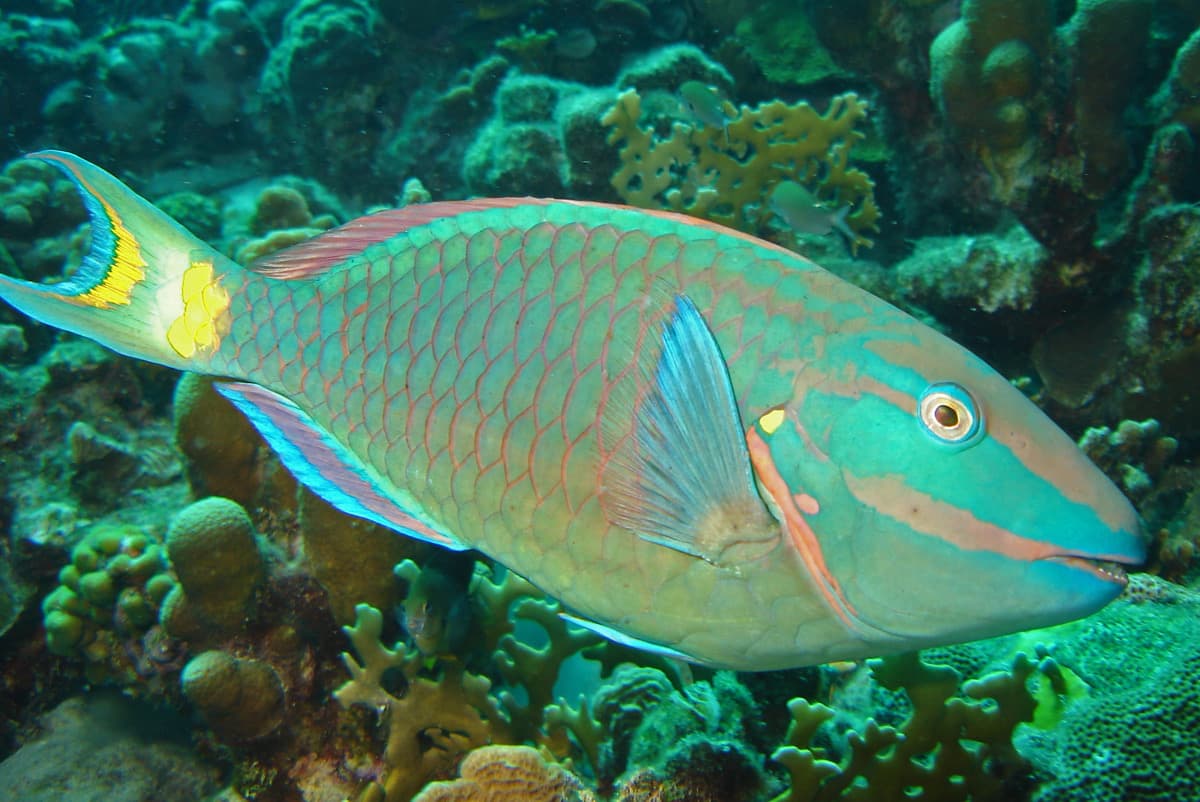
Parrotfish (Stoplight & others) (Sparisoma viride)
Photo: Adona9 / CC-BY-SA 3.0

Parrotfish (Stoplight & others)

LoroPez loro

Sparisoma viride

Restricted — verify
reefup to ~60 cmCiguatera: moderate
Edibility & ciguatera
Eaten locally; moderate ciguatera risk. Because parrotfish are key reef-grazers, taking them is strongly discouraged.
Where you'll see it
Reefs, grazing on algae over coral. The local name is 'loro' / 'pez loro'.
Legal status
PARTIALLY PROTECTED — blue, midnight and rainbow parrotfish are no-take in the federal EEZ. Other parrotfish are legal but capped (max 2 per person within the reef-fish aggregate). As key reef herbivores, PR discourages taking them — verify the current DRNA stance.
White Grunt (Haemulon plumieri)
Photo: Quinn / CC-BY 4.0

White Grunt

CachicataRoncoBoquicolorao

Haemulon plumieri

Restricted — verify
reefmin ~20 cm (8 in)
Edibility & ciguatera
Good pan fish; low ciguatera risk.
Where you'll see it
Reefs and hard bottom, often in loose schools over rubble.
Legal status
Legal to spear with a minimum size of 8 in (fork length) in territorial waters; falls under the federal grunts aggregate.

Local names & details still being verified

  • Schoolmaster Snapper — we list 'Caji / Cajisote' (the names FishBase attributes to Puerto Rico). The name 'Canané' circulates online but appears to be Dominican/wider-Caribbean usage, not PR. A local should confirm which term Puerto Rican divers actually use.
  • Blackfin Snapper — we use 'Alinegra / Negrita' (DRNA). 'Sesí', which is common online, is the Cuban/Mexican name and should not be labelled as Puerto Rican.
  • Goliath Grouper — we use 'Mero batata' (DRNA/FishBase-PR). 'Mero guasa' is the Cuban/Colombian name; in PR 'guasa' points to a different grouper (misty grouper). Confirm local usage.
  • Hogfish — we use 'Capitán' (FishBase-PR). 'Pez perro' is the Cuban name and should not be labelled as Puerto Rican.
  • Parrotfish — we use 'Loro / Pez loro' (the documented forms). 'Cotorro' and 'Vieja' are heard colloquially in PR but are not documented in FishBase/DRNA — confirm local usage.
  • Blue Runner & Bar Jack — 'Cojinúa' is well-established Caribbean usage but is not in the DRNA regulated-species guide; confirm it is the everyday PR term (and how PR divers distinguish it from 'Cibí').
  • Cubera Snapper — 'Guasinuco' is FishBase-attributed to PR but not confirmed in the DRNA guide; worth a local check.
  • Cero Mackerel — 'Sierra' is correct but ambiguous in PR (DRNA also lists 'sierra' under king mackerel/carite). DRNA's specific cero name is 'sierra alasana / pintado / pelicán'; confirm what divers say.
  • Closure dates differ between territorial and federal waters (e.g. mutton snapper closes Apr 1-May 31 territorially but Apr 1-Jun 30 federally; the Feb-Apr grouper closure appears federal-only). Confirm which applies to your dive site before relying on it.

A guide, not a ruling

Species identification and local names are provided as a guide, not a substitute for local knowledge. Puerto Rico common names vary and several are easily confused with Cuban or Dominican usage — anything we were unsure of is flagged above for a resident to verify. Confirm legality with DRNA and federal (NOAA) rules before taking any fish, remember that Puerto Rico is freedive-only (no SCUBA spearfishing), and be aware that many tropical reef fish carry ciguatera risk that cooking does not remove.

Ready to get in the water

Local guides & charters in Puerto Rico

Spearfishing charters, guides, and freediving instructors operating in Puerto Rico — compiled from public info, free to browse. A new, unclaimed directory: verify and book direct.

Do not spear

Prohibited species

  • Nassau grouper / mero cherna (Epinephelus striatus) - no take, must be released; protected under Ley Num. 241 (Art. 8.34)
  • Goliath grouper / mero batata / guasa (Epinephelus itajara) - no take, must be released; protected under Ley Num. 241 (Art. 8.34)
  • Sea turtles / tortugas marinas - prohibited and protected under Ley Num. 241 (Art. 8.38)
  • Marine mammals / mamiferos marinos - prohibited and protected under Ley Num. 241 (Art. 8.38)
  • Nurse shark / tiburon gata (Ginglymostoma cirratum) - no take, sale or possession (Art. 8.27)
  • Tarpon / sabalo (Megalops atlanticus) - catch-and-release only (Art. 8.26, 8.36)
  • Bonefish / macaco (Albula vulpes) - catch-and-release only (Art. 8.26)
  • Permit / pampano (Trachinotus falcatus) and palometa (Trachinotus goodei) - catch-and-release only (Art. 8.26)
  • Longbill spearfish / aguja picuda (Tetrapturus pfluegeri) - must be returned to sea, alive or dead (Art. 8.14)
  • Corals / arrecifes de coral - protected reef structures; damaging/removing prohibited (protected under Ley Num. 241 and reef provisions)
  • Barracuda / picua (Sphyraena barracuda), amberjack / medregal (Seriola dumerili), black jack / jurel negron (Caranx lugubris) - SALE/trafficking prohibited (Art. 8.31); catch for personal consumption is not itself banned

Where you can't

Area restrictions

  • Isla de Desecheo - fishing prohibited within a 1/2-mile perimeter; designated Marine Reserve by Ley Num. 57 of 10 March 2000 (Art. 8.7)
  • Reserva Natural Isla de Mona y Monito - fishing prohibited within a 1-mile restricted perimeter; only shoreline line-and-single-hook fishing allowed in two mapped zones (Playa Sardinera and Playa Pajaros); spear and all other gear prohibited (Art. 8.8)
  • Reserva Marina Tres Palmas, Rincon - fishing prohibited within mapped coordinates (Art. 8.9)
  • Reserva Natural del Canal Luis Pena, Culebra - fishing prohibited within mapped coordinates (Art. 8.10)
  • Laguna del Condado (excluding the Canal San Antonio) - fishing prohibited except lionfish under Art. 22 (Art. 8.39)
  • Reserva Natural Isla Caja de Muertos - no-take zone and reef-recovery area, fishing prohibited within mapped coordinates except lionfish under Art. 22 (Art. 8.41)
  • El Tourmaline (Buoy #8), Abrir La Sierra (Buoy #6), and El Bajo de Cico / Las Esponjas - anchoring, nets, pots/traps and benthic longlines prohibited within mapped coordinates (Art. 8.42)
  • General: spearfishing is banned in ANY area designated as a Marine Reserve, designated area, or swimmer-reserved area (Art. 8.5)

Worth knowing

Notable rules, seasons & limits

  • Closed season (veda) - Red hind / mero cabrilla (Epinephelus guttatus): 1 December to 28 February (Art. 8.24)
  • Closed season (veda) - Yellowfin grouper / guajil (Mycteroperca venenosa): 1 February to 30 April; any caught must be released immediately (Art. 8.48). NOTE: the reg text literally reads '1 de febrero al 31 de abril,' an apparent drafting typo since April has 30 days; the effective end date is 30 April, consistent with the federal Feb 1-Apr 30 grouper closure.
  • Closed season (veda) - Mutton snapper / sama (Lutjanus analis): 1 April to 31 May (Art. 8.25)
  • Closed season (veda) - Silk snapper / chillo ojo amarillo (Lutjanus vivanus) and blackfin snapper / alinegra (Lutjanus buccanella): 1 October to 31 December (Art. 8.40)
  • Closed season (veda) - Queen conch / carrucho (Strombus gigas): 1 August to 31 October (Art. 8.23)
  • Closed season (veda) - Land crab / juey (Cardisoma guanhumi): 15 July to 15 October (Art. 8.21)
  • Size limit - Yellowtail snapper / colirrubia (Ocyurus chrysurus): minimum 10.5 in (267 mm) fork length (Art. 8.29)
  • Size limit / slot - Snook / robalo (Centropomus undecimalis): between 22 in (558 mm) and 38 in (965 mm) fork length (Art. 8.35)
  • Size limits - Reef fish species per Apendice 5 minimum sizes (Art. 8.30)
  • Bag limit - Wahoo/Spanish mackerel (peto/sierra): 5 per species per angler per day or 10 per boat, whichever is less; Dolphinfish (dorado): 10 per angler per day or 30 per boat (Art. 18.11)
  • Bag limit - Queen conch (carrucho): 3 per person per day, max 12 per boat (Art. 18.5); minimum shell length 9 in (229 mm) or lip thickness 3/8 in (Art. 18.6)
  • Lobster (Panulirus argus): minimum 3.5 in (89 mm) carapace length; egg-bearing lobster prohibited; may NOT be taken by spear (Art. 8.15, 8.17, 8.18)
  • FEDERAL WATERS (NOAA / Caribbean Fishery Management Council, beyond PR jurisdictional waters, 50 CFR 622): Nassau and goliath grouper harvest prohibited year-round; black, tiger, yellowfin and yellowedge grouper closed 1 Feb-30 Apr; red hind closed 1 Dec-last day of Feb; mutton and lane snapper closed 1 Apr-30 Jun; black, blackfin, vermilion and silk snapper closed 1 Oct-31 Dec. Area closures: Tourmaline Bank and Abrir La Sierra closed 1 Dec-28 Feb (plus year-round gear bans); Bajo de Sico closed 1 Oct-31 Mar (plus year-round gear/anchoring bans). Verified against NOAA Fisheries seasonal-closures page 2026-07-04.

What divers here typically use

Gear up for Puerto Rico spearfishing

Most divers working Puerto Rico's coast start with a band speargun sized to the water and the fish they are after. Our honest guide to the Best Speargun for Beginners walks through what to look for — curated from published specs and community consensus, not paid placement.

If you break them

Penalties

Under Reglamento 7949 (Art. 25) and Ley Num. 278, administrative fines run $100-$5,000 per infraction, escalating by offense: 1st violation $100-$1,000, 2nd $200-$2,000, 3rd and beyond $1,000-$5,000. Each organism illegally taken and each illegal fishing gear counts as a separate violation. Violations of Art. 7 (pollution/poisoning waters) are a misdemeanor (delito menos grave) punishable by $500-$3,000 per day of occurrence. The DRNA may confiscate gear and catch (Art. 24) and deny or revoke licenses/permits (Art. 26).

Not yet independently confirmed — verify directly

  • Possible changes to specific closed-season (veda) dates, quotas or size limits made after 2010 by Orden Administrativa. The base regulation (7949, 2010) is confirmed as the controlling regulation still hosted by DRNA with no superseding replacement (the DRNA server's 'reglamento_de_pesca_vigente.pdf' is actually the older 2005 predecessor, Reglamento 6768, not a newer version). However, 7949 repeatedly authorizes the Secretario to modify vedas/quotas 'mediante Orden Administrativa' without a new reglamento; those administrative orders were not exhaustively checked and the current-season dates should be reconfirmed with DRNA before publishing.
  • Exact current COMMERCIAL fishing license requirements/fees were not detailed here (this page covers recreational spearfishing). Anyone intending to SELL catch should confirm commercial licensing directly with the DRNA.

Confirm these points directly with Departamento de Recursos Naturales y Ambientales (DRNA) before you rely on them.

Primary sources

Sources

Every fact above is drawn from these official sources. Each was retrieved on the date shown; regulations can change after that date.

  1. Source 1: DRNA - Reglamento de Pesca de Puerto Rico Num. 7949 (2010), full text PDF (primary source for all territorial-water rules cited above)

    Retrieved July 5, 2026https://www.drna.pr.gov/wp-content/uploads/2019/04/Reglamento-de-Pesca-de-Puerto-Rico-7949.pdf

  2. Source 3: NOAA Fisheries - Seasonal and Area Fishing Closures, U.S. Caribbean (federal-waters grouper/snapper seasons and area closures)

    Retrieved July 5, 2026https://www.fisheries.noaa.gov/southeast/rules-and-regulations/seasonal-and-area-fishing-closures-us-caribbean

  3. Source 4: NOAA Fisheries - Current Fishing Regulations, U.S. Caribbean (federal-waters management overview, 50 CFR 622)

    Retrieved July 5, 2026https://www.fisheries.noaa.gov/southeast/rules-and-regulations/current-fishing-regulations-us-caribbean

  4. Source 5: Caribbean Fishery Management Council - Regulations

    Retrieved July 5, 2026https://caribbeanfmc.com/regulations

Quick answers

Frequently asked questions

Is spearfishing legal in Puerto Rico?
Yes — spearfishing is legal in Puerto Rico's saltwater, but it is not permitted in fresh water, subject to license, gear, species, and area rules. Spearfishing in marine waters is permitted using a spear (arpon) while free-diving (apnea) only. Recreational fishers may fish 'usando arpon en apnea' (Art. 18.9); it is illegal…
Do you need a license to spearfish in Puerto Rico?
No license is specifically required to spearfish in Puerto Rico, but other rules still apply. Recreational fishers — including spearfishers — do NOT currently need a license in Puerto Rico. The 2010 Reglamento de Pesca 7949 (Art. 16) created recreational 'agua interior' (inland) and 'mar' (marine) licenses, but the same article makes them available only once the DRNA issues an 'aviso al público' (public notice) — and that notice has never been issued, so the recreational license has never been offered or enforced (confirmed directly with the DRNA). Only COMMERCIAL fishers (anyone selling their catch) must be licensed by the DRNA.
Can you spearfish on scuba in Puerto Rico?
No. It is illegal for a recreational fisher to use a spear (arpon) and a dive tank at the same time (Reglamento 7949, Art. 18.2). Recreational spearfishing is limited to free-diving/breath-hold ('en apnea', Art. 18.9). The ONLY exception is lionfish (pez leon) control by…
What can't you spear in Puerto Rico?
Protected or no-take species you may not spear in Puerto Rico include: Nassau grouper, Goliath grouper, Sea turtles, Marine mammals, Nurse shark, Tarpon, Bonefish, Permit. Always check the full prohibited-species list and current seasons before diving, and confirm with Departamento de Recursos Naturales y Ambientales (DRNA).

Stay current

Get an email when Puerto Rico's size & bag limits change

Regulations shift between seasons. We re-check Puerto Rico's rules against the primary source and send a short note when the limits, seasons, or licensing move — nothing else.

No spam. Regulations updates, gear data drops, and the launch of the guide.

Last verified July 5, 2026. Regulations change — always confirm the current rules with Departamento de Recursos Naturales y Ambientales (DRNA) before you dive.