Island Spear Co.

Regulations New Jersey

Spearfishing Regulations in New Jersey

Checked against the primary source (NJDEP) on July 5, 2026state

Governing agency: New Jersey Department of Environmental Protection (NJDEP), Division of Fish & Wildlife. Last verified July 5, 2026 by independent primary-source check.

Summary

Spearfishing is legal in New Jersey's marine (salt) waters for essentially all managed finfish while completely submerged, using a spear, harpoon, or other missile, or by hand — the one flatly excluded animal is lobster, and any 'specifically protected' species (harvest-moratorium/no-possession fish) may not be taken. There is no paid saltwater fishing license: instead, anyone 16 or older who spearfishes in marine waters must hold a FREE annual NJ Saltwater Recreational Registry Program (NJSRRP) certificate. In fresh waters, spearing fish is unlawful except as specified for the Delaware River; game fish may never be speared, but a licensed angler may take rough/nongame and invasive species (carp, suckers, eels, catfish, gizzard shad, snakeheads) by bow and arrow with a line attached.

License

What you need to be legal

LegalA license is required
License
Marine: NJ Saltwater Recreational Registry Program (NJSRRP) certificate (FREE). Freshwater: New Jersey Freshwater Fishing License.
Who needs it
SALTWATER SPEARFISHING: Every angler age 16 and older who recreationally fishes New Jersey marine/tidal waters by spearfishing (or by rod and line, hand line, or hand) must register with the free NJSRRP before fishing 4. It is a registration, NOT a paid license, and is valid for a single calendar year (Jan 1 - Dec 31) regardless of sign-up date, so it must be renewed annually 4. Anglers under 16, and those fishing exclusively aboard a registered/licensed charter or party (for-hire) vessel, are exempt from registering 4. FRESHWATER: A New Jersey Freshwater Fishing License is required to fish (including bowfishing) in fresh waters for residents and non-residents age 16 and older (s5, s7).
Resident cost
Saltwater NJSRRP: FREE 4. Freshwater license: $22.50 annual for residents ages 16-64; $12.50 for residents ages 65-69; free for residents 70 and older 7.
Non-resident cost
Saltwater NJSRRP: FREE for residents and non-residents alike 4. Freshwater license: $34 annual for non-residents 16+, with short-term options ($9 for 2 days, $19.50 for 7 days) 7.
Where to buy
NJSRRP saltwater registration is free and available online at the NJDEP Saltwater Registry (dep.nj.gov/njfw/fishing/marine/saltwater-registry/, which routes to saltwaterregistry.nj.gov); it is the fastest and primary route, and in-person registration at NJ Fish & Wildlife offices is also possible 4. Freshwater licenses are sold online through NJ Fish & Wildlife's Online Licensing System and at license agents statewide.

Exemptions

  • Saltwater: the NJSRRP itself has no fee — but everyone 16+ who spearfishes marine waters must register. Anglers under 16 are not required to register, and anglers fishing exclusively aboard a registered/licensed charter or party (for-hire) vessel are also exempt 4.
  • Freshwater license: New Jersey residents under 16 and residents age 70 and older are exempt / fish free (residents 70+ receive a free license) 7.
  • Freshwater license: residents ages 65-69 pay a reduced $12.50 fee 7.

The full story

The full story

New Jersey is unusual in a way that trips up out-of-state divers: there is no such thing as a paid New Jersey saltwater fishing license. When the federal government created a national saltwater angler registry (with a $15 fee) in 2011, New Jersey stood up its own state program so residents and visitors would be exempt from the federal charge. The result is the NJ Saltwater Recreational Registry Program (NJSRRP): a free, online-only, annual registration that anyone 16 or older must complete before spearfishing (or rod-and-line or hand fishing) in marine waters 4. It is legally mandatory and enforced, but it costs nothing — so a diver who assumes they must buy a saltwater 'license' is half right (registration is required) and half wrong (there is no fee). This is a genuine law-vs-expectation gap worth flagging, but it is NOT a paper-only rule: the registry is real, issued, and checked in the field.

The marine spearfishing right itself is clean and generous. N.J.A.C. 7:25-18.4 makes it lawful to take 'all species of fish' by spear, harpoon, or other missile, or by hand, while completely submerged, during each species' open season, excepting only 'specifically protected' species 2. The NJDEP Marine Digest adds the practical carve-out that lobster may not be speared 3. Everything else a diver must know flows from the ordinary size/season/possession rules — including the important catch that, unlike hook-and-line anglers who can release an undersize fish, a spearfisher is responsible for confirming the fish is legal size BEFORE striking it 3.

Freshwater is the mirror image. Spearing fish in New Jersey's fresh waters is flatly unlawful except as specified for the Delaware River 6. Game fish are rod-and-reel only. The legal way to take rough, nongame, and invasive fish is bowfishing — a bow and arrow with a line attached — for carp, suckers, American eels, catfish, gizzard shad, snakeheads, and (in the Delaware River only) American shad, under a valid freshwater fishing license (s5, s6). Crossbows are allowed for bowfishing with minimum-spec requirements, except on Greenwood Lake, and some municipalities ban discharging a bow entirely 6. So a freshwater 'spearo' in New Jersey is really a bowfisher, and only for the rough-fish list.
Where it's legal

Saltwater & freshwater

Saltwater

Legal

New Jersey is a coastal Atlantic state (roughly 130 miles of ocean shoreline plus Raritan Bay, Delaware Bay, and extensive back bays). Spearfishing is legal in marine waters under N.J.A.C. 7:25-18.4: it is lawful 'to take, catch, or kill all species of fish by means of spearfishing, during the respective open season, except for those species of fish specifically protected' — spearfishing meaning taking fish by spear, harpoon, or other missile, or by hand, 'while completely submerged in the marine waters of the State' 2. The NJDEP Marine Digest restates this as 'any species managed by New Jersey, except lobster' 3. Every species' own season, minimum size, and possession limit applies to spear-caught fish, and the diver is expressly responsible for confirming a fish meets the minimum size before it is killed or injured 3. A free NJSRRP registration is required for anyone 16+ 4.

Freshwater

Not permitted

Spearing FISH is unlawful in New Jersey fresh waters, except as specified for the Delaware River 6. Game fish (trout, bass, pickerel, walleye, muskellunge, catfish as game, etc.) are hook-and-line only and may never be speared. However, a licensed angler MAY take certain rough/nongame and invasive species by BOW AND ARROW (with a line attached to the arrow): carp (bighead, common, grass), American eels, catfish, American shad (Delaware River only), gizzard shad, snakeheads, and suckers, or hybrids of these species, at any time (s5, s6). Crossbows are permitted for bowfishing (except on Greenwood Lake) and must have at least a 25-inch stock, minimum 75-pound draw weight, and a working safety, uncocked in transport and not permanently mounted 6. Some municipalities ban discharge of a bow and arrow (tethered or not), so local rules must be checked 6. Separately, under commercial-harvest permits, bullfrogs, green frogs, and snapping turtles may be taken by spear 5.

Gear

What you can carry

Speargun
Allowed in marine waters. N.J.A.C. 7:25-18.4 permits taking fish by 'a spear, harpoon, or other missile' while completely submerged 2; a band-powered or pneumatic speargun is a spear/missile device and is covered. NJDEP names no restriction on speargun type for recreational marine spearfishing (s2, s3).
Pole spear
Allowed in marine waters. A pole spear is a 'spear' within N.J.A.C. 7:25-18.4's 'spear, harpoon, or other missile' language 2. Not named individually by NJDEP; permissibility follows from the general definition.
Hawaiian sling
Allowed in marine waters. A Hawaiian sling propels a spear/missile and is covered by the 'spear, harpoon, or other missile' definition in N.J.A.C. 7:25-18.4 2. Not named individually by NJDEP.
Spearfishing on SCUBA
Not prohibited. The regulation requires the fisher to be 'completely submerged in the marine waters of the State' 2, which contemplates free diving and SCUBA; NJDEP imposes no rule banning SCUBA for spearfishing. This rests on absence of any prohibition rather than an affirmative permission (see unverified).

Gear restrictions

  • Marine spearfishing requires the fisher to be COMPLETELY SUBMERGED in marine waters 2 — surface-based spearing is outside the rule.
  • Spearfishing does not override any species' open season, minimum size, or possession limit; the diver must confirm a fish meets the minimum size BEFORE killing or injuring it 3.
  • Lobster may NOT be taken by spearfishing 3.
  • In fresh waters, spearing fish is unlawful except as specified for the Delaware River; nongame/invasive species may instead be taken by bow and arrow with a line attached, under a valid license (s5, s6).
  • Crossbow bowfishing gear must meet minimum specs (25-inch stock, 75-lb draw, working safety) and is banned on Greenwood Lake 6.

What you'll see

Target species

A field guide to the fish a spearo actually encounters in New Jersey's cold Atlantic — the wrecks, artificial reefs, jetties, inlets and back bays that define diving here. This is not an exhaustive list and it is not a legality ruling. New Jersey's spear right is broad (all managed finfish except lobster), but the catch is that nearly every target has a tight, yearly-changing season, size and bag limit, and a spearfisher must confirm a fish is legal size BEFORE striking it — there is no undersize release. There is no ciguatera in these cold waters, but ice oily fish (bluefish, mackerel) quickly to avoid scombroid. Always confirm current NJDEP rules before taking anything.

Tautog

BlackfishTogWhite chin

Tautoga onitis

Restricted — verify
reefmin 15 in (38 cm), commonly 2-5 kg, up to ~10 kg
Edibility & ciguatera
Excellent — firm, sweet white meat and a top NJ table fish; no ciguatera risk in these cold waters.
Where you'll see it
THE signature New Jersey spearfishing target. Holds tight to wrecks, rock piles, jetties and reef structure, often tucked into holes — a pole spear is the classic tool for firing into cover. Most plentiful on inshore wrecks May-June; big adults move to deeper wrecks in late fall (prime trophy 'tog' season).
Legal status
Legal to spear at 15 in minimum, but the season runs in complex split windows (roughly Jan 1-Feb 28, Apr 1-30, and Aug 1-Dec 31) with bag limits that change by period (about 1-5 fish); closed roughly March and May-July. Confirm current NJDEP dates and limits before diving.

Black Sea Bass

Sea bassKnotheadHumpback

Centropristis striata

Restricted — verify
reefmin 12.5 in (32 cm), commonly 0.4-1.5 kg, big males ('humpbacks') larger
Edibility & ciguatera
Excellent — clean, mild white flesh, one of the most prized NJ eating fish; no ciguatera risk.
Where you'll see it
A wreck and reef mainstay found alongside tautog and fluke. Sea bass hide under and around structure and will often let a diver approach closely if they feel safe in their den; big blue-headed males ('knotheads'/'humpbacks') are the trophy.
Legal status
Legal to spear at 12.5 in minimum, but open only in split seasons (roughly mid-May through Dec 31) with bag limits that change by period (about 1-15 fish); typically closed in late winter/early spring. Confirm current NJDEP dates and limits.

Summer Flounder

FlukeDoormat

Paralichthys dentatus

Restricted — verify
bottommin ~18 in (46 cm), 'doormats' to ~4.5 kg
Edibility & ciguatera
Excellent — a premium flatfish; no ciguatera risk.
Where you'll see it
A prime summer spear target lying flat and camouflaged on sand near inlets, jetties and reef edges (Barnegat, Manasquan and Shark River inlets are classics). Fast reflexes — a pole spear with a paralyzer tip is the go-to, and a good beginner species. Note: summer flounder is the ONE flatfish exempt from New Jersey's ban on filleting fish at sea.
Legal status
Legal to spear, generally 18 in minimum (reduced sizes apply in special Delaware Bay and shore-based programs), about 2-3 fish, open roughly May-late September. Confirm the current NJDEP size, bag and season for your area.

Striped Bass

StriperRockfishLinesider

Morone saxatilis

Restricted — verify
inshoreslot 28-31 in (71-79 cm), adults to ~1.5 m / 30+ kg
Edibility & ciguatera
Excellent — the iconic Mid-Atlantic table fish; no ciguatera risk. Sale is prohibited in NJ (recreational only).
Where you'll see it
Found in the water column around inlets, jetties, rips, bridges and along the surf — fast-moving and wary, not a beginner's fish to spear. Unlike many Northeast states (Massachusetts, New York, Connecticut all BAN spearing stripers), New Jersey explicitly allows striped bass to be taken by spearfishing.
Legal status
Legal to spear — NJDEP states it is illegal to take striped bass by any method other than angling with hook and line OR by spear fishing. Strict rules apply: one fish in a 28-31 in slot, sale prohibited, and it is illegal to gaff a striped bass at any time. Confirm the current slot, seasons and any area rules.

Bluefish

BluesChopper

Pomatomus saltatrix

Legal to spear
nearshore1-5 kg, big 'choppers' to ~9 kg
Edibility & ciguatera
Good eating fresh, but oily and best iced immediately — bleed and chill to avoid scombroid (histamine) sickness; no ciguatera risk.
Where you'll see it
Fast, aggressive schooling predators in the water column nearshore, around inlets, jetties and the surf; juveniles are the well-known 'snapper blues.' A hard, darting spear target. Handle with care — bluefish have sharp teeth and snap even after landing.
Legal status
Legal to spear with no minimum size; bag limit about 5/day from a private vessel or shore and 7/day aboard a for-hire (party/charter) vessel. Confirm the current bag limit.

Winter Flounder

BlackbackFlounder

Pseudopleuronectes americanus

Restricted — verify
bottommin 12 in (30 cm), commonly 0.3-1 kg
Edibility & ciguatera
Very good — a sweet, mild flatfish; no ciguatera risk.
Where you'll see it
A cool-season flatfish on sand and mud bottom in back bays, harbors and near inlet structure; like fluke it lies flat and camouflaged and is easily taken with a pole spear and paralyzer tip. Present when fluke are not (spring and late fall).
Legal status
Legal to spear at 12 in minimum, about 2 fish/day, open roughly March 1-Dec 31. Confirm current NJDEP dates and bag.

Scup

Porgy

Stenotomus chrysops

Restricted — verify
reefmin 10 in (25 cm), commonly 0.3-1 kg
Edibility & ciguatera
Very good pan fish — sweet white meat, though bony; no ciguatera risk.
Where you'll see it
Schools over hard bottom, wrecks, reefs and mussel beds, often mixed with sea bass; common and approachable, a good smaller spear target.
Legal status
Legal to spear at 10 in minimum, generous bag (about 30/day), open roughly Jan 1-Jun 30 and Sep 1-Dec 31. Confirm current NJDEP dates and bag.

Weakfish

WeakieTiderunnerSqueteague

Cynoscion regalis

Restricted — verify
inshoremin 13 in (33 cm), big 'tiderunners' to ~5 kg
Edibility & ciguatera
Good — delicate, soft-textured white meat best eaten fresh; no ciguatera risk. The name 'weakfish' refers to its soft mouth, not the flesh.
Where you'll see it
Back bays, inlets, channels and the surf, usually in the water column near sand and grass edges; a spring/summer visitor. NOTE: locally also called 'sea trout,' but we omit that name deliberately — it collides with spotted seatrout, a different species that is a no-spear gamefish elsewhere. This is New Jersey's Cynoscion regalis.
Legal status
Legal to spear at 13 in minimum, about 1 fish/day (the stock is depleted, hence the tight limit), no closed season. Confirm current NJDEP size and bag.

Atlantic Cod

CodCodfish

Gadus morhua

Restricted — verify
bottommin 23 in (58 cm), commonly 2-9 kg
Edibility & ciguatera
Excellent — the classic flaky white fish; no ciguatera risk.
Where you'll see it
A cold-water winter fish on deep offshore wrecks and rocky bottom, usually well beyond safe freedive range — most NJ cod are taken by hook-and-line or by scuba divers on deep wrecks, not by breath-hold spearos. A prized but hard-won target.
Legal status
Legal to spear at 23 in minimum, about 5 fish/day, open roughly Jan 1-May 31 and Sep 1-Dec 31. Confirm current NJDEP size, bag and season.

Pollock

PollockBoston bluefish

Pollachius virens

Legal to spear
bottommin 19 in (48 cm), commonly 2-7 kg
Edibility & ciguatera
Very good — mild white meat, a little softer than cod; no ciguatera risk.
Where you'll see it
A cold-water cousin of cod on deep wrecks and rocky bottom, often more willing to rise in the water column than cod; a winter deep-wreck target, generally beyond freedive range.
Legal status
Legal to spear at 19 in minimum, no bag limit, no closed season. Confirm current NJDEP rule.

Spanish Mackerel

Spanish

Scomberomorus maculatus

Legal to spear
nearshoremin 14 in (36 cm), commonly 0.5-2 kg
Edibility & ciguatera
Good — rich, oily flesh; ice immediately to avoid scombroid. No ciguatera risk in NJ waters.
Where you'll see it
A fast, warm-season (summer/early fall) visitor in fast-moving schools nearshore and around inlets, high in the water column; a challenging, darting target.
Legal status
Legal to spear at 14 in minimum, about 10 fish/day, no closed season. Confirm current NJDEP size and bag.
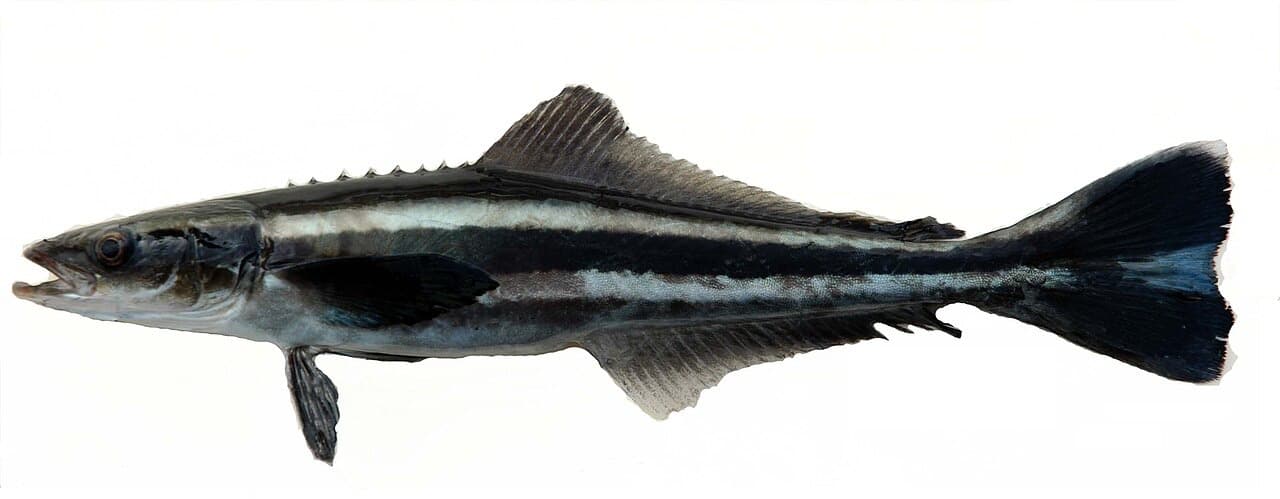
Cobia (Rachycentron canadum)
Photo: D Ross Robertson · Public domain

Cobia

Lemonfish?

Rachycentron canadum

Legal to spear
pelagicmin 43 in (109 cm), 9-27 kg, up to ~45 kg
Edibility & ciguatera
Excellent — firm, rich white meat; no ciguatera risk.
Where you'll see it
A warm-season visitor (rare but increasing) that follows rays and turtles near the surface and hangs on buoys, wrecks and nearshore structure; often a surprise cruising shot. NOTE: in New Jersey the nickname 'ling' means red hake, NOT cobia — do not use 'ling' for this fish here.
Legal status
Legal to spear at 43 in minimum, 1 fish per person and 2 per vessel, no closed season. Confirm current NJDEP size and limit.
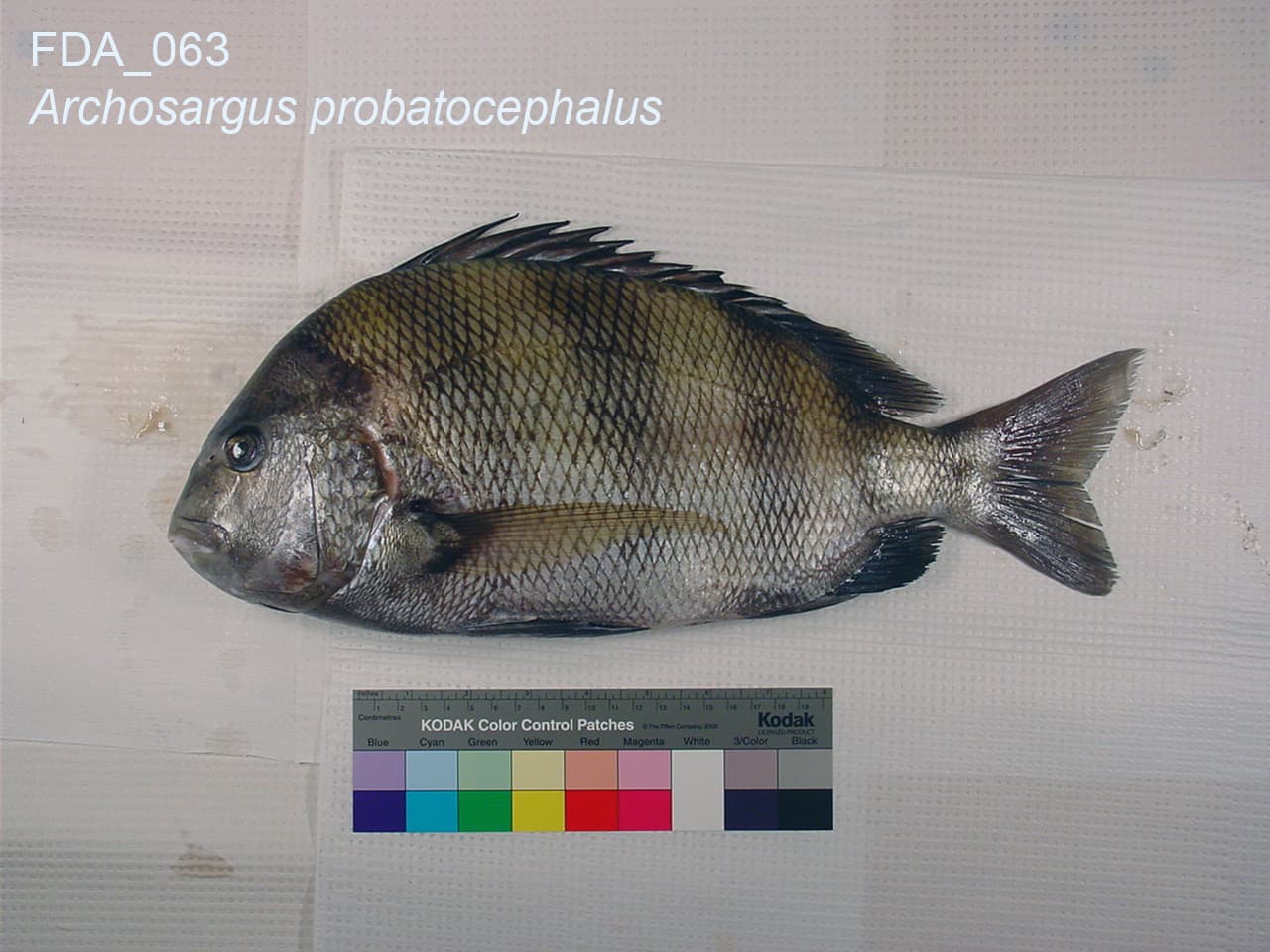
Sheepshead (Archosargus probatocephalus)
Photo: FDA

Sheepshead

Convict fish

Archosargus probatocephalus

Legal to spear
reef0.5-4 kg, up to ~5 kg
Edibility & ciguatera
Very good — sweet, firm white meat; no ciguatera risk.
Where you'll see it
An increasingly common warm-water visitor in southern New Jersey (Cape May, Delaware Bay, jetties and bridge/dock pilings) as waters warm; found anywhere with barnacles and mussels. Wary and a rewarding structure target.
Legal status
Legal to spear. No New Jersey-specific recreational size or bag limit was located (it is an occasional/emerging catch here); general marine rules apply. Verify the current NJDEP status before taking one.
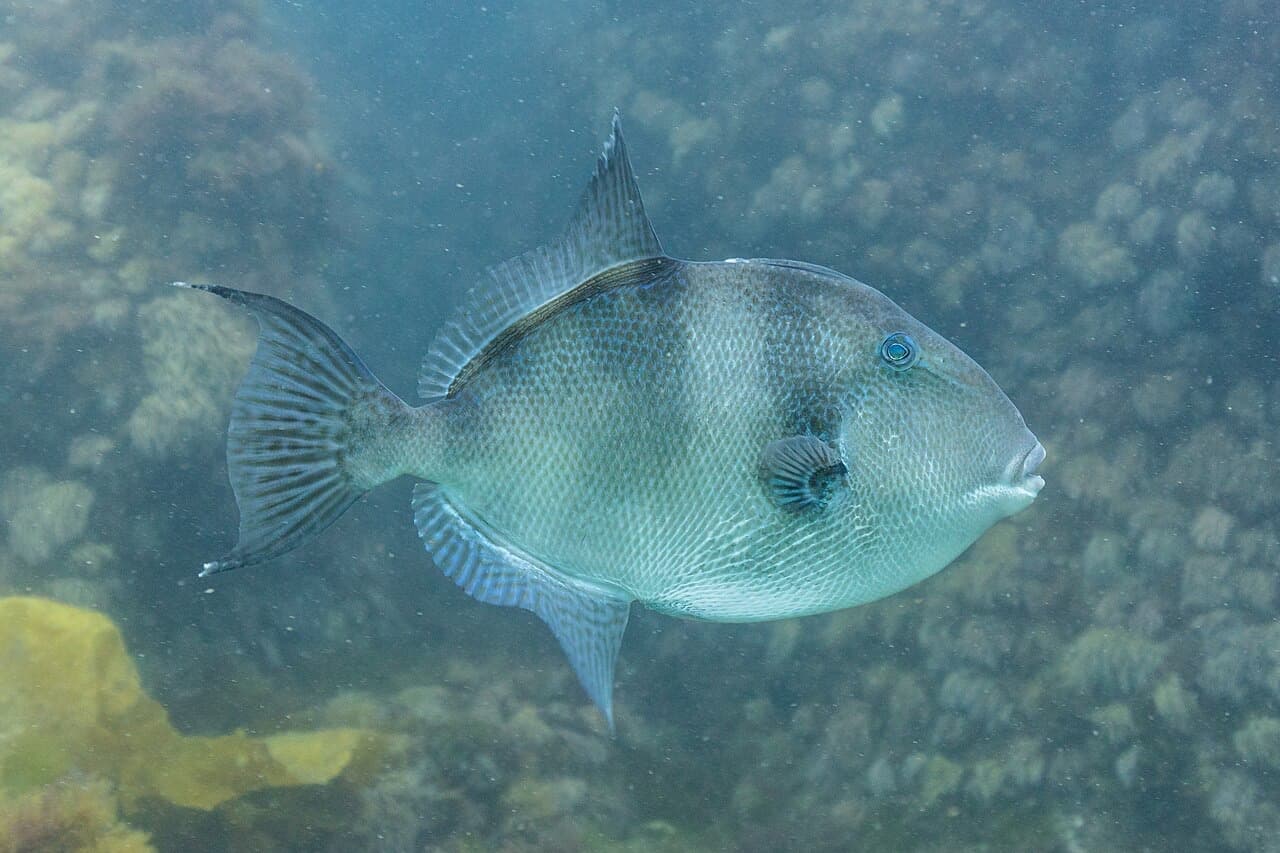
Gray Triggerfish (Balistes capriscus)
Photo: Diego Delso / CC-BY-SA 4.0

Gray Triggerfish

Trigger

Balistes capriscus

Legal to spear
reef0.5-2 kg
Edibility & ciguatera
Excellent — dense, sweet white meat; no ciguatera risk.
Where you'll see it
A late-summer/early-fall visitor on offshore wrecks, reefs and buoys as warm water pushes in; hovers near structure and is a willing, approachable spear target when present.
Legal status
Legal to spear. No New Jersey-specific recreational size or bag limit was located (a seasonal visitor here); general marine rules apply. Verify the current NJDEP status.

Atlantic Sturgeon

Acipenser oxyrinchus

Protected — do not take
bottomup to ~4.3 m / 360 kg
Edibility & ciguatera
Do not take — protected.
Where you'll see it
A large, armored, bottom-dwelling fish of the Delaware Bay/River and coastal waters; unmistakable with its bony scutes. A diver may encounter one near the bottom in bays and estuaries.
Legal status
PROHIBITED — no take or possession by any method, including spearing. Atlantic sturgeon is federally listed as endangered under the Endangered Species Act and is a New Jersey no-possession species. Must never be speared; if encountered, leave it alone.

Sand Tiger Shark

Sand tiger

Carcharias taurus

Protected — do not take
reefup to ~3.2 m
Edibility & ciguatera
Do not take — protected.
Where you'll see it
A large, snaggle-toothed but docile shark famously encountered by New Jersey wreck divers in summer (Sea Girt Reef and other wrecks are known aggregation sites). Impressive and often approachable — a photo subject, never a target.
Legal status
PROHIBITED — sand tiger is on New Jersey's no-possession prohibited-shark list and must be released; it may not be speared or otherwise harvested. Federally protected. Enjoy the encounter and let it swim.

Local names & details still being verified

  • Seasons, size limits and bag limits for tautog, black sea bass, summer flounder (fluke), winter flounder, scup and Atlantic cod change every year and run in complex split windows — the numbers here are approximate. Confirm the current NJDEP Marine Digest dates and limits before diving.
  • Weakfish is locally nicknamed 'sea trout' in New Jersey, but we deliberately OMIT that name because it collides with spotted seatrout (Cynoscion nebulosus), a different species that is a no-spear gamefish in southern states. We use weakfish / weakie / tiderunner / squeteague instead.
  • 'Ling' in New Jersey commonly refers to red hake (Urophycis chuss), a small wreck fish — NOT to cobia. We flag the southern nickname 'lemonfish' for cobia as unverified for NJ usage and avoid 'ling' entirely to prevent confusion. A local should confirm what NJ divers actually call cobia.
  • No New Jersey-specific recreational size or bag limit was located for sheepshead or gray triggerfish — both are occasional warm-season visitors (mainly southern NJ / offshore wrecks) rather than staple managed species here. General marine rules apply; verify current NJDEP status before taking either.
  • Striped bass being legal to spear is New Jersey-specific and government-confirmed (NJDEP: take only by hook-and-line or spear fishing) — but the 28-31 in slot and one-fish limit move, sale is prohibited, and gaffing is illegal. Do not assume neighboring states allow spearing stripers; most do not.

A guide, not a ruling

Species identification and regional names are provided as a guide, not a substitute for local knowledge or a legality ruling. New Jersey's spear right covers all managed finfish except lobster, but nearly every species has a season, minimum size and possession limit that changes yearly — and, unlike a hook-and-line angler, a spearfisher must confirm a fish is legal size BEFORE striking it (there is no undersize release). There is no ciguatera in New Jersey's cold Atlantic, but ice oily fish (bluefish, mackerel) quickly to avoid scombroid. Anyone 16+ needs the FREE annual NJ Saltwater Recreational Registry (NJSRRP) certificate. Never spear a protected/no-possession species (Atlantic or shortnose sturgeon, river herring, prohibited sharks such as the sand tiger). Confirm current rules with the NJDEP Division of Fish & Wildlife before taking any fish.

Do not spear

Prohibited species

  • Lobster — may not be taken by spearfishing in marine waters; spears, gigs, gaffs, and other penetrating devices are prohibited for lobster 3.
  • Marine 'specifically protected' / no-possession species may not be taken by spear (or any method) — N.J.A.C. 7:25-18.4's spear right explicitly excludes 'specifically protected' species 2, and the NJ Marine Digest enumerates the no-possession list 3: Atlantic sturgeon, shortnose sturgeon, river herring (alewife and blueback herring), and diamondback terrapin (with all sea turtles and marine mammals also prohibited to possess).
  • Prohibited (no-possession) SHARK species must be released and may not be speared: Atlantic angel, basking, bigeye sand tiger, bigeye sixgill, bigeye thresher, bignose, Caribbean reef, Caribbean sharpnose, dusky, Galapagos, longfin mako, narrowtooth, night, oceanic whitetip, sandbar, sand tiger, sevengill, silky, sixgill, smalltail, whale, and white shark (s9, s10).
  • Freshwater GAME FISH (trout, largemouth and smallmouth bass, chain pickerel, walleye, muskellunge, northern pike, etc.) may NOT be speared — spearing fish is unlawful in fresh waters except as specified for the Delaware River 6.
  • Snapping turtles may not be taken with a bow and arrow (they may be taken by spear only under a commercial-harvest permit) 5.

Where you can't

Area restrictions

  • Spearing fish is prohibited throughout New Jersey fresh waters except as specified for the Delaware River 6.
  • Crossbow bowfishing is prohibited on Greenwood Lake 6.
  • Some municipalities ban the discharge of a bow and arrow (tethered or not); anglers must check with the waterbody owner and/or municipality before bowfishing 6.
  • Standard marine closed areas and any site-specific NJDEP or federal restrictions still apply; divers should also observe local ordinances and swim-area/pier separation rules where they exist (see unverified — no statewide distance-from-swimmers spearfishing setback was located in NJDEP primary sources this session).

Worth knowing

Notable rules, seasons & limits

  • New Jersey has NO paid saltwater fishing license. The only saltwater credential is the FREE NJ Saltwater Recreational Registry Program (NJSRRP) certificate, required annually (valid by calendar year, Jan 1 - Dec 31) for anyone 16+ who spearfishes marine waters; it is registered primarily online at saltwaterregistry.nj.gov but is also available in person at NJ Fish & Wildlife offices and select agents 4.
  • The marine spearfishing right is broad: 'all species of fish' during their open season, except specifically protected species and lobster (s2, s3).
  • The diver bears the burden of confirming a speared fish meets the minimum size BEFORE it is killed or injured — there is no undersize-release grace for spearfishing 3.
  • Filleting at sea is prohibited for any fish with a size limit and for any flatfish, EXCEPT summer flounder; party/charter boats may fillet at sea only under a Special Fillet Permit 3.
  • Freshwater spearing of fish is unlawful except for the Delaware River; the legal freshwater analog is bowfishing (bow and arrow with a line attached) for carp, suckers, eels, catfish, gizzard shad, snakeheads, and American shad (Delaware River only), all requiring a freshwater license (s5, s6).
  • The eRegulations.com New Jersey Fishing pages are the official NJDEP-contracted digest, not a third-party site — its text is the state's published regulation summary (s3, s6, s7).

What divers here typically use

Gear up for New Jersey spearfishing

New Jersey's water runs cold, so divers here tend to reach for a thicker open-cell wetsuit before anything else. Our honest guide to the Best Spearfishing Wetsuit walks through what to look for — curated from published specs and community consensus, not paid placement.

If you break them

Penalties

Spearfishing and marine finfish violations are enforced by NJDEP Fish & Wildlife Conservation Officers under Title 23 (Fish and Game) and the marine fisheries rules at N.J.A.C. 7:25. Violations of size, season, possession, gear, or the spearfishing rule can carry monetary penalties, and illegally taken fish and gear may be seized. Fishing in fresh waters without a required license, or spearing fish where prohibited, is likewise a fish-and-game violation. Exact per-offense fine schedules were not isolated from a New Jersey primary source this session (see unverified).

Not yet independently confirmed — verify directly

  • RESOLVED on QA pass: the NJ list of 'specifically protected' / no-possession marine species that may not be speared is now enumerated from the NJDEP-contracted Marine Digest — Atlantic sturgeon, shortnose sturgeon, river herring (alewife/blueback), diamondback terrapin (plus all sea turtles and marine mammals) (s3) — and the full prohibited-shark list from the digest Shark page (s9) and the nj.gov NOAA prohibited-shark placard (s10). Residual: this reflects the 2026 digest; the fully codified N.J.A.C. no-possession list was not cross-checked line-by-line, and season-specific 'closed' (vs permanently prohibited) species still turn on each species' open season.
  • SCUBA legality for spearfishing rests on the absence of any prohibition in N.J.A.C. 7:25-18.4 (which requires being 'completely submerged') rather than an explicit NJDEP statement permitting SCUBA; no rule barring SCUBA spearfishing was found, but no affirmative allowance was located either.
  • The precise scope of the Delaware River freshwater spearing exception ('except as specified for Delaware River') — which species/methods it covers — was not pulled verbatim from an NJDEP primary source this session.
  • No statewide distance-from-swimmers, distance-from-pier, or beach/bathing-area setback specific to spearfishing was located in NJDEP primary sources; such limits, if any, may exist in local ordinances or beach regulations not reviewed here.
  • Exact monetary penalty amounts / fine schedules for spearfishing, size, season, or unlicensed-freshwater violations were not isolated from a New Jersey primary source; the penalties field states the enforcement framework generally.
  • Freshwater license fee figures (resident $22.50; senior tiers; non-resident $34 and short-term options) were read from the eRegulations fee table (official NJDEP digest publisher) but were not cross-checked against the NJDEP Online Licensing System this session.

Confirm these points directly with New Jersey Department of Environmental Protection (NJDEP), Division of Fish & Wildlife before you rely on them.

Primary sources

Sources

Every fact above is drawn from these official sources. Each was retrieved on the date shown; regulations can change after that date.

  1. Source 1: NJDEP Division of Fish & Wildlife — agency home

    Retrieved July 5, 2026https://dep.nj.gov/njfw/

  2. Source 2: N.J.A.C. 7:25-18.4 'Spearfishing' — New Jersey Administrative Code, verbatim rule (via Cornell LII)

    Retrieved July 5, 2026https://www.law.cornell.edu/regulations/new-jersey/N-J-A-C-7-25-18-4

  3. Source 5: NJDEP Fish & Wildlife — Freshwater Regulations & Permits (bowfishing species, frog/turtle spear permits, license requirement)

    Retrieved July 5, 2026https://dep.nj.gov/njfw/fishing/freshwater/regulations-and-permits/

  4. Source 7: 2026 NJ Freshwater Fishing Digest — Licenses, Permits & Fees (resident/non-resident freshwater license costs and age exemptions)

    Retrieved July 5, 2026https://www.eregulations.com/newjersey/fishing/freshwater/licenses-permits-fees

  5. Source 10: NJDEP / NOAA Prohibited Shark Identification placard (nj.gov government PDF) — corroborates the NJ prohibited-shark species list

    Retrieved July 5, 2026https://www.nj.gov/dep/fgw/pdf/marine/prohibited-shark-id-placard_noaa.pdf

Quick answers

Frequently asked questions

Is spearfishing legal in New Jersey?
Yes — spearfishing is legal in New Jersey's saltwater, but it is not permitted in fresh water, subject to license, gear, species, and area rules. New Jersey is a coastal Atlantic state (roughly 130 miles of ocean shoreline plus Raritan Bay, Delaware Bay, and extensive back bays). Spearfishing is legal in marine waters under…
Do you need a license to spearfish in New Jersey?
Yes. New Jersey requires the Marine: NJ Saltwater Recreational Registry Program (NJSRRP) certificate (FREE). Freshwater: New Jersey Freshwater Fishing License.. Resident cost: Saltwater NJSRRP: FREE. Freshwater license: $22.50 annual for residents ages 16-64; $12.50 for residents ages 65-69; free for residents 70 and older. Non-resident cost: Saltwater NJSRRP: FREE for residents and non-residents alike. Freshwater license: $34 annual for non-residents 16+, with short-term options ($9 for 2 days, $19.50 for 7 days).
Can you spearfish on scuba in New Jersey?
Not prohibited. The regulation requires the fisher to be 'completely submerged in the marine waters of the State', which contemplates free diving and SCUBA; NJDEP imposes no rule banning SCUBA for spearfishing. This rests on absence of any prohibition rather than an affirmative…
What can't you spear in New Jersey?
Protected or no-take species you may not spear in New Jersey include: Lobster — may not be taken by spearfishing in marine waters; spears, gigs, gaffs, and other penetrating devices are prohibited for lobster, Marine 'specifically protected', Prohibited, Freshwater GAME FISH, Snapping turtles may not be taken with a bow and arrow. Always check the full prohibited-species list and current seasons before diving, and confirm with New Jersey Department of Environmental Protection (NJDEP), Division of Fish & Wildlife.

Stay current

Get an email when New Jersey's size & bag limits change

Regulations shift between seasons. We re-check New Jersey's rules against the primary source and send a short note when the limits, seasons, or licensing move — nothing else.

No spam. Regulations updates, gear data drops, and the launch of the guide.

Last verified July 5, 2026. Regulations change — always confirm the current rules with New Jersey Department of Environmental Protection (NJDEP), Division of Fish & Wildlife before you dive.