Island Spear Co.

Regulations Louisiana

Spearfishing Regulations in Louisiana

Checked against the primary source (LDWF) on July 5, 2026state

Governing agency: Louisiana Department of Wildlife and Fisheries (LDWF). Last verified July 5, 2026 by independent primary-source check.

Summary

Louisiana has a large Gulf of Mexico coast, so spearfishing is legal in both salt and fresh water for divers who are submerged in the water using standard spearing equipment (a speargun or hand spear). In salt water almost every common target is fair game — the only 'game fish' Louisiana protects from spears are the marlins and sailfish, and even red drum is specifically carved back in as speakable. In fresh water it is the reverse: only nongame species may be speared, and it is illegal to spear bass, crappie, bream, and the other named freshwater game fish. A Louisiana Recreational Fishing License is genuinely required and enforced — it is explicitly listed as mandatory for using a spear, scuba gear, or skin-diving spearing equipment.

License

What you need to be legal

LegalA license is required
License
Louisiana Basic Recreational Fishing License (plus a Saltwater License to fish south of the saltwater line)
Who needs it
Anyone 18 or older who uses a spear or scuba gear to pursue or possess fish in Louisiana waters must hold a valid Recreational Fishing License — the LDWF regulations' 'ACTIVITIES THAT REQUIRE A LICENSE' list names 'A barbed or barbless spear' and 'Scuba gear' explicitly, and possessing fish taken in Louisiana waters requires the license regardless. A Basic Fishing License covers freshwater species; a Saltwater License (in addition to the Basic license) is required to take fish south of Louisiana's saltwater line. (s2, s3)
Resident cost
Basic Fishing License $17; Saltwater License $15 (resident). A combined Basic + Saltwater package is available. 3
Non-resident cost
Basic Fishing License $68 (nonresident 5-day $30); Saltwater License $60 (nonresident 5-day $30). 3
Where to buy
Online at louisianaoutdoors.com, at LDWF Headquarters (2000 Quail Drive, Baton Rouge), or from local license retailers statewide. 3

Exemptions

  • Residents and nonresidents under age 18 (17 and under) are not required to have a Basic or Saltwater Fishing License 3
  • Mobility-impaired Louisiana residents over 60 must still purchase the applicable license (no free spearing exemption) 2
  • Free-swimming tunas (except bluefin) taken by speargun additionally require an Atlantic HMS Angling Permit from NOAA/NMFS ($24) (s2, s4)

The full story

The full story

Louisiana has no phantom-license problem: the license is real and actively enforced. The LDWF regulations carry an 'ACTIVITIES THAT REQUIRE A LICENSE' list stating that a valid Recreational Fishing License is required to possess fish in Louisiana waters OR to use — among other gears — 'A barbed or barbless spear' and 'Scuba gear.' Spearfishing gear is named on that license-trigger list, so license.required is true in both law and practice. (Note: the LDWF public license web page, s3, does not itemize spear/scuba gear; this gear list is in the LDWF regulations PDF, s2.) 2

The interesting nuance is definitional, not law-vs-practice. Louisiana's whole spearfishing framework hinges on a single narrow statutory list of 'game fish' in R.S. 56:8. In FRESH water that list is broad and off-limits to spears — bass, crappie, bream, and the white/yellow/striped/hybrid basses — so a freshwater spearo is limited to nongame rough fish (gar, buffalo, carp, drum, choupique). In SALT water the 'game fish' list is startlingly short: only sailfish and the marlins, plus red drum. Because spotted seatrout, snappers, groupers, sheepshead, black drum, cobia and virtually every other popular saltwater species are NOT statutory game fish, they are perfectly legal to spear. (s1, s2)

Then comes the carve-out that trips people up: red drum IS a game fish, but the statute specifically says red drum 'may be taken... by skin divers using standard spearing equipment' — so the state's most iconic inshore fish is the one game fish you CAN spear, while the marlins you almost certainly never would target with a spear are the ones you cannot. Flounder gets its own special allowance: it is the only species you may take with a barbless spear or a multi-pronged barbed gig, and only in salt water. In every case the diver must be submerged, and speared fish are held to the same size and creel limits as any other gear. (s1, s2)

Where it's legal

Saltwater & freshwater

Saltwater

Legal

Louisiana's Gulf and estuarine waters are open to spearfishing. Under R.S. 56:320, 'standard spearing equipment used by a skin diver sport fishing in saltwater... when submerged in the water' is a legal method. The only saltwater fish a spearo may NOT take are the statutory saltwater game fish — sailfish and the marlins (blue, black, striped, hatchet, white) — with red drum expressly carved back in as speakable. Everything else commonly targeted (red/mangrove/other snappers, groupers, sheepshead, spotted seatrout, black drum, cobia, jacks, mackerel, etc.) is not a statutory 'game fish' and may be speared, subject to the same size and creel limits that apply to any gear. Flounder may be taken in salt water with a barbless spear or a multi-pronged barbed gig. Free-swimming tunas except bluefin may be speared with an Atlantic HMS Angling Permit. Federally protected species (Gulf sturgeon, sawfish, sea turtles, goliath and Nassau grouper, and the listed prohibited sharks) may not be taken by any method. A Basic + Saltwater license is required (age 18+). (s1, s2, s4)

Freshwater

Legal

Freshwater spearing is legal but limited to NONGAME species. Per the LDWF regulations, 'standard spearing equipment is the only legal method of take for non-game species that can be used by a skin diver submerged in water,' and 'the taking of gamefish with standard spearing equipment is prohibited.' Louisiana's freshwater game fish (which may NOT be speared) are largemouth/spotted/shadow bass, black and white crappie, white/yellow/striped/hybrid striped bass, and any species of bream. Nongame species that may be speared include rough/nongame fish such as gar, buffalo, carp, freshwater drum, and bowfin (choupique). The diver must be submerged in the water while spearing. A Basic Fishing License is required (age 18+). (s1, s2)

Gear

What you can carry

Speargun
Legal. A speargun is 'standard spearing equipment' and is lawful when used by a skin diver who is submerged in the water, in both salt and fresh water (nongame only in fresh water). (s1, s2)
Pole spear
Legal. A pole spear is standard hand-held spearing equipment used by a submerged skin diver. Louisiana's statute uses the general term 'standard spearing equipment' rather than naming pole spears individually. (s1, s2)
Hawaiian sling
Legal by general definition. A Hawaiian sling is standard spearing equipment used by a submerged skin diver; it is not named individually in the statute but falls within 'standard spearing equipment.' (s1, s2 / unverified as to the specific term)
Spearfishing on SCUBA
Permitted. 'Scuba gear' is expressly listed by LDWF among the gears that REQUIRE a recreational fishing license, which contemplates and allows spearing on scuba (the statute's operative requirement is that the skin diver be 'submerged in the water'). Verify current LDWF guidance before diving. 2

Gear restrictions

  • The diver must be submerged in the water while spearing — you cannot lawfully spear from the surface or from a boat (s1, s2)
  • Standard spearing equipment is the ONLY legal spearing method for taking fish; general 'spears' (and spears/guns as a taking method) are otherwise prohibited (s1, s2)
  • A barbless spear or a multi-pronged barbed gig may be used ONLY in salt water and ONLY for taking flounder (s1, s2)
  • Speared fish are subject to the same size limits, bag/creel limits and seasons as fish taken by any other gear (s2, s4)
  • Free-swimming tunas except bluefin taken by speargun require an Atlantic HMS Angling Permit (NOAA/NMFS) (s2, s4)

What you'll see

Target species

A field guide to the fish a spearo may actually encounter in Louisiana's Gulf and estuarine waters — the oil-rig, jetty and offshore-bank fishery — with the local names divers here use. This is not exhaustive, and it is not a legality ruling. Louisiana's whole spearfishing framework turns on a narrow statutory 'game fish' list: in salt water the ONLY game fish off-limits to a spear are the billfish (sailfish and the marlins), and red drum is specifically carved back in as the one game fish you may spear. Always confirm the current LDWF sizes, seasons and creel limits, remember you must be submerged in the water to spear legally, and note that the far-offshore Gulf banks carry a documented ciguatera risk on large reef fish.

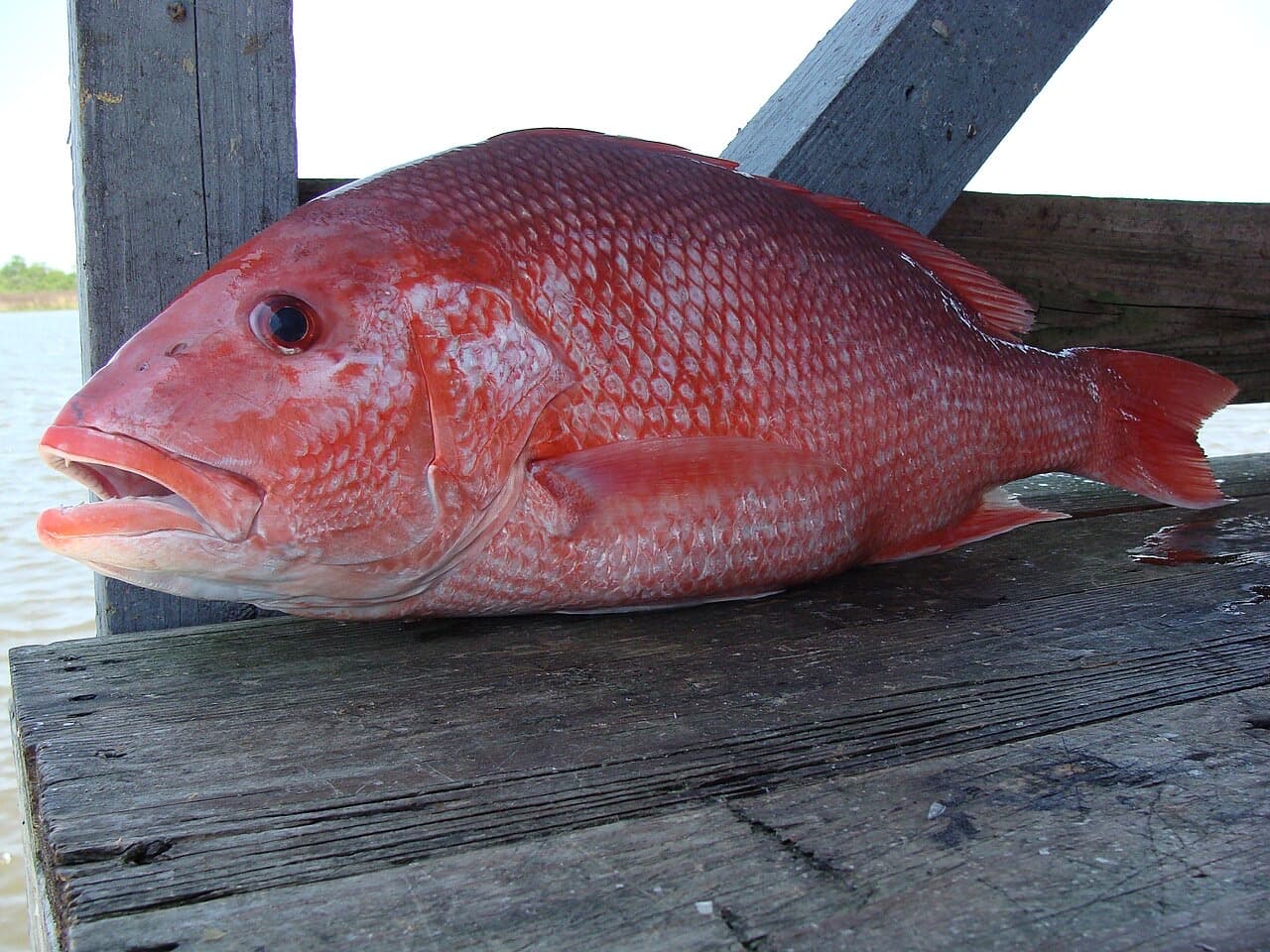
Red Snapper (Lutjanus campechanus)
Photo: Geeklikepi / CC-BY-SA 3.0

Red Snapper

American red snapperSow

Lutjanus campechanus

Restricted — verify
bottom16 in min total length; 1-7 kg, up to ~14 kg
Edibility & ciguatera
Excellent eating; low ciguatera risk in the northern Gulf. The signature Louisiana rig fish.
Where you'll see it
Oil and gas platforms, rigs, wrecks and offshore hard bottom, often 60-200+ ft — deep for freedivers. The crown-jewel target of the Louisiana rig fishery.
Legal status
Legal to spear ONLY during the open recreational season. Louisiana sets its own private-recreational/state-charter season: in 2026 it opened Friday May 1, running seven days a week, and stays open until recreational landings approach the state's annual private-recreational allocation (monitored weekly by LA Creel) — as of early July 2026 the season was still open. Size 16 in total length, 4/day. Closed much of the year — always confirm the current open/closed status with LDWF before targeting.
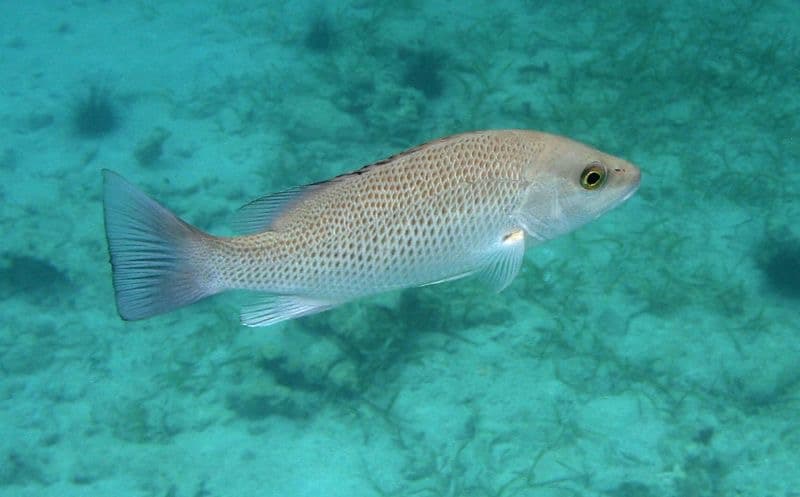
Mangrove (Gray) Snapper (Lutjanus griseus)
Photo: Clinton & Charles Robertson / CC-BY 2.0

Mangrove (Gray) Snapper

MangoBlack snapper

Lutjanus griseus

Legal to spear
reef12 in min total length; 25-40 cm, larger offshore
Edibility & ciguatera
Excellent eating; low ciguatera risk. A rig-fishery staple.
Where you'll see it
Rigs, wrecks, jetties and offshore hard bottom; wary and a good ambush target around structure.
Legal status
Not a statutory game fish — legal to spear year-round when submerged. 12 in total length minimum, 20/day within the snapper aggregate.
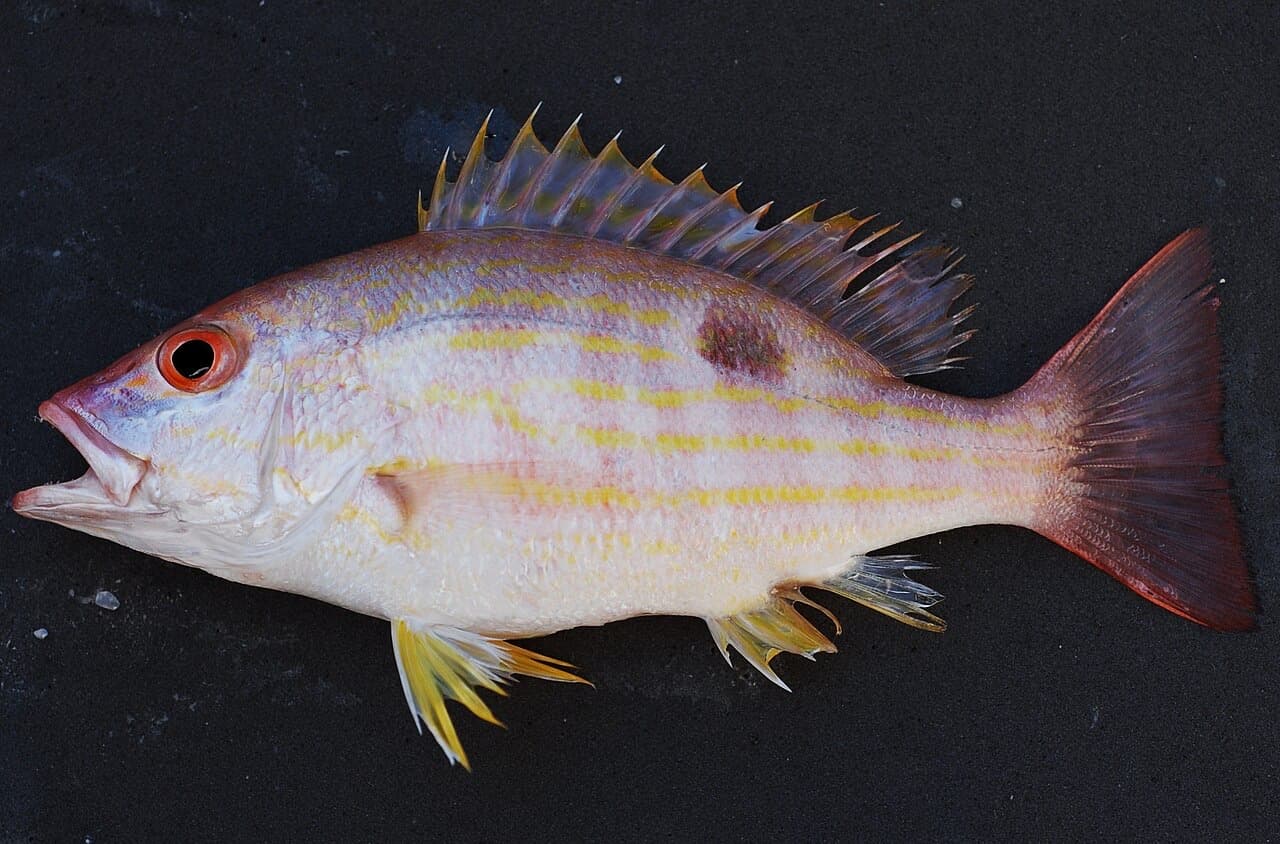
Lane Snapper (Lutjanus synagris)
Photo: NOAA

Lane Snapper

Candy snapper

Lutjanus synagris

Legal to spear
reef8 in min total length; typically 20-35 cm
Edibility & ciguatera
Very good eating; low ciguatera risk.
Where you'll see it
Rigs, reefs, hard bottom and shell/rubble edges; common and approachable around structure.
Legal status
Not a statutory game fish — legal to spear year-round when submerged. 8 in total length minimum, 20/day within the snapper aggregate.
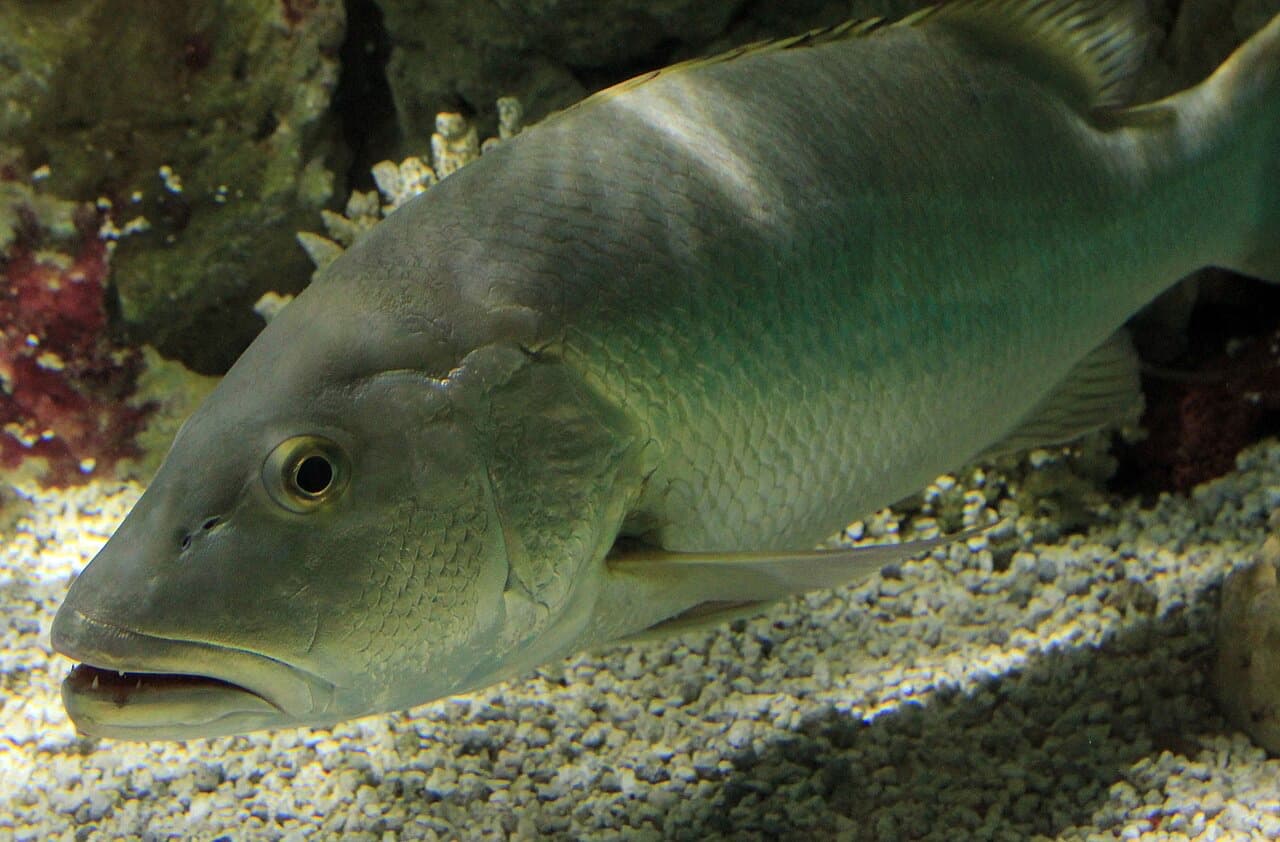
Cubera Snapper (Lutjanus cyanopterus)
Photo: Yinan Chen · Public domain

Cubera Snapper

Cuban snapper

Lutjanus cyanopterus

Legal to spear
reef12 in min total length; big adults up to ~1.5 m / 45+ kg
Edibility & ciguatera
Good eating. In the northern Gulf ciguatera risk is low, but large cubera from the far-offshore banks warrant caution — flag big offshore fish.
Where you'll see it
Deep rigs, wrecks and channel structure; big adults are apex ambushers holding tight to structure.
Legal status
Not a statutory game fish — legal to spear year-round when submerged. 12 in total length minimum, 20/day within the snapper aggregate.
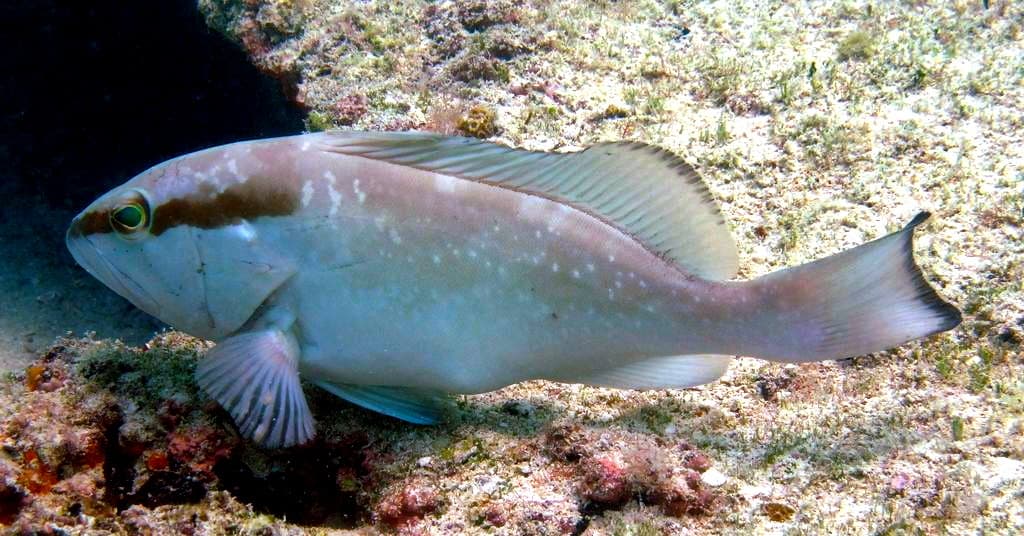
Red Grouper (Epinephelus morio)
Photo: Simões, N.; Zarco Perello, S.; Moreno Mendoza, R. / CC-BY 4.0

Red Grouper

Red grouper

Epinephelus morio

Restricted — verify
bottom20 in min total length; 2-7 kg, up to ~18 kg
Edibility & ciguatera
Excellent eating; low ciguatera risk in the northern Gulf.
Where you'll see it
Offshore hard bottom, rocky ledges and rigs, often solitary in excavated 'pits'.
Legal status
Not a game fish — legal to spear when submerged, 20 in total length minimum, within the 4/day grouper aggregate. Federal Gulf grouper seasons/rules can change — verify current dates and the aggregate.
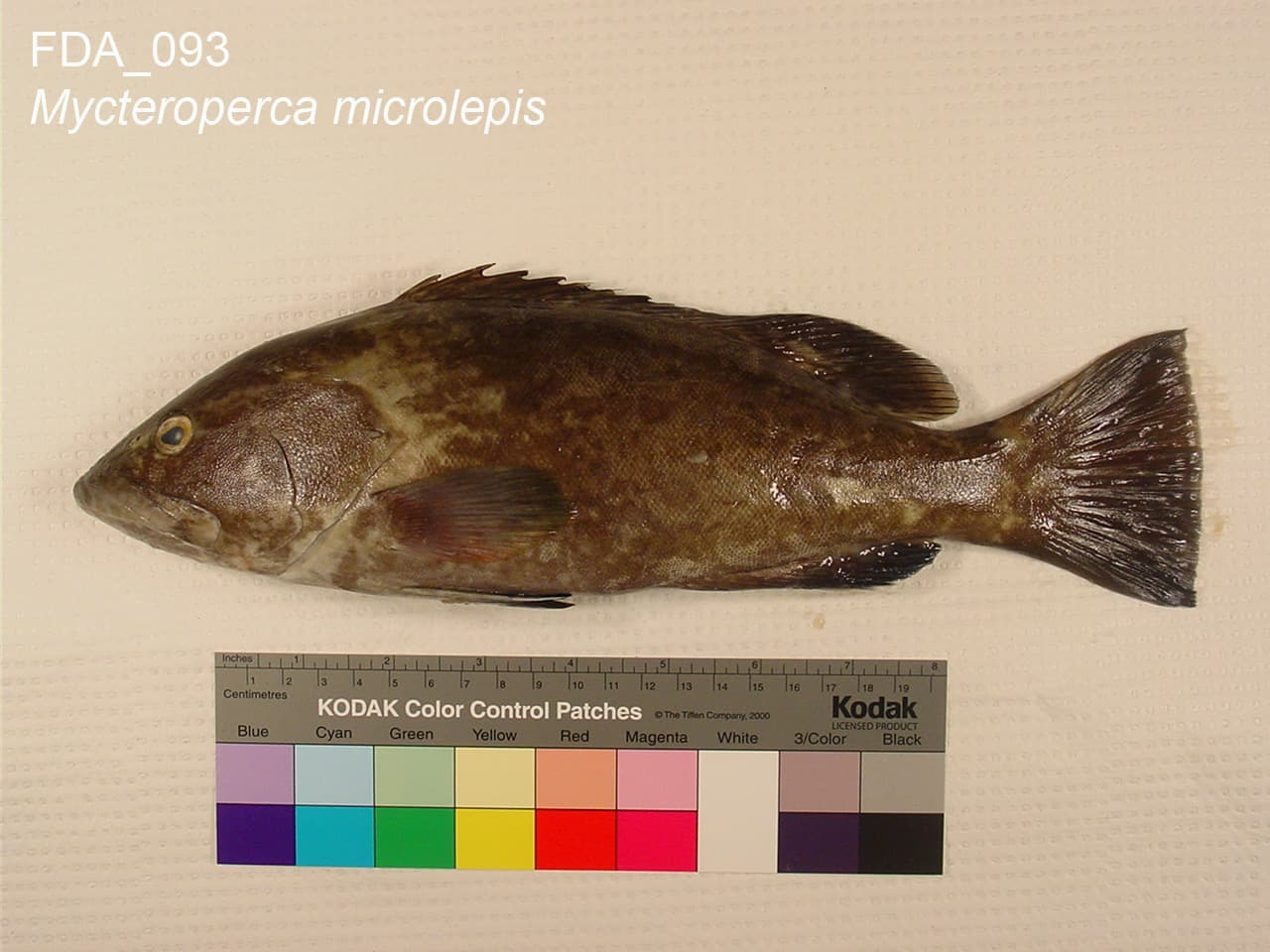
Gag Grouper (Mycteroperca microlepis)
Photo: FDA

Gag Grouper

GagGrey grouper

Mycteroperca microlepis

Restricted — verify
reef24 in min total length; 2-12 kg, up to ~23 kg
Edibility & ciguatera
Excellent eating; low ciguatera risk in the northern Gulf.
Where you'll see it
Ledges, wrecks, rigs and live bottom; a strong fighter that bolts to structure — a classic spear target.
Legal status
Not a game fish, but recreational harvest of gag is CLOSED Jan 1-Aug 31; open the rest of the year at 24 in total length within the 4/day grouper aggregate. Verify current dates.
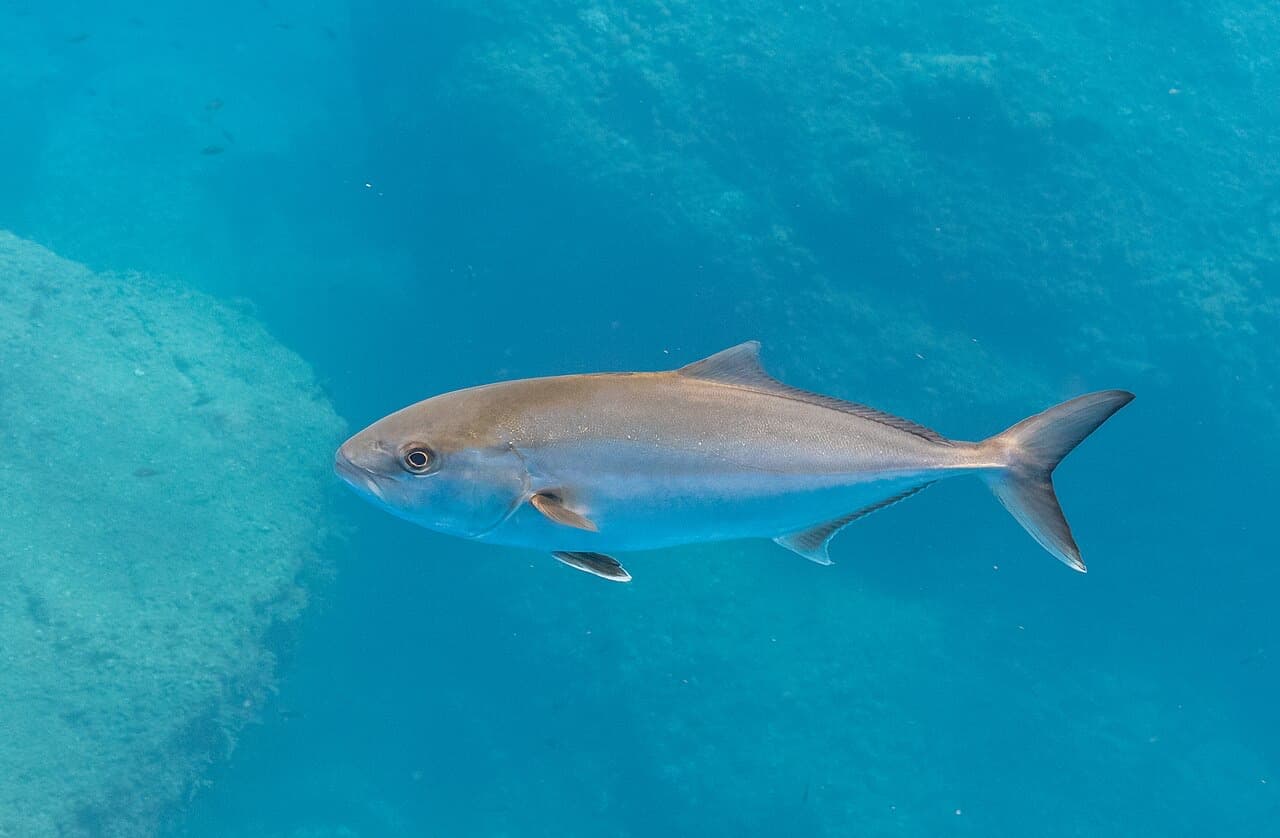
Greater Amberjack (Seriola dumerili)
Photo: Diego Delso / CC-BY-SA 4.0

Greater Amberjack

AJReef donkey

Seriola dumerili

Restricted — verify
reef34 in min fork length; 9-27 kg, up to ~45 kgCiguatera: moderate
Edibility & ciguatera
Good eating (watch for cosmetic flesh worms). Low ciguatera risk nearshore, but greater amberjack from the far-offshore Gulf banks have tested above FDA ciguatoxin levels — flag large offshore-banks fish.
Where you'll see it
Rigs, wrecks and deep reefs in aggressive schools — a bucket-list rig-fishery brawl.
Legal status
Not a game fish, but the recreational season is short: open Sept 1-Oct 31 each year, 34 in fork length, 1/day. Closed the rest of the year — verify current dates.
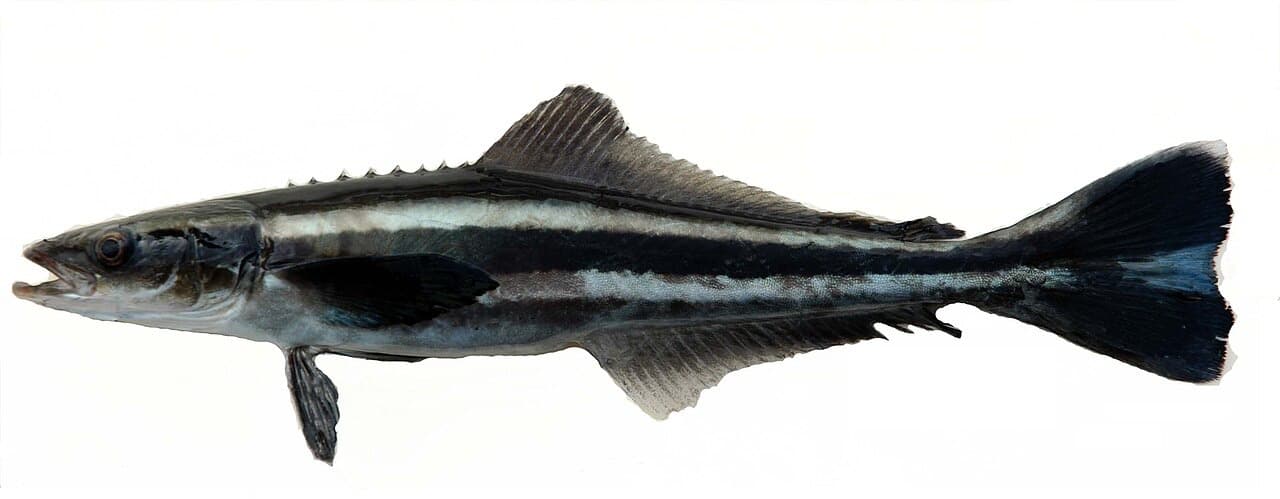
Cobia (Rachycentron canadum)
Photo: D Ross Robertson · Public domain

Cobia

LemonfishLing

Rachycentron canadum

Legal to spear
pelagic36 in min fork length; 9-27 kg, up to ~45 kg
Edibility & ciguatera
Excellent eating; low ciguatera risk. In Louisiana it is almost always called 'lemonfish'.
Where you'll see it
Cruises near the surface around rigs, buoys, wrecks and nearshore structure, and follows rays and turtles; often shot as a surprise cruising target.
Legal status
Not a game fish — legal to spear year-round when submerged. 36 in fork length minimum, 1/day, no more than 2 per vessel.
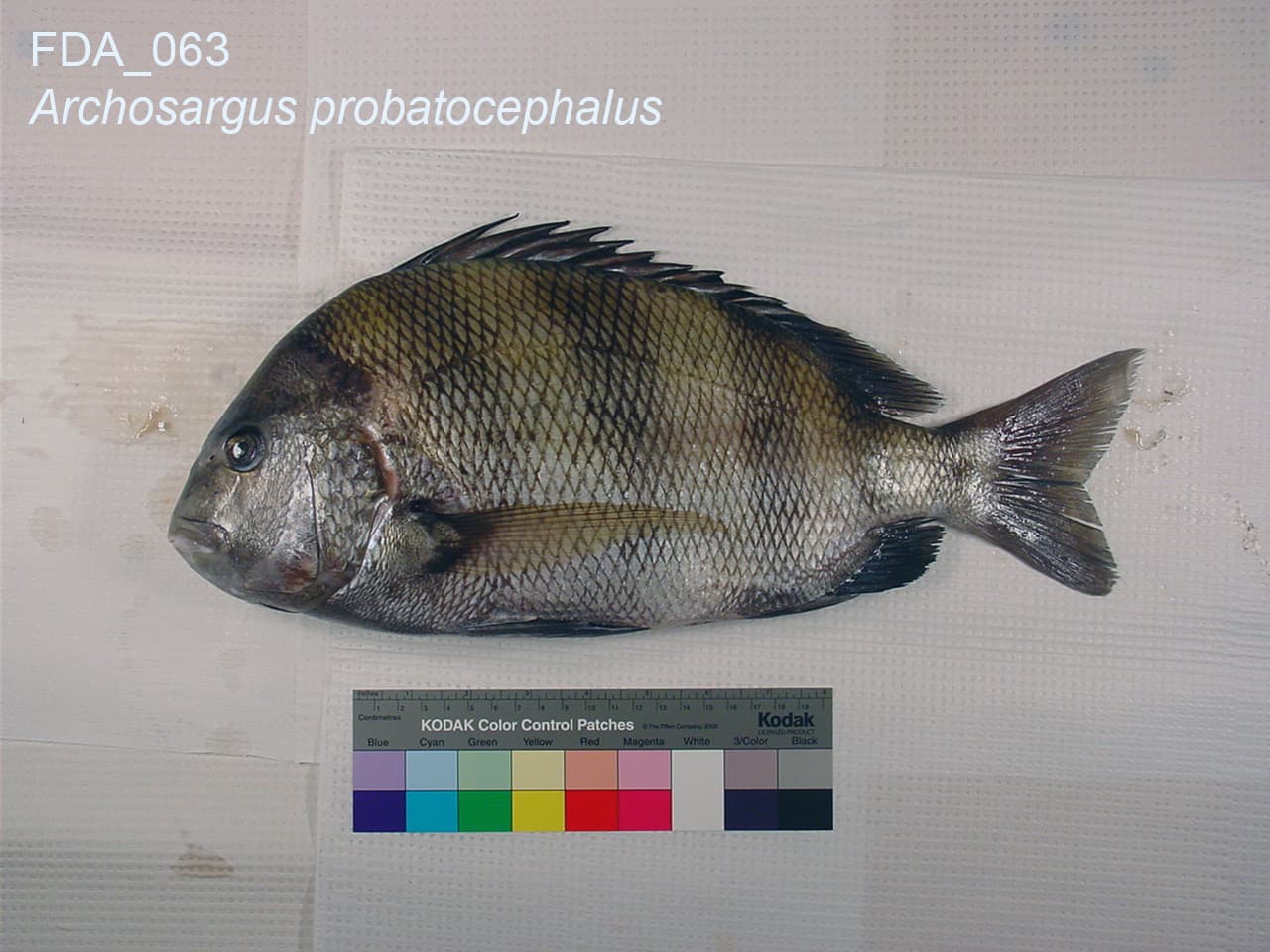
Sheepshead (Archosargus probatocephalus)
Photo: FDA

Sheepshead

Convict fishSheephead

Archosargus probatocephalus

Legal to spear
inshore0.5-4 kg, up to ~5 kg
Edibility & ciguatera
Very good eating; low ciguatera risk.
Where you'll see it
Jetties, bridges, rigs, wrecks and pilings — anywhere with barnacles; a common, approachable inshore/nearshore spear target.
Legal status
Not a game fish — legal to spear year-round when submerged. Louisiana sets no size limit and no daily bag limit for sheepshead.

Black Drum

Bull drumPuppy drum

Pogonias cromis

Legal to spear
inshore16 in min total length; slot fish 3-7 kg, 'bulls' to ~30+ kg
Edibility & ciguatera
Good eating in the smaller/slot sizes; large 'bull' drum can be coarse and are often released. Low ciguatera risk.
Where you'll see it
Jetties, passes, rigs, oyster reefs and marsh edges; large bulls school in the passes. Not a game fish, unlike red drum.
Legal status
Not a game fish — legal to spear year-round when submerged. 16 in total length minimum, 5/day, of which only one may exceed 27 in.
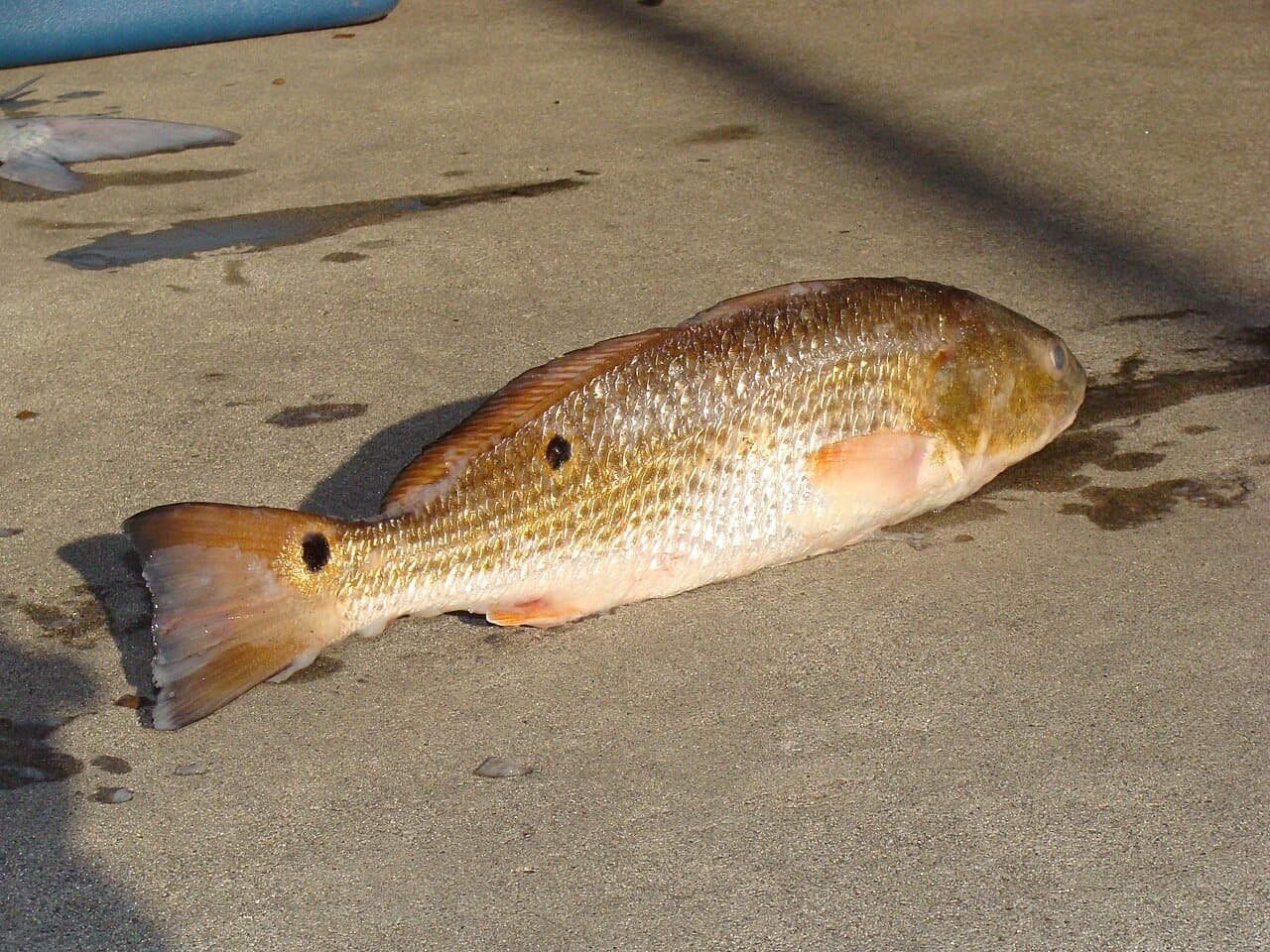
Red Drum (Redfish) (Sciaenops ocellatus)
Photo: Geeklikepi / CC-BY-SA 3.0

Red Drum (Redfish)

RedfishBull red

Sciaenops ocellatus

Restricted — verify
inshoreslot 18-27 in total length; 'bull reds' to ~1.5 m
Edibility & ciguatera
Very good eating in the slot; low ciguatera risk. Louisiana's iconic inshore fish.
Where you'll see it
Marsh, flats, passes, jetties and nearshore rigs; a prized inshore gamefish that — uniquely in Louisiana — you MAY spear.
Legal status
SPECIAL EXCEPTION. Red drum is a statutory game fish, yet Louisiana law names it as the ONE game fish a submerged skin diver may take with standard spearing equipment (bow-and-arrow is also allowed). Slot 18-27 in total length, 4/day. No OTHER saltwater game fish (the billfish) may be speared.
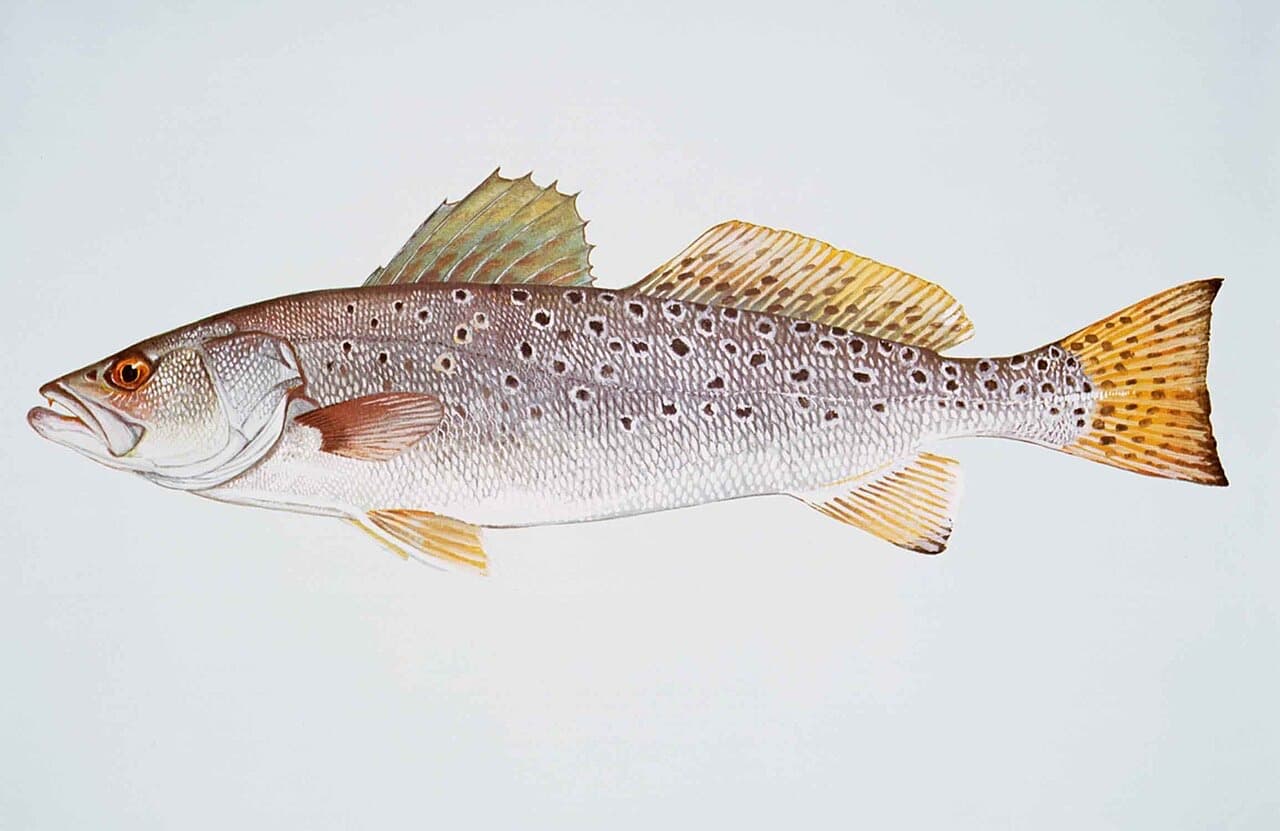
Spotted Seatrout (Cynoscion nebulosus)
Photo: USFWS

Spotted Seatrout

Speckled troutSpecks

Cynoscion nebulosus

Restricted — verify
inshoreslot 13-20 in total length
Edibility & ciguatera
Good eating; low ciguatera risk. A soft-fleshed inshore fish rarely targeted with a spear, but legal to spear here.
Where you'll see it
Marsh, grass, passes and nearshore structure. Unlike Florida (where seatrout is illegal to spear), Louisiana does not classify it as a game fish, so it may be speared.
Legal status
Not a statutory game fish — legal to spear when submerged. Slot 13-20 in total length, 15/day with no more than 2 over 20 in. These numbers were revised recently and a fillet-size rule was under review in 2026 — verify current LDWF limits.

Southern Flounder

FlatfishDoormat

Paralichthys lethostigma

Restricted — verify
bottomno size limit; commonly 30-50 cm, 'doormats' larger
Edibility & ciguatera
Excellent eating; low ciguatera risk. The classic Louisiana gigging fish.
Where you'll see it
Sand/mud bottom near passes, jetties, marsh edges and shell — the target of Louisiana's flounder-gigging tradition. The dominant Louisiana flatfish is the southern flounder (Paralichthys lethostigma); the very similar Gulf flounder (P. albigutta) also occurs and shares the same rules.
Legal status
Flounder is the one species you may take in salt water with a barbless spear or a multi-pronged barbed gig (as well as by standard spearing equipment when submerged). No size limit, 10/day, but possession is PROHIBITED Oct 15-Nov 30. Verify current dates.
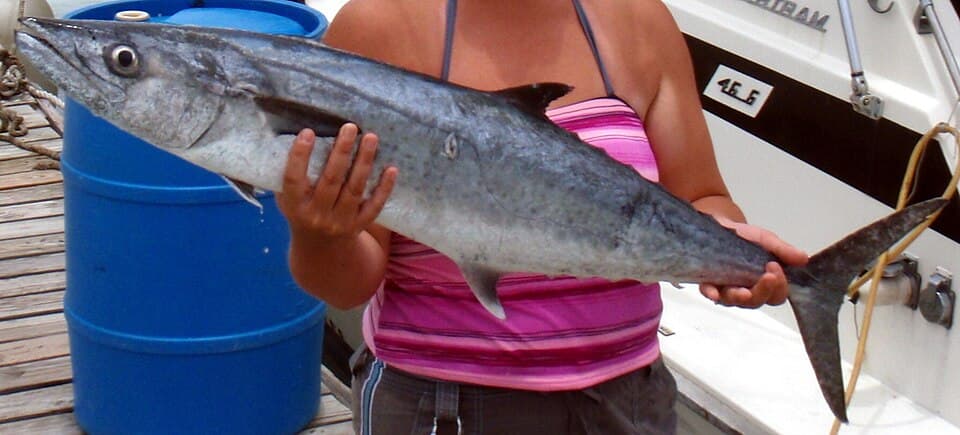
King Mackerel (Scomberomorus cavalla)
Photo: ScubaBear68 / CC BY 2.0

King Mackerel

KingfishSmoker

Scomberomorus cavalla

Restricted — verify
pelagic24 in min fork length; 2-14 kg, up to ~23 kg
Edibility & ciguatera
Good eating; low ciguatera risk in the northern Gulf (minor caution on very large offshore-banks fish). Ice quickly to avoid scombroid/histamine.
Where you'll see it
Rigs, wrecks and nearshore-to-offshore in the water column; fast — usually a bluewater or rig spear target.
Legal status
Not a game fish — legal to spear when submerged, 24 in fork length minimum, 3/day. Verify current federal Gulf king mackerel limits.
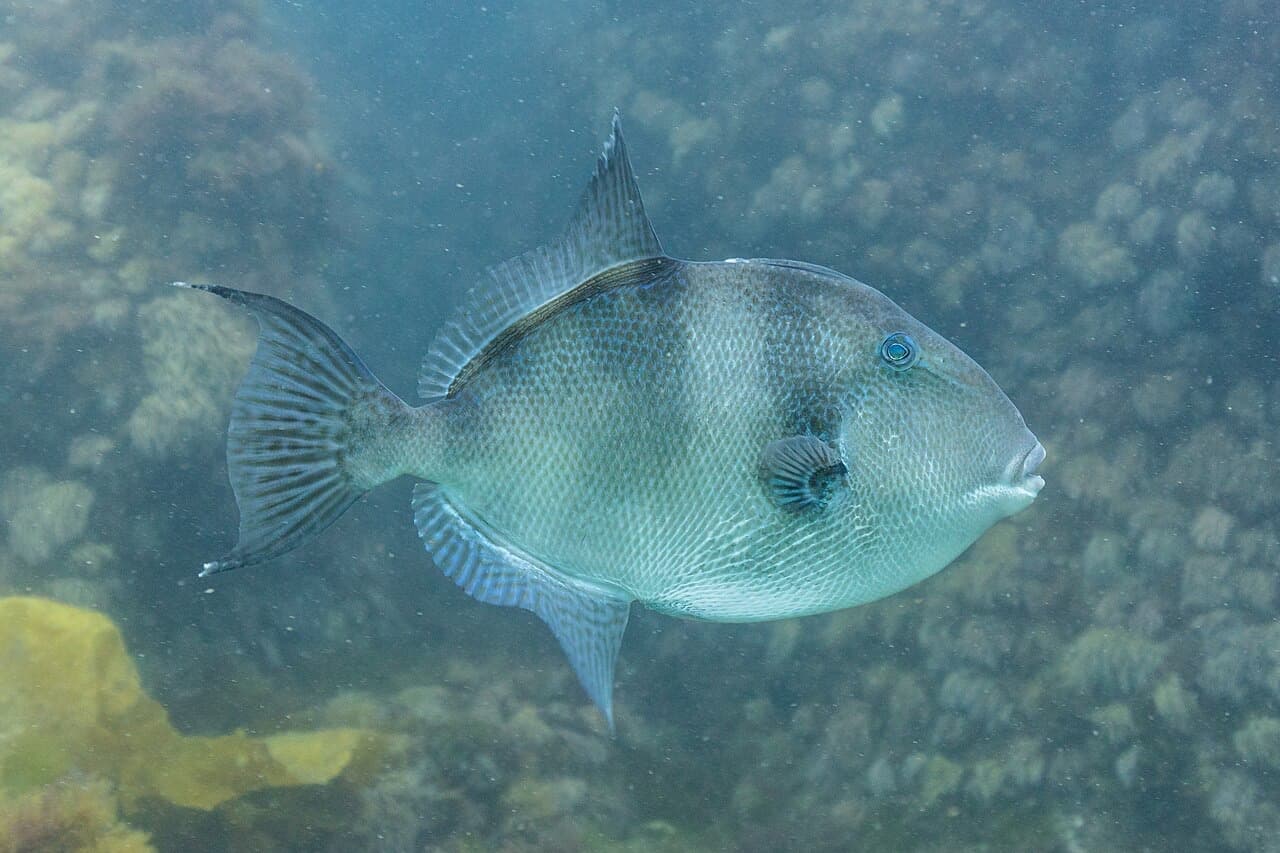
Gray Triggerfish (Balistes capriscus)
Photo: Diego Delso / CC-BY-SA 4.0

Gray Triggerfish

Trigger

Balistes capriscus

Restricted — verify
reef15 in min fork length; typically 0.5-2 kg
Edibility & ciguatera
Excellent — dense, sweet white meat; low ciguatera risk.
Where you'll see it
Rigs, reefs, wrecks and hard bottom; holds tight to structure and a rewarding rig-fishery target.
Legal status
Not a game fish — legal to spear when open, 15 in fork length minimum, 1/day, but CLOSED Jan 1-Feb 28 and Jun 1-Jul 31. Verify current dates.
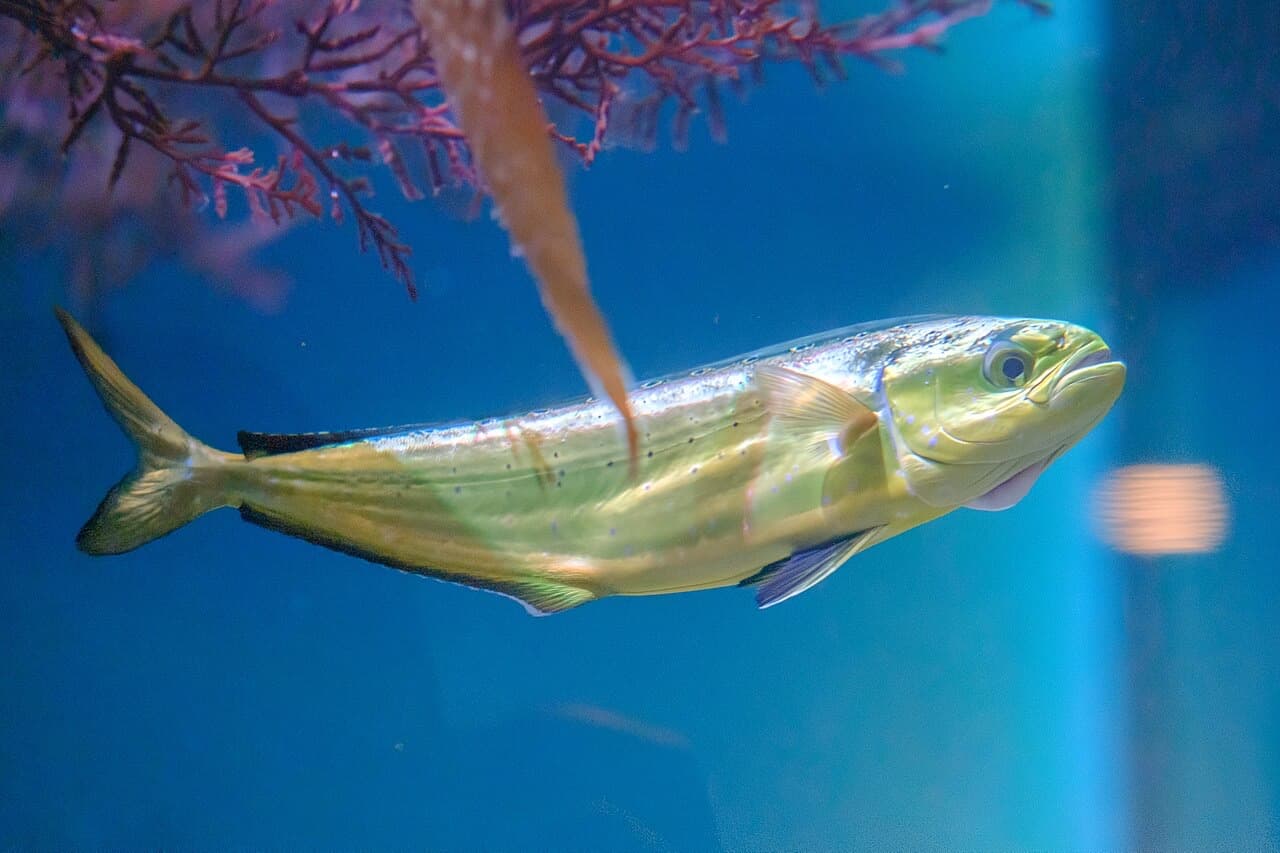
Mahi-mahi (Dolphinfish) (Coryphaena hippurus)
Photo: gendereuphorbia / CC0

Mahi-mahi (Dolphinfish)

DoradoDolphin

Coryphaena hippurus

Legal to spear
pelagic1.5-7 kg, up to ~40 kg
Edibility & ciguatera
Excellent eating; low ciguatera risk (open-water feeder, not a reef-toxin fish). Ice quickly to avoid scombroid/histamine.
Where you'll see it
Offshore bluewater around weedlines, rigs, FADs and floating debris — a bluewater target, not a reef fish.
Legal status
Not a game fish — legal to spear when submerged. Louisiana sets no state size or bag limit; federal Gulf recreational rules apply offshore — verify.
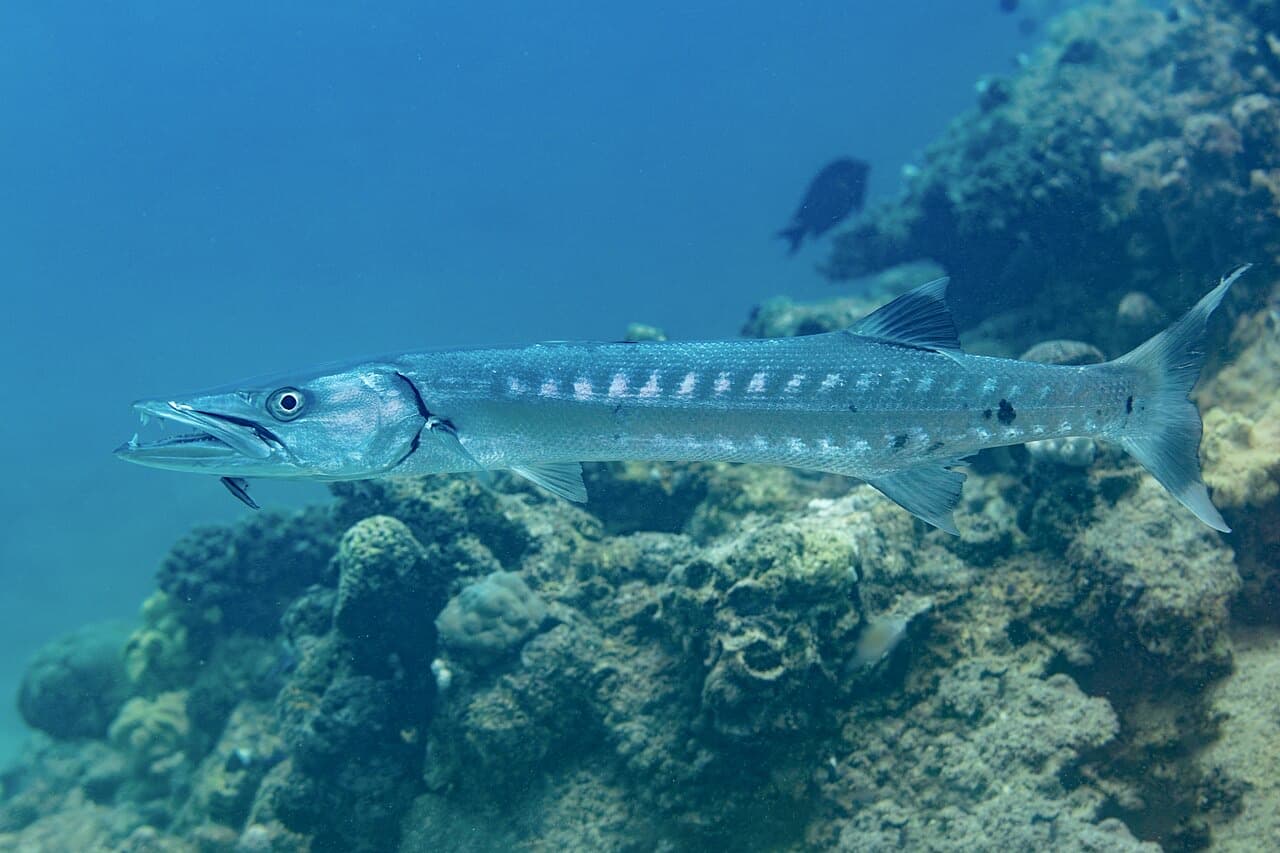
Great Barracuda (Sphyraena barracuda)
Photo: Diego Delso / CC-BY-SA 4.0

Great Barracuda

Cuda

Sphyraena barracuda

Legal to spear
reef60-180 cm, up to ~1.8 mCiguatera: moderate
Edibility & ciguatera
Northern-Gulf barracuda are far lower risk than Keys/Caribbean fish, but ciguatera is NOT zero: NOAA has documented great barracuda above FDA ciguatoxin levels at the far-offshore Flower Garden Banks. Treat large offshore-banks barracuda with real caution.
Where you'll see it
Ubiquitous around rigs, wrecks and offshore banks; curious and often approaches divers. A photogenic encounter more than a food target.
Legal status
Not a game fish — legal to spear (no Louisiana size or bag limit), but the ciguatera risk on large offshore fish means many divers do not eat it.
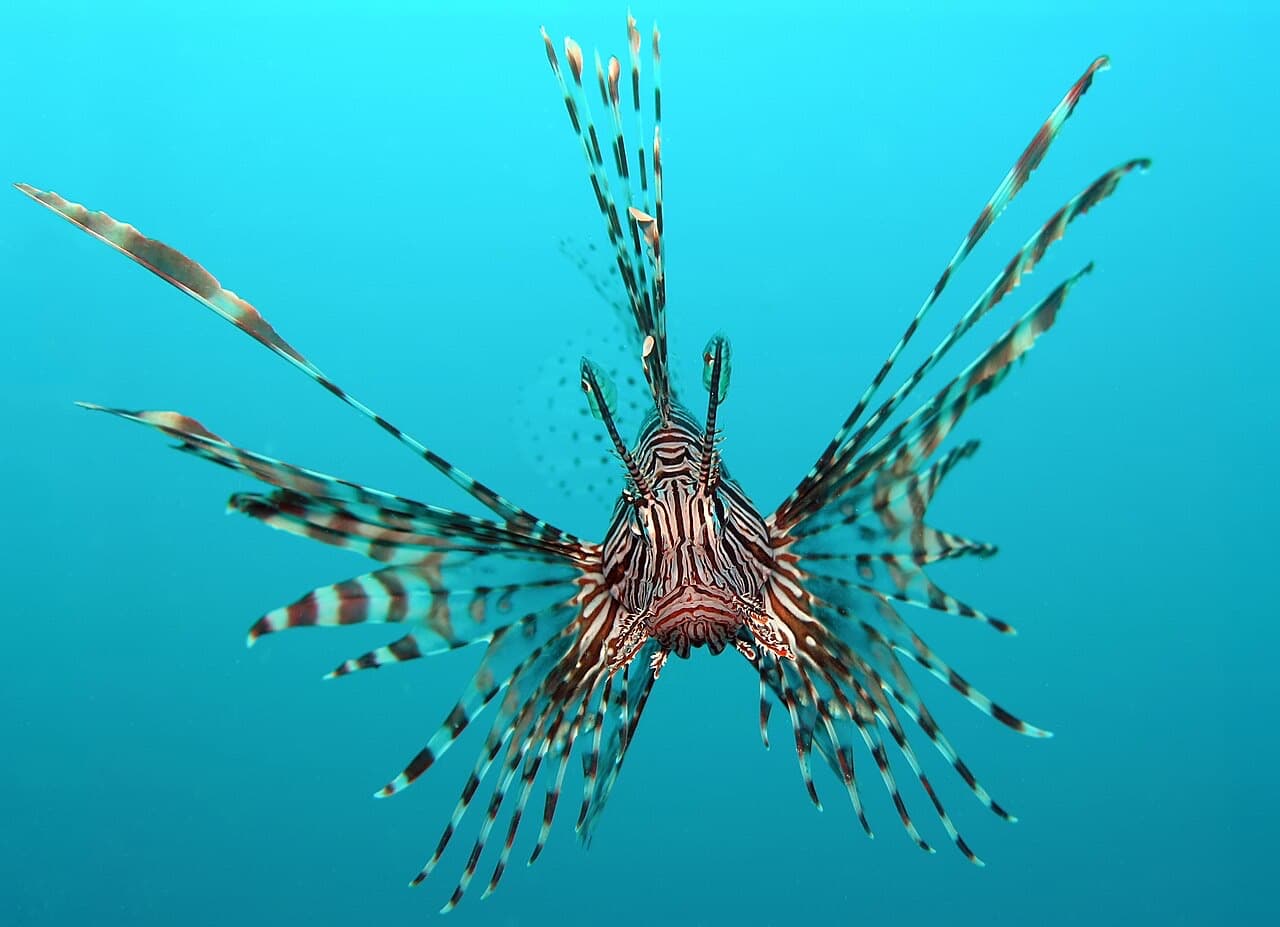
Lionfish (Pterois volitans)
Photo: Jens Petersen / CC-BY 2.5

Lionfish

Zebrafish

Pterois volitans

Legal to spear
reef15-45 cm
Edibility & ciguatera
Excellent, delicate white flesh once the spines are removed. The spines are venomous but the flesh is not — handle with care.
Where you'll see it
Rigs, wrecks and offshore hard bottom — an invasive species now established in the northern Gulf, and one spearos are encouraged to remove.
Legal status
Invasive — removal encouraged. Not a game fish and no size or bag limit; legal to spear when submerged. A recreational fishing license is still required to use spearing gear.
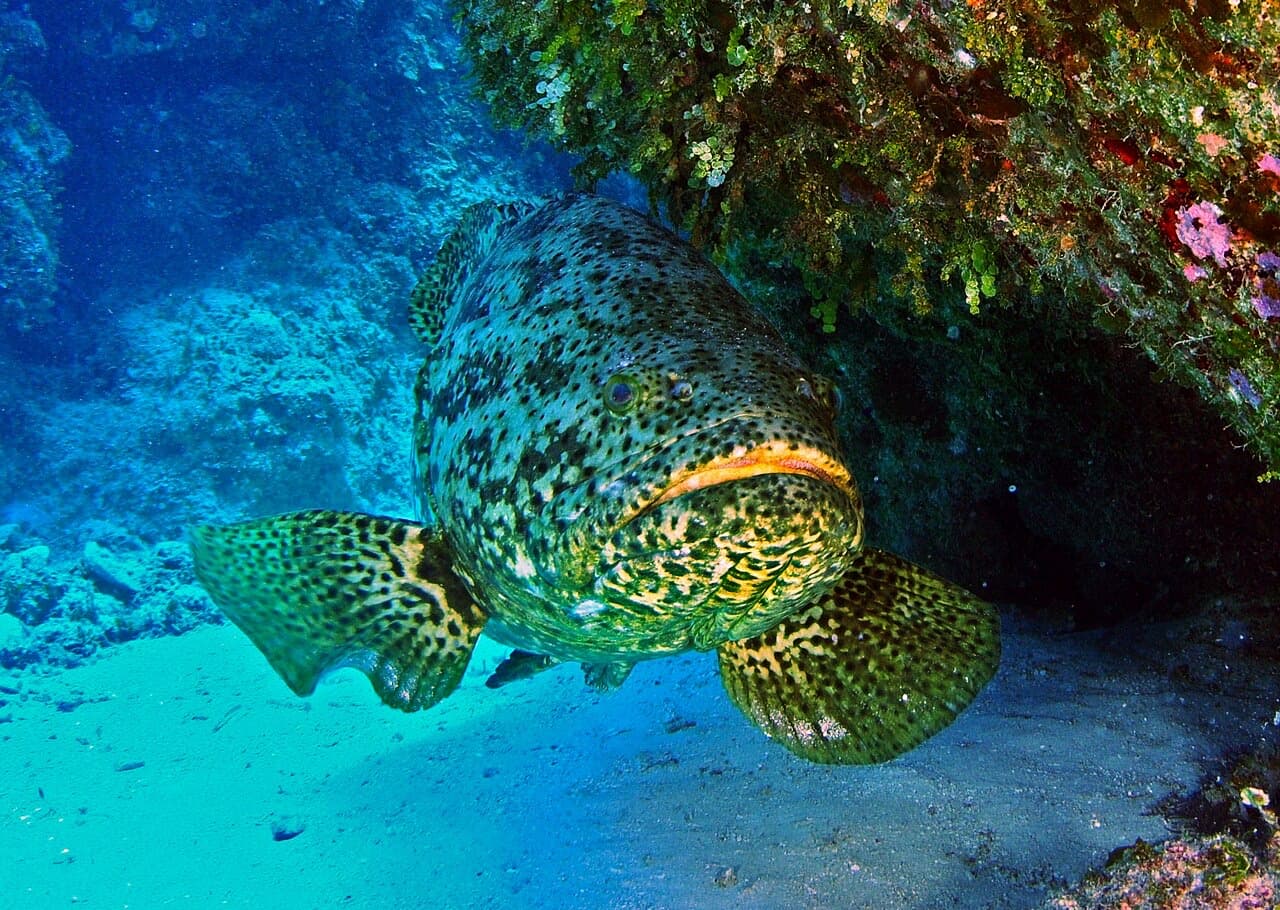
Goliath Grouper (Epinephelus itajara)
Photo: Albert kok / CC-BY-SA 3.0

Goliath Grouper

Jewfish

Epinephelus itajara

Protected — do not take
reefup to ~2.5 m / 360 kg
Edibility & ciguatera
Do not take — protected.
Where you'll see it
Rigs, wrecks and large structure; a massive, curious fish that often shadows divers.
Legal status
PROHIBITED — no harvest by any method, including spearing. Federally protected and named on Louisiana's prohibited-species list. Must be released.
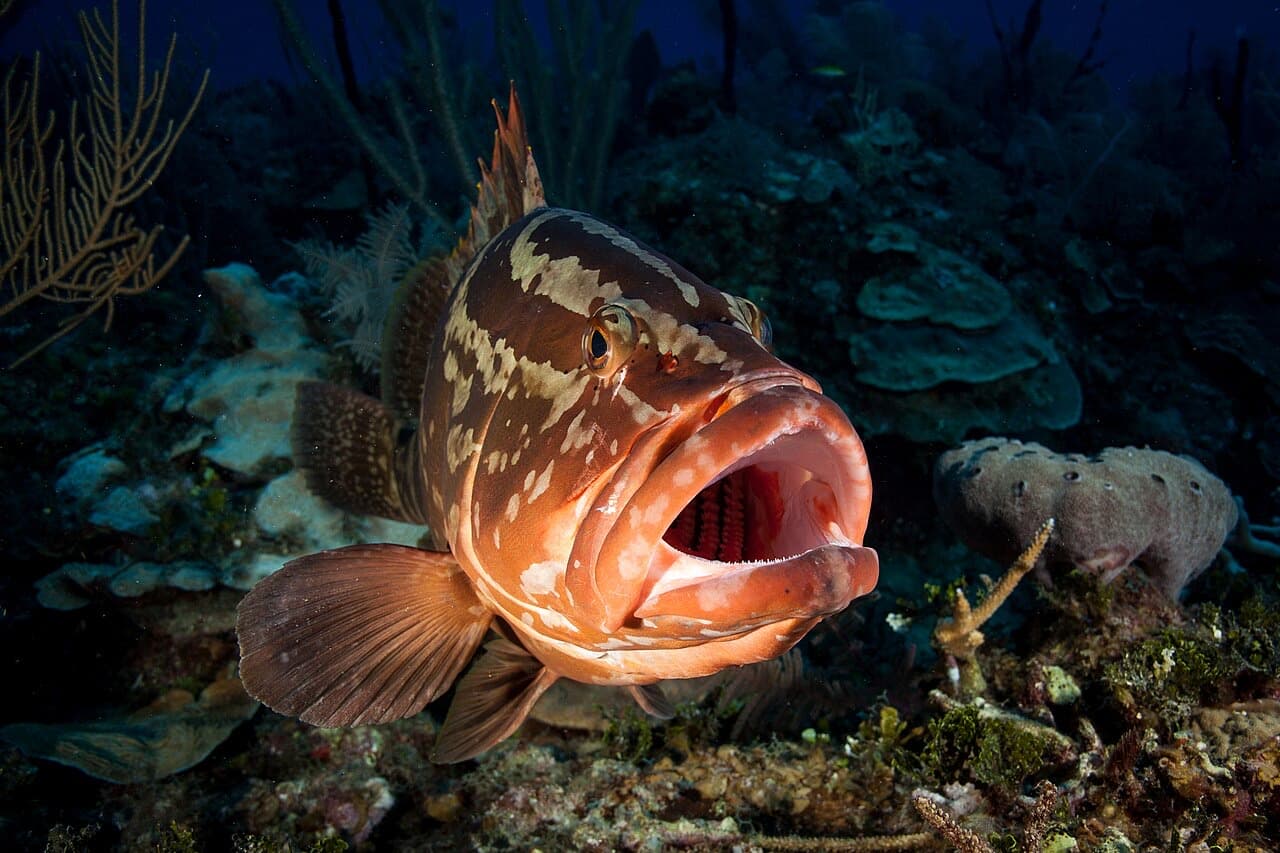
Nassau Grouper (Epinephelus striatus)
Photo: q phia / CC-BY 2.0

Nassau Grouper

Epinephelus striatus

Protected — do not take
reefup to ~1.2 m
Edibility & ciguatera
Do not take — protected.
Where you'll see it
Reefs and ledges; curious and easily approached, which is part of why it was overfished. Rare in the northern Gulf but off-limits everywhere.
Legal status
PROHIBITED — no harvest by any method, including spearing. Federally protected and named on Louisiana's prohibited-species list. Must be released.

Local names & details still being verified

  • Red drum and spotted seatrout limits were revised in 2024-2025 (red drum to an 18-27 in slot, 4/day; seatrout to a 13-20 in slot, 15/day with no more than 2 over 20 in), and a Notice of Intent on allowable fillet sizes for both was open for comment into 2026. Confirm the current LDWF numbers before relying on them.
  • Red snapper, gag grouper (closed Jan 1-Aug 31), greater amberjack (open Sept 1-Oct 31 only), gray triggerfish (closed Jan 1-Feb 28 and Jun 1-Jul 31) and southern flounder (possession closed Oct 15-Nov 30) all have moving or seasonal dates set annually — confirm current open dates with LDWF before targeting.
  • The only saltwater game fish Louisiana forbids to spears are the billfish (sailfish and blue, black, striped, hatchet and white marlin); red drum is the sole game-fish exception you MAY spear. Divers essentially never encounter billfish at freedive depth, so they are not carded here, but never spear one.
  • Ciguatera in the northern Gulf is generally low — far below the Florida Keys or Caribbean — but NOAA has documented great barracuda and greater amberjack above FDA ciguatoxin limits at the far-offshore Flower Garden Banks. Treat large carnivorous reef fish from the far-offshore banks with caution; nearshore and inshore fish are low risk.
  • Louisiana law authorizes spearing by a 'skin diver' who is 'submerged in the water', while the LDWF license-required-gear list separately names 'Scuba gear'; spearing on scuba is common Gulf-rig practice and appears permitted, but the two government texts are in mild tension — confirm current LDWF guidance. Either way you must be submerged (no surface or boat spearing) and hold a Basic + Saltwater recreational license (age 18+).

A guide, not a ruling

Species identification and local names are provided as a guide, not a substitute for local knowledge or a legal ruling. In Louisiana, spearing is legal for almost every common saltwater target because the statutory 'game fish' list is short — only the billfish are off-limits to spears, and red drum is the one game fish you may take. You must be submerged in the water to spear legally, freshwater spearing is limited to nongame species, and speared fish count against the same LDWF size, slot and creel limits as any other gear. Confirm the current LDWF sizes, slots and seasons before taking any fish, and be aware that large reef fish from the far-offshore Gulf banks can carry ciguatera that cooking does not remove.

Do not spear

Prohibited species

  • FRESH WATER: all freshwater game fish may NOT be speared — largemouth bass, spotted bass, shadow bass, black crappie, white crappie, white bass, yellow bass, striped bass, hybrid striped bass, and any species of bream (s1, s2)
  • SALT WATER: the saltwater game fish may NOT be speared — sailfish, blue marlin, black marlin, striped marlin, hatchet marlin, and white marlin (red drum is the sole game-fish EXCEPTION and MAY be speared) (s1, s2)
  • Federally threatened/endangered and prohibited species off-limits to all take: Gulf sturgeon, pallid sturgeon, shovelnose sturgeon, sea turtles, smalltooth and largetooth sawfish, goliath grouper, Nassau grouper, and the NOAA-listed prohibited sharks (e.g., white, whale, basking, dusky, sand tiger) (s2, s4)

Where you can't

Area restrictions

  • Louisiana state waters extend seaward roughly 3 marine leagues (about 9 nautical miles) from shore in the Gulf — farther than most states — so state size/creel limits apply across a wide offshore band; federal (NOAA) rules govern beyond that 2
  • Wildlife Management Areas (WMAs), refuges and wetlands conservation areas have their own access permits and restricted/no-take areas; a WMA Access permit is required for LDWF-administered lands (persons 17 and under exempt) 2
  • No statewide fixed distance-from-swimmers/pier spearfishing setback was located in the state fishing regulations; local ordinances and specific waterbody rules may apply (unverified)

Worth knowing

Notable rules, seasons & limits

  • The red drum (redfish) exception is Louisiana's signature quirk: red drum is a statutory game fish, yet it is the ONE game fish a submerged skin diver may take with standard spearing equipment (bow and arrow is also allowed for red drum); harvest of any OTHER saltwater game fish by these methods is prohibited (s1, s2)
  • 'Game fish' is a narrow, defined list — spotted seatrout, snappers, groupers, sheepshead, black drum, flounder and most other saltwater targets are NOT game fish and may be speared 2
  • Flounder is the only species you may take with a barbless spear or multi-pronged barbed gig, and only in salt water (s1, s2)
  • You must be submerged in the water to spear legally — surface or boat spearing is not permitted (s1, s2)
  • Speared fish count against the same size and bag limits as any other gear; a Saltwater License is required south of the saltwater line (s2, s3)
  • Spearing free-swimming tunas (except bluefin) requires an Atlantic HMS Angling Permit from NOAA/NMFS in addition to the state license (s2, s4)

What divers here typically use

Gear up for Louisiana spearfishing

Most divers working Louisiana's coast start with a band speargun sized to the water and the fish they are after. Our honest guide to the Best Speargun for Beginners walks through what to look for — curated from published specs and community consensus, not paid placement.

If you break them

Penalties

Taking game fish by spear (outside the red drum exception), spearing while not submerged, spearing without the required Recreational/Saltwater license, or using a prohibited spear/gun method violates LA R.S. Title 56 and LDWF regulations, enforceable by citation and fines; taking federally protected species can carry civil and criminal penalties. Exact fine amounts and class designations are set in R.S. Title 56 and were not itemized on the sources reviewed. (s1, s2 / unverified amounts)

Not yet independently confirmed — verify directly

  • Whether 'pole spear' and 'Hawaiian sling' are named individually — Louisiana's statute uses the general term 'standard spearing equipment', which these devices fall under, but they are not enumerated by name.
  • Any statewide fixed distance-from-swimmers or distance-from-pier spearfishing setback — none was located in the state fishing regulations; local ordinances or specific waterbody rules may impose one.
  • Exact penalty/fine dollar amounts and offense class for unlawful spearing — set in R.S. Title 56 and not itemized on the sources reviewed.
  • Precise seaward extent of Louisiana state waters (commonly stated as ~3 marine leagues / ~9 nm in the Gulf) as it bears on which agency's rules apply offshore — confirm the exact boundary and any species where federal limits differ.
  • Whether spearfishing on SCUBA (compressed air) is affirmatively authorized: R.S. 56:320 and the LDWF methods tables authorize spearing only by a 'skin diver' (a term that traditionally denotes breath-hold/free diving), yet the LDWF 'ACTIVITIES THAT REQUIRE A LICENSE' list separately names 'Scuba gear' as a licensable fishing gear (s2) — the two government texts are in mild tension, so 'scuba spearfishing permitted' is inferred (and consistent with common Gulf-rig practice) but not stated in one place. Confirm current LDWF guidance.

Confirm these points directly with Louisiana Department of Wildlife and Fisheries (LDWF) before you rely on them.

Primary sources

Sources

Quick answers

Frequently asked questions

Is spearfishing legal in Louisiana?
Yes — spearfishing is legal in Louisiana's saltwater, and it is permitted in fresh water, subject to license, gear, species, and area rules. Louisiana's Gulf and estuarine waters are open to spearfishing. Under R.S. 56:320, 'standard spearing equipment used by a skin diver sport fishing in saltwater... when submerged…
Do you need a license to spearfish in Louisiana?
Yes. Louisiana requires the Louisiana Basic Recreational Fishing License (plus a Saltwater License to fish south of the saltwater line). Resident cost: Basic Fishing License $17; Saltwater License $15 (resident). A combined Basic + Saltwater package is available. Non-resident cost: Basic Fishing License $68 (nonresident 5-day $30); Saltwater License $60 (nonresident 5-day $30).
Can you spearfish on scuba in Louisiana?
Permitted. 'Scuba gear' is expressly listed by LDWF among the gears that REQUIRE a recreational fishing license, which contemplates and allows spearing on scuba (the statute's operative requirement is that the skin diver be 'submerged in the water'). Verify current LDWF guidance…
What can't you spear in Louisiana?
Protected or no-take species you may not spear in Louisiana include: FRESH WATER: all freshwater game fish may NOT be speared — largemouth bass, spotted bass, shadow bass, black crappie, white crappie, white bass, yellow bass, striped bass, hybrid striped bass, and any species of bream, SALT WATER: the saltwater game fish may NOT be speared — sailfish, blue marlin, black marlin, striped marlin, hatchet marlin, and white marlin, Federally threatened/endangered and prohibited species off-limits to all take: Gulf sturgeon, pallid sturgeon, shovelnose sturgeon, sea turtles, smalltooth and largetooth sawfish, goliath grouper, Nassau grouper, and the NOAA-listed prohibited sharks. Always check the full prohibited-species list and current seasons before diving, and confirm with Louisiana Department of Wildlife and Fisheries (LDWF).
Stay current

Get an email when Louisiana's size & bag limits change

Regulations shift between seasons. We re-check Louisiana's rules against the primary source and send a short note when the limits, seasons, or licensing move — nothing else.

No spam. Regulations updates, gear data drops, and the launch of the guide.

Last verified July 5, 2026. Regulations change — always confirm the current rules with Louisiana Department of Wildlife and Fisheries (LDWF) before you dive.