Island Spear Co.

Regulations Alabama

Spearfishing Regulations in Alabama

Checked against the primary source (ADCNR) on July 5, 2026state

Governing agency: Alabama Department of Conservation and Natural Resources (ADCNR) — Marine Resources Division (saltwater) and Wildlife & Freshwater Fisheries Division (freshwater). Last verified July 5, 2026 by independent primary-source check.

Summary

Spearfishing is legal in Alabama in all waters of the state, both fresh and salt, provided the person doing the spearing is completely submerged and holds the required licenses 1. Alabama has a Gulf of Mexico coast, and in saltwater all species of fish may legally be speared (subject to size and creel limits). In fresh water, only 'commercial or nongame' fish (catfish, drum, buffalo, suckers, etc.) may be speared or gigged — designated game fish such as bass, bream, crappie and striped bass may be taken only by ordinary hook and line and may NOT be speared 13. A separate commercial/nongame spearfishing license is genuinely required and issued, on top of the base fishing license 12.

License

What you need to be legal

LegalA license is required
License
Commercial or Nongame Fish Spearfishing License (Ala. Code § 9-11-171)
Who needs it
Each person engaged in the spearing of commercial or nongame fish must hold a spearfishing license 'in addition to all other Alabama fishing licenses' 1. In practice a diver needs BOTH the spearfishing license AND the appropriate underlying sport-fishing license — a saltwater fishing license for coastal/Gulf waters, or a freshwater fishing license inland 23.
Resident cost
$6.00 annual spearfishing license (current ADCNR fee, s2). The underlying resident annual saltwater fishing license is $30.05 2. Note: the statute itself (§ 9-11-171) still lists the older base figure of $5.00 for the resident spearfishing license 1; the $6.00 sold price reflects issuance/cost adjustments.
Non-resident cost
$8.50 annual spearfishing license, or $3.50 for a 7-day trip spearfishing license (current ADCNR fees, s2). Underlying nonresident annual saltwater fishing license ranges $48.20 (Florida residents) to $129.20 (Louisiana residents) to $64.90 (all other states) under Alabama's reciprocal system 2. Statute § 9-11-171 lists older base figures of $7.50 annual / $2.50 seven-day for the spearfishing license 1.
Where to buy
Online at the ADCNR licensing portal via outdooralabama.com, at authorized license agents, and (per statute) issued by the Department of Conservation and Natural Resources; the spearfishing license must be kept in the boat or base of operations and available for inspection by a conservation officer (§ 9-11-172, s1).

Exemptions

  • Residents and nonresidents under 16 years of age are exempt from the fishing license requirement 2.
  • Alabama residents age 65 and over are exempt from the fishing license requirement 2.
  • Persons exempt from purchasing an annual saltwater license must still complete the free Saltwater Angler Registration 2.

The full story

The full story

Alabama is one of the states where a dedicated spearfishing license is a REAL, actively issued and enforced requirement — not a paper-only relic. Ala. Code § 9-11-171 requires 'a commercial or nongame fish spearfishing license' in addition to all other Alabama fishing licenses, and ADCNR sells it today: the live ADCNR Saltwater Recreational Licenses page (updated August 2025) lists it at $6.00 annual for Alabama residents, $8.50 annual for out-of-state, and $3.50 for a 7-day trip 2. So a spearo genuinely needs two things: the base fishing license (saltwater on the coast, freshwater inland) plus this spearfishing license. Independent confirmation that the license is live and enforced (not paper-only): the CURRENT 2025-2026 ADCNR regulation 220-2-.46(1)(g) lists 'Spear or Similar Instruments (underwater) by Special License' as the only lawful way to take commercial/nongame fish underwater — i.e., the regulation in force today conditions underwater spearing on holding that special (spearfishing) license 5.

There is a minor law-versus-text gap on price, not on force: the 1961 statute still recites the original fee schedule ($5.00 resident, $7.50 nonresident annual, $2.50 nonresident 7-day) 1, while the amounts ADCNR actually charges today are slightly higher ($6.00 / $8.50 / $3.50) after cost and issuance adjustments 2. The requirement itself is fully in force — treat the license as mandatory and rely on the current ADCNR price, not the older statutory number.

The other trap for divers is the freshwater game-fish rule. Because the statute defines spearing as lawful for 'commercial or nongame fish' only, and separately forbids taking any game fish except by ordinary hook and line, artificial lure, troll or spinner, the popular sport fish — largemouth and smallmouth bass, all bream/sunfish, crappie, and the striped/white/yellow bass — are entirely off-limits to spears and gigs in fresh water, with a stiffer $250–$500 fine for a game-fish violation. In salt water the statute is far more permissive: it treats 'all species of saltwater fish' as spearable, so the Gulf is broadly open (subject to normal size, creel and season limits).
Where it's legal

Saltwater & freshwater

Saltwater

Legal

Alabama has a Gulf of Mexico coastline (Mobile Bay, Gulf Shores, Orange Beach, Dauphin Island). Spearing is lawful in all salt waters of the state provided the diver is completely submerged (§ 9-11-170, s1). For spearing purposes the statute treats 'all species of saltwater fish' as commercial or nongame fish 1, so saltwater species are generally open to spearing — subject to the same size limits, creel limits, seasons, and any species-specific protections that apply to all recreational fishing, and to a required Reef Fish Endorsement for certain Gulf reef species 2.

Freshwater

Legal

Spearing and gigging are legal in fresh water but ONLY for 'commercial or nongame fish.' Under the statute (§ 9-11-83, 'Commercial or nongame fish designated') these are drum, buffalo, channel catfish and all members of the catfish family, and the spotted sucker and all members of the sucker family including redhorse and black horse 1. The CURRENT ADCNR regulation 220-2-.45 designates a broader nongame set that is actually in force today — it adds carp, paddlefish (spoonbill), bowfin, all members of the gar family, and mullet taken north of the freshwater/saltwater jurisdictional line — so common spearing/bowfishing targets like carp and gar are lawful nongame in fresh water 5. Designated GAME fish may not be speared or gigged — § 9-11-87 makes it unlawful to take any game fish 'by any other means than ordinary hook and line, artificial lure, troll, or spinner' 13. The diver must be completely submerged when spearing 1.

Gear

What you can carry

Speargun
Allowed. The statutory definition of 'spearing' (§ 9-11-170) covers 'a weapon, other than a firearm, which propels or forces a projectile, arrow or similar device' to which a wire, rope, line or cord for recovery is attached and secured to the weapon or the person 1. Line-tethered spearguns fit this definition. Firearm-propelled devices (powerheads/bangsticks) fall OUTSIDE the definition of lawful 'spearing.'
Pole spear
Allowed. The definition of 'spearing' expressly includes 'a spear or similar instrument that is held in the hand of the person using same' (§ 9-11-170, s1), which covers a hand-held pole spear.
Hawaiian sling
Allowed as a hand-operated spearing device under the 'held in the hand' branch of the § 9-11-170 definition 1. Note the statute's second branch describes projectile weapons with a recovery line attached; a classic Hawaiian sling launches an untethered spear, so it is best read as covered by the hand-held branch. See unverified[] for this nuance.
Spearfishing on SCUBA
Not prohibited, and effectively contemplated: § 9-11-170 requires the person spearing to be 'completely submerged,' and the article repeatedly refers to the 'skin diver' 1. No statute bans SCUBA for spearfishing. Divers must comply with water-safety law, including displaying a diver's flag on the surface (§ 9-11-174, referencing Title 33, Chapter 5) 1.

Gear restrictions

  • The person spearing must be COMPLETELY SUBMERGED — surface spearing is not lawful (§ 9-11-170, s1).
  • Firearms may not be used to propel a spear/projectile (the definition excludes firearms), so powerheads and bangsticks are not a lawful spearing method (§ 9-11-170, s1).
  • A diver's flag must be displayed on the surface where skin divers are operating (§ 9-11-174 → Title 33, Ch. 5, s1).
  • For taking nongame/commercial fish by GIG or hand grabbling, only a single barbless hook may be used — treble hooks and barbed hooks are prohibited for gigging/grabbling 3.

What you'll see

Target species

A field guide to the fish an Alabama spearo may actually encounter — on the Gulf reefs and wrecks off Orange Beach, Dauphin Island and Mobile Bay, and in the state's fresh waters. Alabama's defining rule is the freshwater game-fish trap: in fresh water you may spear ONLY nongame/commercial fish (carp, gar, catfish, drum, buffalo), while bass, bream, crappie and striped bass are hook-and-line only and ILLEGAL to spear. In salt water essentially all species are spearable, subject to size, creel and season limits. This is a guide, not a legality ruling — always confirm current ADCNR rules, and remember you need both a fishing license and the separate spearfishing license.

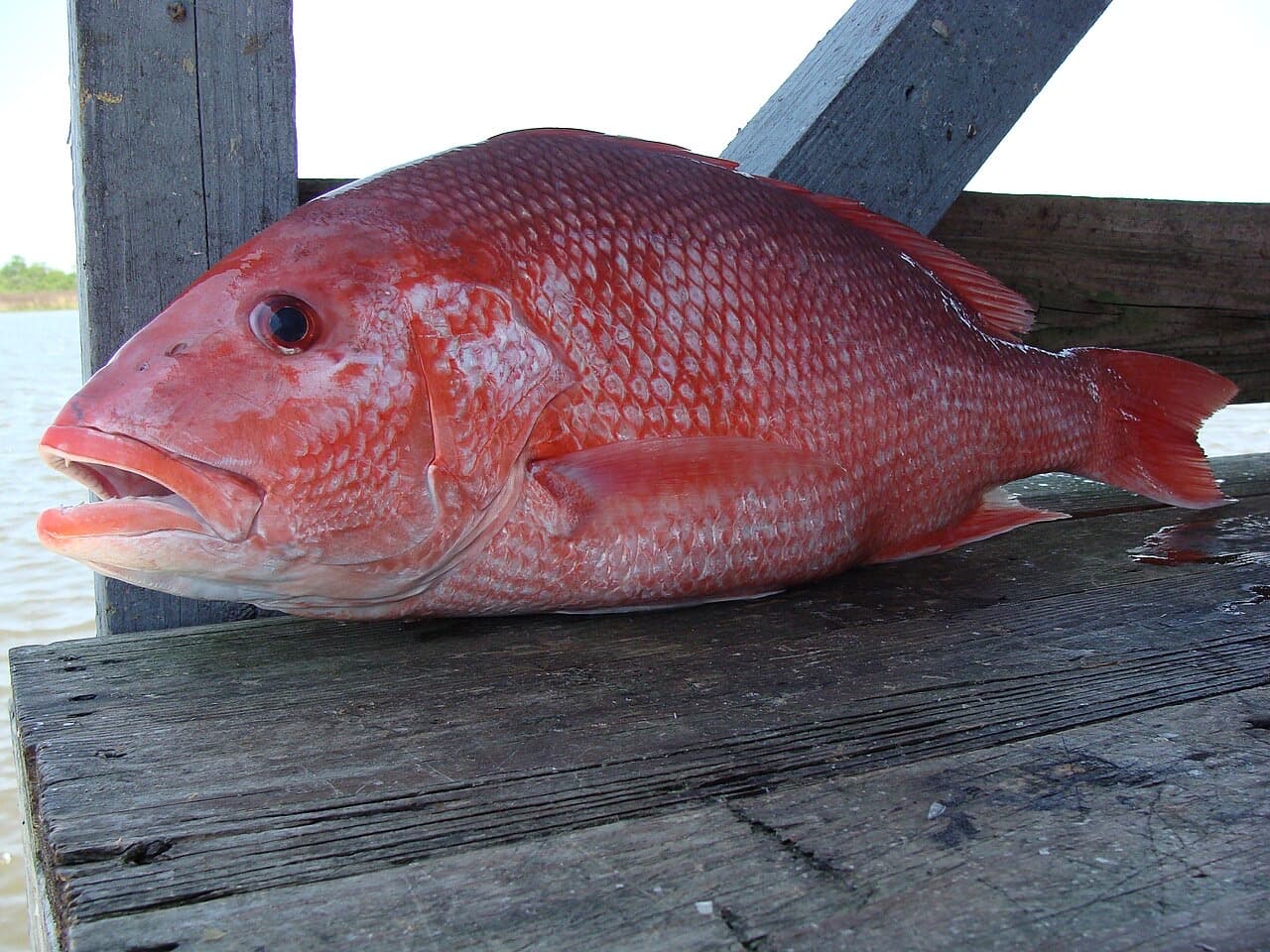
Red Snapper (Lutjanus campechanus)
Photo: Geeklikepi / CC-BY-SA 3.0

Red Snapper

American red snapperSow

Lutjanus campechanus

Restricted — verify
reef1-7 kg, up to ~14 kg
Edibility & ciguatera
Excellent eating; low ciguatera risk (northern Gulf).
Where you'll see it
The marquee northern-Gulf reef fish — artificial reefs, wrecks and hard bottom, often 60-120+ ft. Alabama runs the densest artificial-reef zone in the Gulf off Orange Beach and Dauphin Island.
Legal status
Legal to spear ONLY during the annually-set state red snapper season (typically opening late May, run mostly on summer weekends), 16 in TL minimum. Requires the Alabama Reef Fish Endorsement and Snapper Check reporting. Closed most of the year — confirm current open dates before targeting.
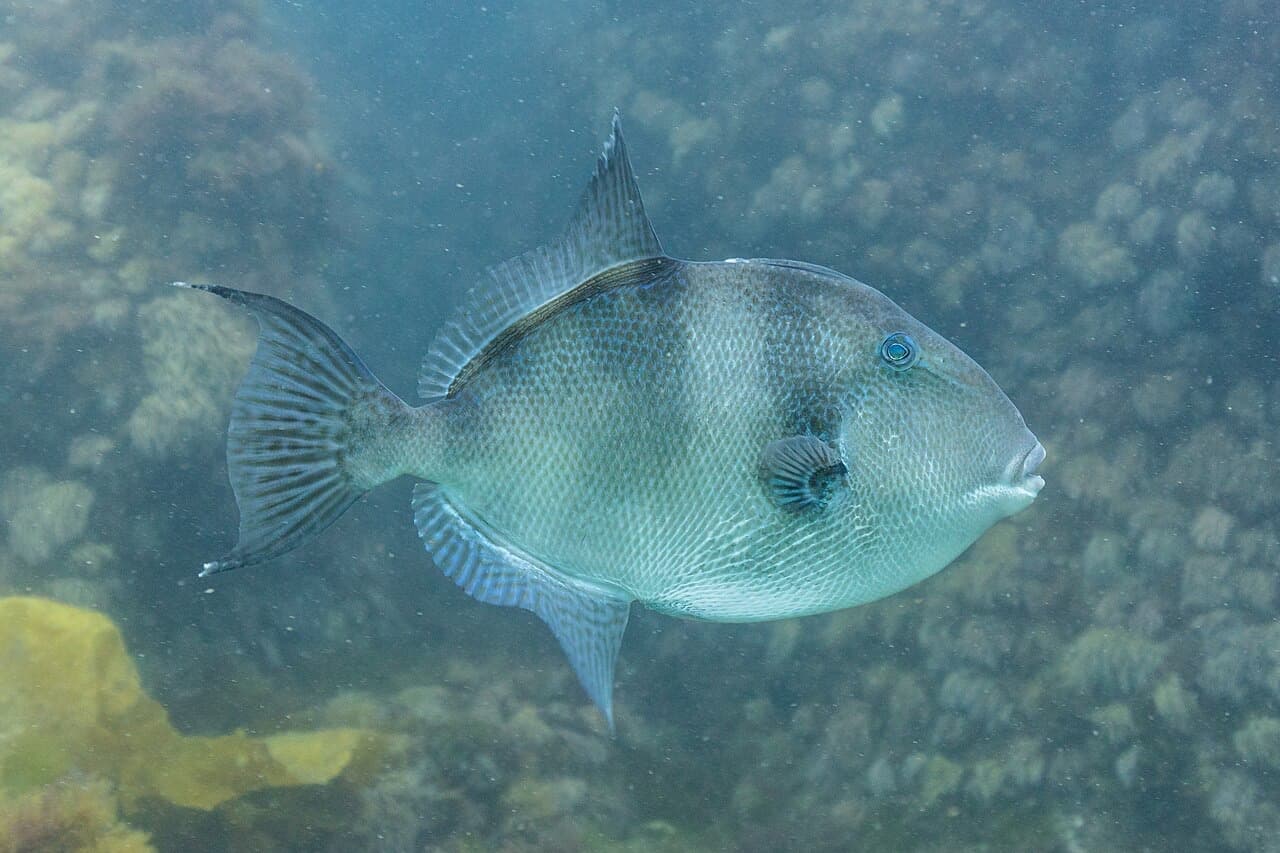
Gray Triggerfish (Balistes capriscus)
Photo: Diego Delso / CC-BY-SA 4.0

Gray Triggerfish

Trigger

Balistes capriscus

Restricted — verify
reef0.5-2 kg
Edibility & ciguatera
Excellent — dense, sweet white meat; low ciguatera risk.
Where you'll see it
Reefs, wrecks and hard bottom over the same structure that holds red snapper; hovers just off the bottom and is a rewarding spear target.
Legal status
Legal to spear in season with a minimum size (about 15 in FL, Gulf) and a split season set annually — closed part of the year. Requires the Reef Fish Endorsement. Verify current Gulf season dates and size before targeting.
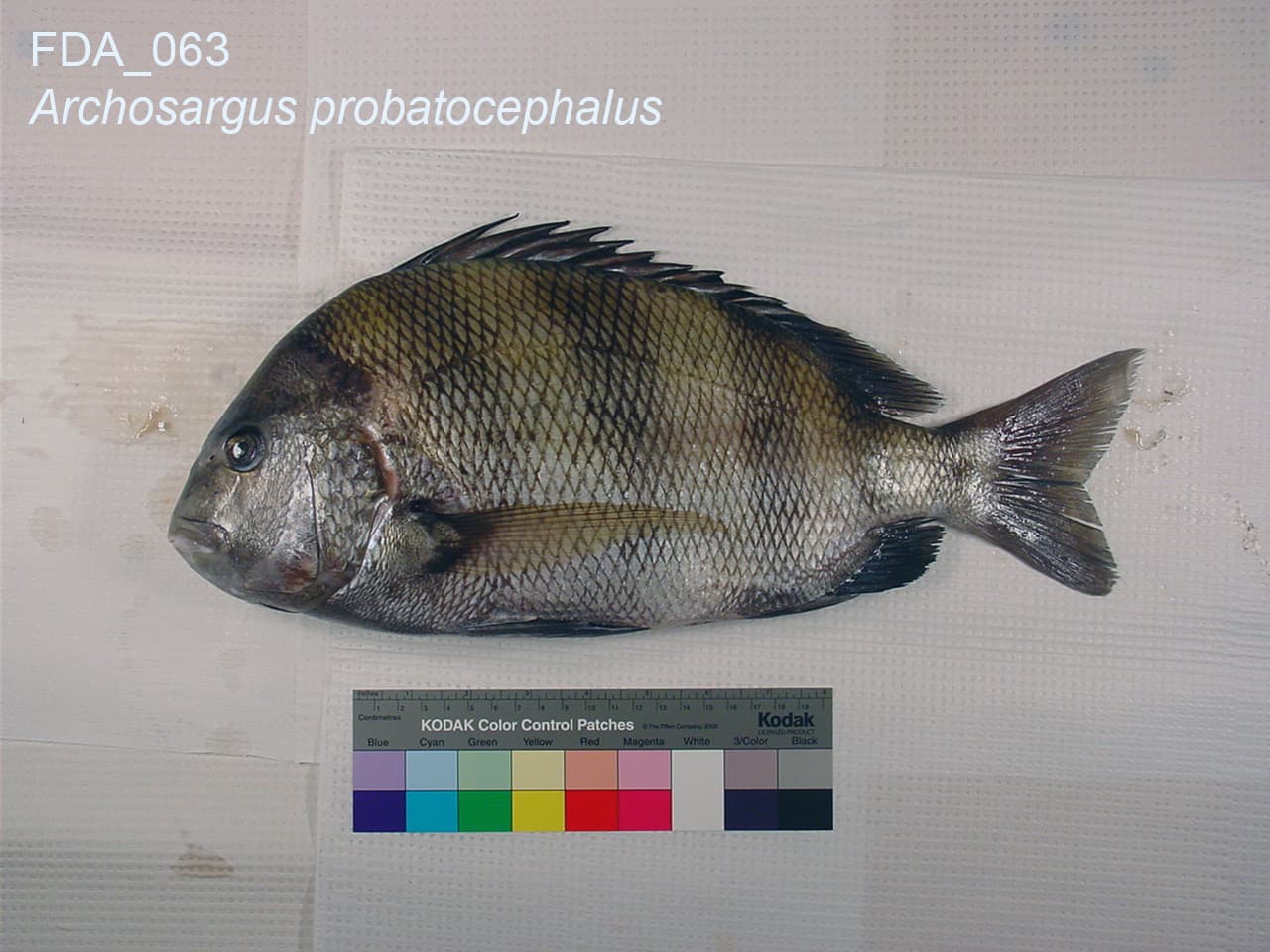
Sheepshead (Archosargus probatocephalus)
Photo: FDA

Sheepshead

Convict fish

Archosargus probatocephalus

Legal to spear
inshore0.5-4 kg, up to ~5 kg
Edibility & ciguatera
Very good eating; low ciguatera risk.
Where you'll see it
Bridges, jetties, gas rigs, oil-rig legs, docks and nearshore wrecks — anywhere with barnacles and hard structure in Mobile Bay and the Gulf. A reliable, approachable inshore spear target.
Legal status
Legal to spear as a saltwater species; standard ADCNR size and creel limits apply — verify current Marine Resources numbers before harvesting.

Southern Flounder

FlatfishDoormat

Paralichthys lethostigma

Restricted — verify
bottom30-50 cm, 'doormats' to ~63 cm
Edibility & ciguatera
Excellent eating; low ciguatera risk.
Where you'll see it
Sand and mud bottom near passes, bayous, the Gulf shore and Mobile Bay grass edges — the classic Alabama flounder-gigging target, taken at night on the shallow flats. The Gulf flounder (Paralichthys albigutta) also occurs but is far less common. A saltwater fishing license is required for coastal flounder gigging.
Legal status
Legal to spear/gig with a size limit (14 in TL) and daily creel, and a spawning CLOSURE in November (roughly Nov 1-30) enacted for the Gulf flounder stock. Confirm the current ADCNR size, creel and closed-season dates before gigging.
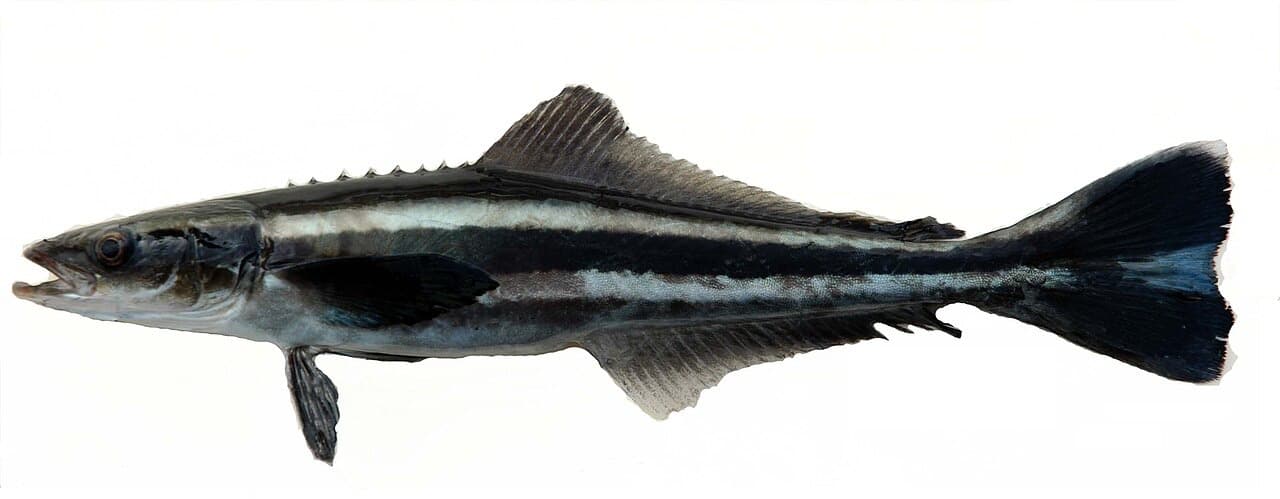
Cobia (Rachycentron canadum)
Photo: D Ross Robertson · Public domain

Cobia

LingLemonfishCrab-eater

Rachycentron canadum

Restricted — verify
pelagic9-27 kg, up to ~45 kg
Edibility & ciguatera
Excellent eating; low ciguatera risk.
Where you'll see it
Cruises near the surface following rays and turtles, and hangs on buoys, wrecks and nearshore rigs — the spring 'ling run' along the Alabama Gulf coast is a prized sight-hunting opportunity.
Legal status
Legal to spear, 36 in FL minimum, with a tight per-person / per-vessel limit; the Gulf stock has declined and limits have tightened. Verify the current ADCNR size and creel before harvesting.
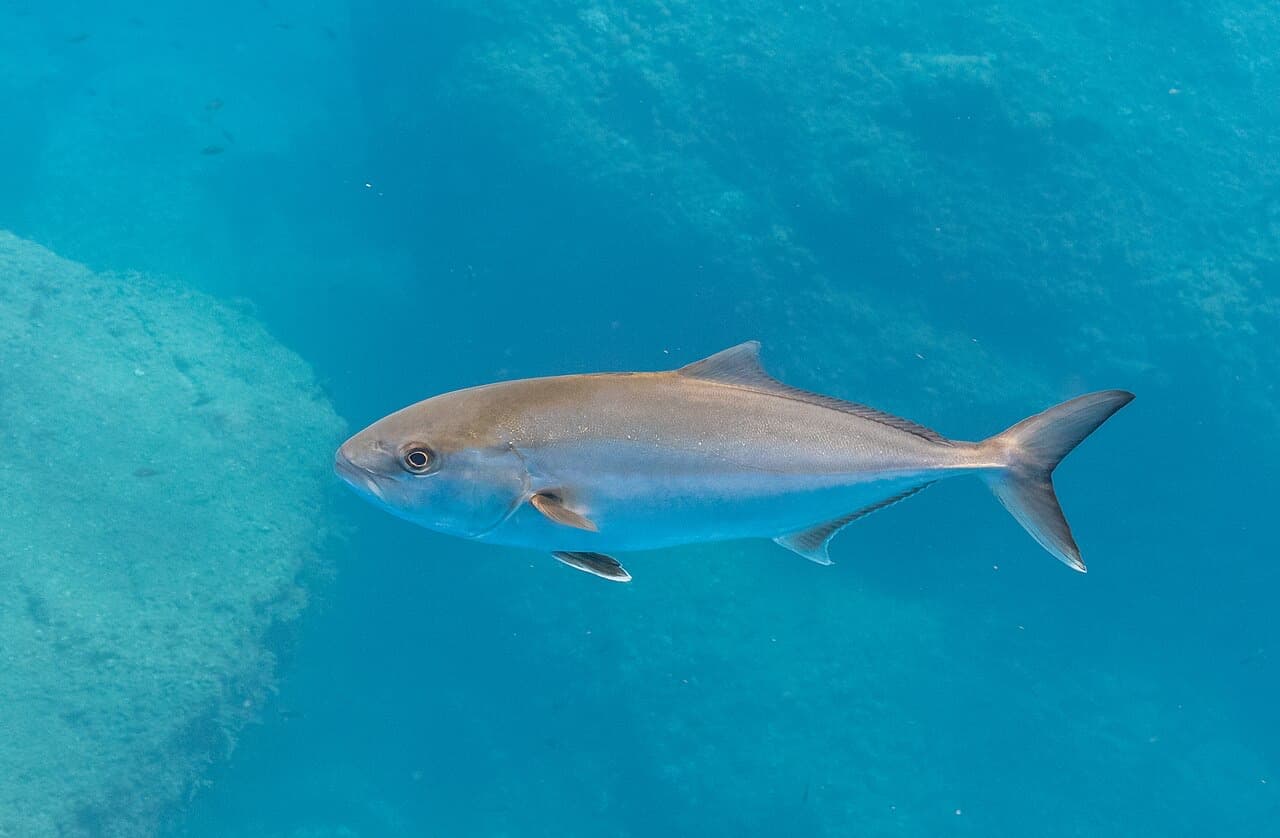
Greater Amberjack (Seriola dumerili)
Photo: Diego Delso / CC-BY-SA 4.0

Greater Amberjack

AJReef donkey

Seriola dumerili

Restricted — verify
reef9-27 kg, up to ~45 kg
Edibility & ciguatera
Good eating (watch for cosmetic flesh worms); low ciguatera risk in the northern Gulf.
Where you'll see it
Wrecks and deep reefs in aggressive schools over the Alabama artificial-reef zone — a hard-fighting, bucket-list spear target.
Legal status
Legal to spear only during the annually-set Gulf season (34 in FL minimum, 1/person). The stock is overfished and the season is short and often closed — confirm current open dates before targeting.
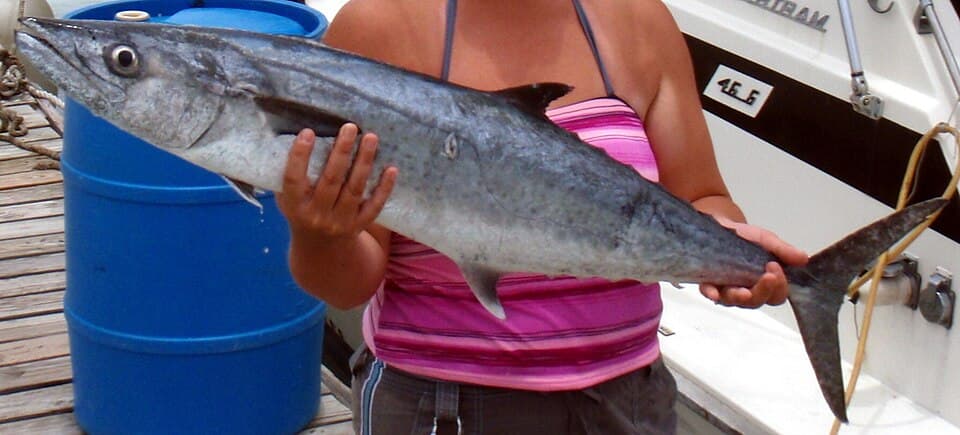
King Mackerel (Scomberomorus cavalla)
Photo: ScubaBear68 / CC BY 2.0

King Mackerel

KingfishSmoker

Scomberomorus cavalla

Restricted — verify
pelagic2-14 kg, up to ~23 kg
Edibility & ciguatera
Good eating; low ciguatera risk in the northern Gulf.
Where you'll see it
Fast-moving in the water column over nearshore wrecks, rigs and reefs; usually a bluewater or reef spear target rather than a bottom fish.
Legal status
Legal to spear year-round as a saltwater species, 24 in FL minimum, with a daily creel (Gulf typically 3/day). Verify the current ADCNR size and creel before harvesting.
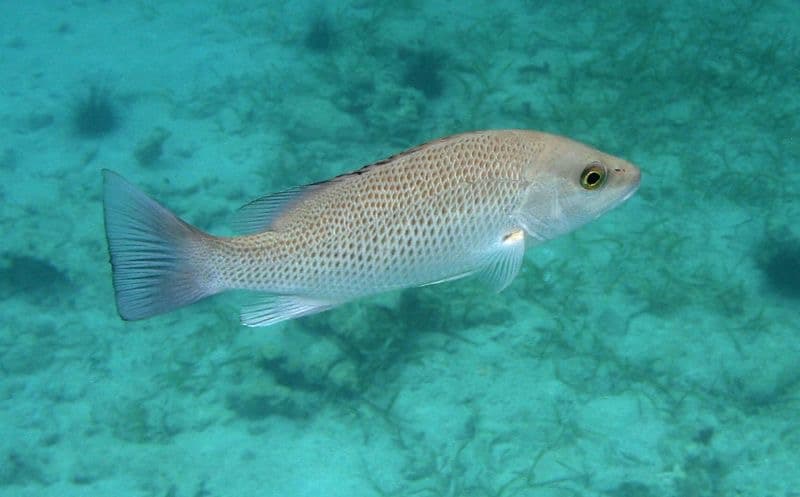
Gray (Mangrove) Snapper (Lutjanus griseus)
Photo: Clinton & Charles Robertson / CC-BY 2.0

Gray (Mangrove) Snapper

Mangrove snapperBlack snapperMango

Lutjanus griseus

Legal to spear
reef25-40 cm inshore, larger offshore
Edibility & ciguatera
Excellent eating; low ciguatera risk.
Where you'll see it
Wrecks, rigs, reefs and nearshore structure; wary and a good ambush target once you find the school.
Legal status
Legal to spear as a saltwater species, 12 in TL minimum, within the reef-fish creel (snappers are reef fish, so the Alabama Reef Fish Endorsement is required). Standard ADCNR limits apply — verify current numbers before harvesting.
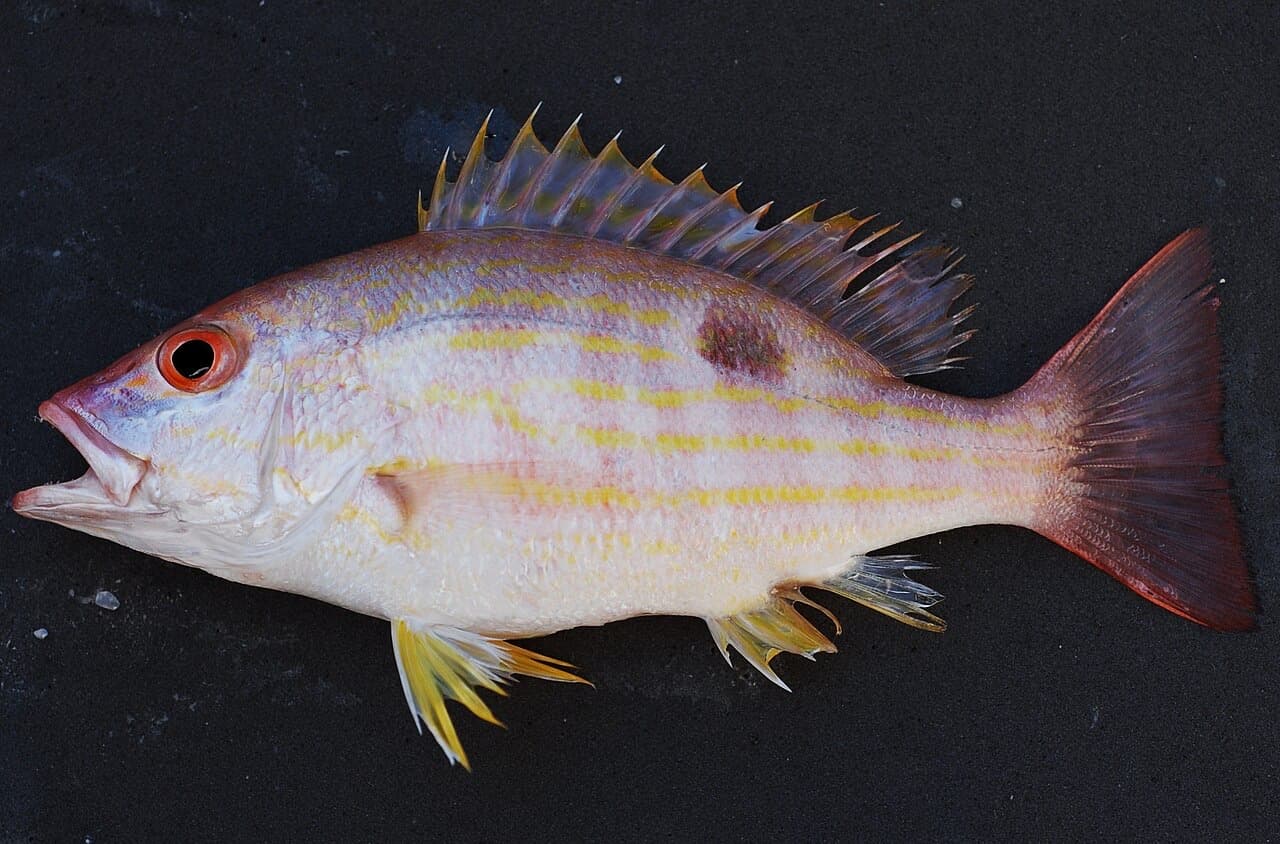
Lane Snapper (Lutjanus synagris)
Photo: NOAA

Lane Snapper

Candy snapper

Lutjanus synagris

Legal to spear
reef20-35 cm
Edibility & ciguatera
Very good eating; low ciguatera risk.
Where you'll see it
Reefs, hard bottom and rubble over the artificial-reef zone; common and approachable, often mixed with other snapper.
Legal status
Legal to spear as a saltwater species, 8 in TL minimum, within the reef-fish creel (snappers are reef fish, so the Alabama Reef Fish Endorsement is required). Standard ADCNR limits apply — verify current numbers before harvesting.

Vermilion Snapper

BeelinerB-linerMingo

Rhomboplites aurorubens

Restricted — verify
reef20-40 cm, up to ~60 cm
Edibility & ciguatera
Very good eating; low ciguatera risk.
Where you'll see it
Deeper reefs, wrecks and hard bottom, often up in the water column in loose schools; a common northern-Gulf reef fish.
Legal status
Legal to spear as a saltwater species, 10 in TL minimum, within the reef-fish creel (requires the Reef Fish Endorsement). Verify current ADCNR size and creel before harvesting.
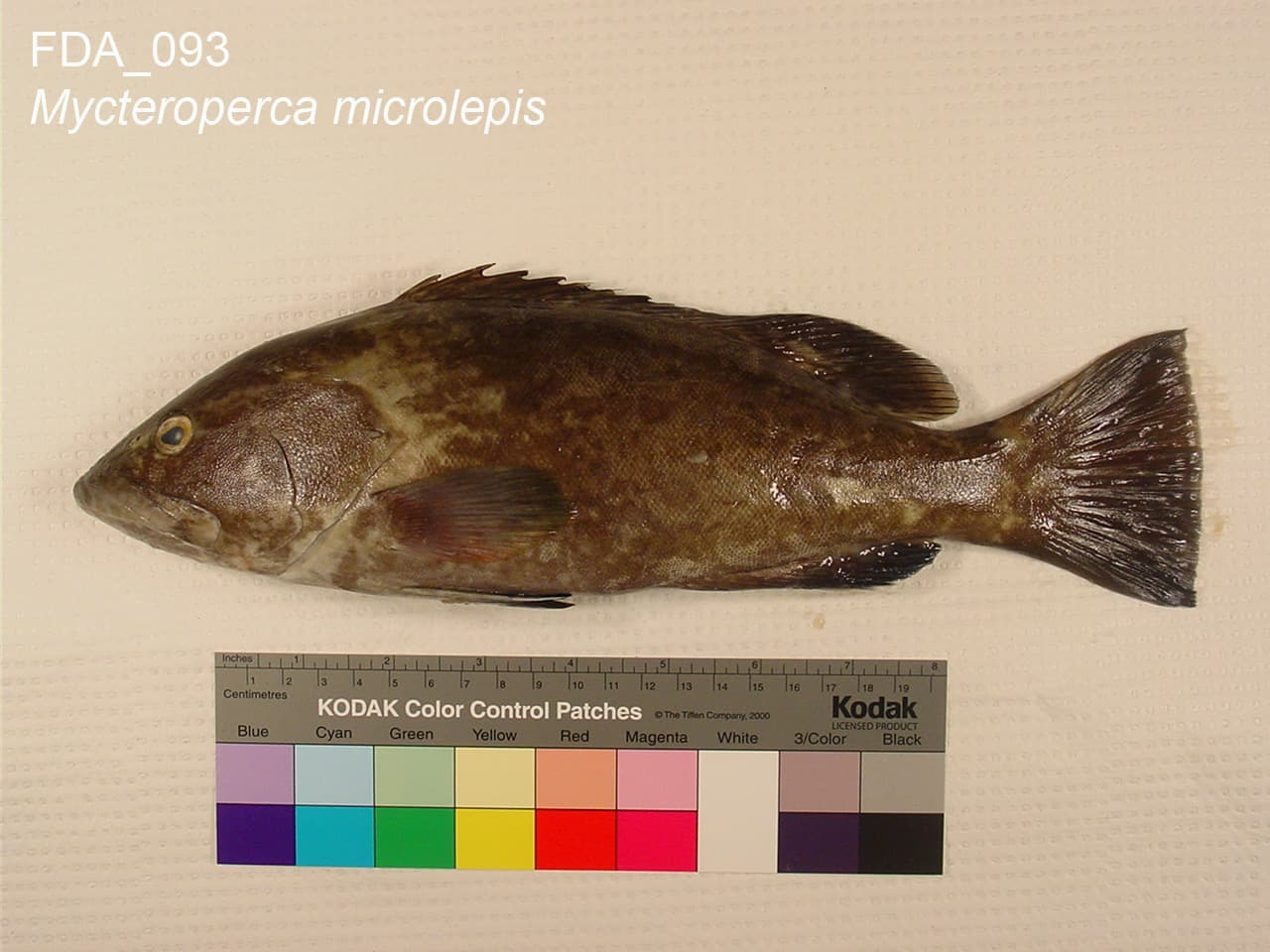
Gag Grouper (Mycteroperca microlepis)
Photo: FDA

Gag Grouper

GagGrey grouper

Mycteroperca microlepis

Restricted — verify
reef2-12 kg, up to ~23 kg
Edibility & ciguatera
Excellent eating; low ciguatera risk.
Where you'll see it
Ledges, wrecks and live bottom over the reef zone; a strong fighter that bolts to structure — a classic reef spear target off Alabama, though less abundant here than off Florida.
Legal status
Legal to spear in the annually-set Gulf season, 24 in TL minimum, within the grouper aggregate (requires the Reef Fish Endorsement). Closed much of the year — confirm current open dates before targeting.

Common Carp

Carp

Cyprinus carpio

Legal to spear
bottom2-9 kg, up to ~18 kg
Edibility & ciguatera
Edible but bony and rarely eaten; usually a bowfishing target rather than table fare.
Where you'll see it
Shallow freshwater bays, backwaters, rivers and reservoir edges — the classic Alabama freshwater spearing/bowfishing target, cruising or tailing in warm shallows.
Legal status
Legal to spear/gig in fresh water as a nongame/commercial fish under current ADCNR regulation 220-2-.45; no minimum size. Requires the freshwater fishing license PLUS the separate spearfishing license.

Longnose Gar

GarGarfish

Lepisosteus osseus

Legal to spear
inshore60-120 cm, up to ~1.5 m
Edibility & ciguatera
Edible (firm white meat), but the roe is TOXIC to humans and must be discarded; a common bowfishing target.
Where you'll see it
Rivers, oxbows, reservoirs and sluggish backwaters, often basking near the surface — a favourite freshwater bowfishing/spearing target in Alabama.
Legal status
Legal to spear/gig in fresh water as a nongame fish (gar family) under current ADCNR regulation 220-2-.45; no minimum size. Requires the freshwater fishing license PLUS the spearfishing license. NOTE: the much larger Alligator Gar (Atractosteus spatula) is managed separately in Alabama with its own protections — this entry is the common Longnose Gar.

Freshwater Drum

GaspergouGou

Aplodinotus grunniens

Legal to spear
bottom1-4 kg, up to ~9 kg
Edibility & ciguatera
Good eating when fresh; a legitimate nongame table and bowfishing fish.
Where you'll see it
Deeper freshwater river channels, tailraces and reservoir flats, rooting on the bottom for mussels and crawfish. Locally also called 'sheepshead' — but that name belongs to the unrelated saltwater sheepshead in this guide (see review notes).
Legal status
Legal to spear/gig in fresh water — 'drum' is named explicitly in the nongame/commercial list (§ 9-11-83) and current reg 220-2-.45; no minimum size. Requires the freshwater fishing license PLUS the spearfishing license.

Largemouth Bass

LargemouthGreen troutBigmouth

Micropterus salmoides

Protected — do not take
inshore30-55 cm, trophies to ~70 cm
Edibility & ciguatera
Prized on hook-and-line, but cannot be speared — freshwater game fish.
Where you'll see it
Reservoirs, rivers, ponds and backwaters statewide — Alabama's iconic freshwater gamefish. You will see them while spearing/bowfishing for carp and gar, but they are strictly off-limits to a spear.
Legal status
PROHIBITED TO SPEAR. Designated game fish (§ 9-11-82 / reg 220-2-.34) — may be taken only by ordinary hook and line, artificial lure, troll or spinner (§ 9-11-87). Spearing a game fish is a separate misdemeanour ($250-$500 fine). Includes smallmouth, spotted/Alabama and shoal bass.

Bluegill (Bream)

BreamCopper nose

Lepomis macrochirus

Protected — do not take
inshore12-25 cm
Edibility & ciguatera
Excellent panfish on hook-and-line, but cannot be speared — freshwater game fish.
Where you'll see it
Ubiquitous in ponds, reservoirs and slow rivers, bedding in the shallows in warm months. Abundant and easily seen while diving, but a sunfish-family game fish and off-limits to a spear.
Legal status
PROHIBITED TO SPEAR. Bream, sunfish and all members of the sunfish family are designated game fish (§ 9-11-82 / reg 220-2-.34) — hook-and-line only (§ 9-11-87). This covers bluegill, shellcracker/redear, longear, warmouth and redbreast.

Black Crappie

CrappieSpeckled perchCalico bass

Pomoxis nigromaculatus

Protected — do not take
inshore20-35 cm
Edibility & ciguatera
A top freshwater table fish on hook-and-line, but cannot be speared — game fish.
Where you'll see it
Reservoirs and slow rivers, schooling around brush, standing timber and bridge pilings. Commonly seen around structure while diving, but a game fish and off-limits to a spear.
Legal status
PROHIBITED TO SPEAR. Crappie ('speckled perch'/'calico bass') and the perch/sunfish family are designated game fish (§ 9-11-82 / reg 220-2-.34) — hook-and-line only (§ 9-11-87). Covers both black and white crappie.

Striped Bass

StriperRockfish

Morone saxatilis

Protected — do not take
inshore40-100 cm, up to ~1.4 m
Edibility & ciguatera
Good on hook-and-line, but cannot be speared in fresh water — game fish.
Where you'll see it
Rivers, reservoirs and tailraces (Alabama's Gulf-strain and stocked stripers), plus the related white and yellow bass. A powerful gamefish you may encounter, but off-limits to a spear in fresh water.
Legal status
PROHIBITED TO SPEAR in fresh water. The white/lake/striped bass family, yellow bass and the saltwater striped bass ('rockfish') taken in fresh water are designated game fish (§ 9-11-82 / reg 220-2-.34) — hook-and-line only (§ 9-11-87).

Local names & details still being verified

  • Saltwater size, creel and season numbers are set/adjusted annually by ADCNR Marine Resources and (for federally managed reef fish) NOAA. The figures here (e.g., red snapper 16 in, cobia 36 in, flounder 14 in and the November flounder closure) are the recent, widely-cited values — confirm the CURRENT ADCNR Saltwater Creel & Size Limits table before harvesting.
  • Gulf reef fish require the Alabama Reef Fish Endorsement — this covers ALL the saltwater snappers and groupers in this guide (red snapper, gray/mangrove snapper, lane snapper, vermilion snapper, gag grouper) plus gray triggerfish and greater amberjack, not just the seasonal species. Red snapper, gray triggerfish and greater amberjack harvest must additionally be reported via Snapper Check. The seasonal reef fish (red snapper, gag grouper, greater amberjack, gray triggerfish) have short open seasons set each year — verify dates before targeting.
  • Inshore saltwater gamefish (spotted 'speckled' seatrout and red drum/redfish) were deliberately OMITTED as target species: Alabama's statute treats 'all species of saltwater fish' as spearable for licensing, but whether these specific gamefish may lawfully be speared was not confirmed against live Marine Resources rules. Confirm with ADCNR before spearing any inshore gamefish.
  • Freshwater Drum is locally called 'sheepshead' (or 'freshwater sheepshead'), which collides with the unrelated saltwater Sheepshead (Archosargus probatocephalus) in this guide. Both are legal to spear, but we reserve 'sheepshead' for the saltwater fish to avoid ID confusion. The nickname 'white perch' — sometimes applied colloquially to both freshwater drum and crappie in the South, and also a real distinct species (Morone americana) — was omitted as ambiguous.
  • Longnose Gar is listed as a lawful nongame target, but the far larger Alligator Gar (Atractosteus spatula) is managed separately in Alabama with its own protections — do not treat the two as interchangeable. Paddlefish (spoonbill), though listed as nongame in reg 220-2-.45, is a sensitive, separately-regulated species and was intentionally left off this target list; verify before ever targeting it.
  • 'Green trout' (largemouth bass) and 'speckled perch/calico bass' (crappie) are documented Alabama nicknames placed here on the correct PROTECTED entries — both are freshwater game fish that MAY NOT be speared. Do not confuse 'green trout' (bass) with the saltwater 'speckled trout' (seatrout).

A guide, not a ruling

Species identification and regional names are provided as a guide, not a substitute for local knowledge or the current rules. Alabama's key trap is the fresh-vs-salt divide: in fresh water only nongame/commercial fish (carp, gar, catfish, drum, buffalo, suckers) may be speared, while bass, bream, crappie and striped bass are game fish and ILLEGAL to spear or gig; in salt water essentially all species are spearable, subject to size, creel and season limits. Confirm current ADCNR (Marine Resources for saltwater, Wildlife & Freshwater Fisheries for freshwater) rules before taking any fish, and remember you must hold both the underlying fishing license and the separate spearfishing license, and be completely submerged when spearing.

Do not spear

Prohibited species

  • All freshwater GAME fish, which may not be speared or gigged (hook-and-line only) — per § 9-11-82 ('Game fish designated') these are: largemouth and smallmouth black bass ('trout'/'green trout'); bream, crappie or perch and all other members of the sunfish family (rock bass/goggle-eye, calico bass, warmouth, redbreast, white perch, speckled perch, bluegill, copper nose); walleye pike, sauger ('jack salmon'), jack fish/pickerel and all members of the pickerel and pike families; white/lake bass ('striped bass'), yellow bass and other members of the bass family; and the saltwater striped bass (rockfish) when taken in fresh water 1. The current ADCNR regulation 220-2-.34 designates an even broader game-fish list (adding spotted/Alabama/shoal/Coosa/Warrior/Cahaba/Tallapoosa/Chattahoochee bass, longear sunfish, flier, shadow bass, and rainbow trout), all likewise off-limits to spear or gig 5.
  • Saltwater: no blanket statutory no-spear species list — 'all species of saltwater fish' are treated as spearable for licensing purposes 1 — but general recreational size limits, creel limits, seasons, and any separately protected/prohibited saltwater species still apply; confirm current Marine Resources creel/size limits before harvesting 2. See unverified[].

Where you can't

Area restrictions

  • No statewide distance-from-swimmers/pier/beach spearing setback appears in Article 5; the primary spatial rules are the 'completely submerged' requirement and mandatory diver's-flag display 1.
  • Competitive spearfishing events: when a group meets for a competitive spearfishing event, written notice of the time, date and place must be given to ADCNR at least one week in advance (§ 9-11-170(b), s1).
  • State parks, wildlife management areas, and specific reservoirs may carry additional local restrictions — not covered in Article 5; verify locally. See unverified[].

Worth knowing

Notable rules, seasons & limits

  • The diver must be COMPLETELY SUBMERGED to spear lawfully (§ 9-11-170, s1).
  • A distinct spearfishing license is required IN ADDITION to the regular saltwater or freshwater fishing license (§ 9-11-171, s1)2.
  • Possession of a spear, speargun or spearing device in a boat, on the bank, or in/on public waters is prima facie evidence that the person is spearfishing — unless they are frog gigging only (§ 9-11-175, s1).
  • The spearfishing license must be kept in the boat or base of operations and be readily available for inspection by a conservation officer (§ 9-11-172, s1).
  • Freshwater game fish (bass, bream, crappie, striped bass, etc.) may be taken only by ordinary hook and line, artificial lure, troll, or spinner — NEVER by spear or gig (§ 9-11-87, s1)3.
  • Gigging or hand-grabbling nongame fish is allowed with a sport-fishing license, but only with a single barbless hook (no treble or barbed hooks) 3.
  • Flounder gigging in coastal waters requires a saltwater fishing license 23.

What divers here typically use

Gear up for Alabama spearfishing

Most divers working Alabama's coast start with a band speargun sized to the water and the fish they are after. Our honest guide to the Best Speargun for Beginners walks through what to look for — curated from published specs and community consensus, not paid placement.

If you break them

Penalties

Violation of the spearfishing article (Article 5) is a misdemeanor punishable by a fine of not less than $100 nor more than $250 (§ 9-11-176, s1). Taking a game fish by an unlawful method such as spearing is a separate misdemeanor punishable by a fine of not less than $250 nor more than $500 (§ 9-11-87, s1). Taking, catching, stunning or killing game or nongame fish by an electrical device or any other device not expressly allowed by law or ADCNR regulation carries a fine of $500 to $2,000 for a first offense, rising to $1,000 to $3,000 on a second conviction, plus up to six months in jail (§ 9-11-94, s1).

Not yet independently confirmed — verify directly

  • Whether the age-based exemptions (under 16, residents 65+) that waive the underlying fishing license also waive the separate $6.00 spearfishing license was not stated on the primary pages reviewed; the statute (§ 9-11-171) lists no such exemption for the spearfishing license. Verify with ADCNR before relying on any exemption for the spearfishing license itself.
  • Hawaiian sling: classified here as an allowed hand-operated spearing device under the 'held in the hand' branch of § 9-11-170, but the statute's projectile branch requires a recovery line attached; a classic sling fires an untethered spear. ADCNR does not name the Hawaiian sling explicitly, so its treatment is inferred from the definition rather than an express agency statement.
  • Saltwater species that may NOT be speared: the statute treats 'all species of saltwater fish' as spearable, but separately managed/protected species (e.g., federally protected species, tarpon, sturgeon, or any species under a Marine Resources closure) and current size/creel limits were not exhaustively confirmed against the live Marine Resources creel-limit tables for this file. Confirm current saltwater size/creel/season limits and any protected species before harvesting.
  • Local/area closures in state parks, wildlife management areas, and specific reservoirs (e.g., wire-basket-restricted waters) were not individually verified; Article 5 contains no statewide swimmer/pier/beach setback.
  • Exact current statutory citation numbering may differ between the 2019-2020 Title 9 PDF used here and the very latest code; the substantive Article 5 spearfishing provisions were unchanged as of the ADCNR-hosted text reviewed.

Confirm these points directly with Alabama Department of Conservation and Natural Resources (ADCNR) — Marine Resources Division (saltwater) and Wildlife & Freshwater Fisheries Division (freshwater) before you rely on them.

Primary sources

Sources

Every fact above is drawn from these official sources. Each was retrieved on the date shown; regulations can change after that date.

  1. Source 4: ADCNR / Outdoor Alabama — Saltwater Regulations and Enforcement (Marine Resources Division contacts; Gulf Shores 251-968-7576, Dauphin Island 251-861-2882)

    Retrieved July 5, 2026https://www.outdooralabama.com/saltwater-fishing/saltwater-regulations-and-enforcement

Quick answers

Frequently asked questions

Is spearfishing legal in Alabama?
Yes — spearfishing is legal in Alabama's saltwater, and it is permitted in fresh water, subject to license, gear, species, and area rules. Alabama has a Gulf of Mexico coastline (Mobile Bay, Gulf Shores, Orange Beach, Dauphin Island). Spearing is lawful in all salt waters of the state provided the diver is completely…
Do you need a license to spearfish in Alabama?
Yes. Alabama requires the Commercial or Nongame Fish Spearfishing License (Ala. Code § 9-11-171). Resident cost: $6.00 annual spearfishing license (current ADCNR fee, s2). The underlying resident annual saltwater fishing license is $30.05. Note: the statute itself (§ 9-11-171) still lists the older base figure of $5.00 for the resident spearfishing license; the $6.00 sold price reflects issuance/cost adjustments. Non-resident cost: $8.50 annual spearfishing license, or $3.50 for a 7-day trip spearfishing license (current ADCNR fees, s2). Underlying nonresident annual saltwater fishing license ranges $48.20 (Florida residents) to $129.20 (Louisiana residents) to $64.90 (all other states) under Alabama's reciprocal system. Statute § 9-11-171 lists older base figures of $7.50 annual / $2.50 seven-day for the spearfishing license.
Can you spearfish on scuba in Alabama?
Not prohibited, and effectively contemplated: § 9-11-170 requires the person spearing to be 'completely submerged,' and the article repeatedly refers to the 'skin diver'. No statute bans SCUBA for spearfishing. Divers must comply with water-safety law, including displaying a…
What can't you spear in Alabama?
Protected or no-take species you may not spear in Alabama include: All freshwater GAME fish, which may not be speared or gigged, Saltwater: no blanket statutory no-spear species list — 'all species of saltwater fish' are treated as spearable for licensing purposes. Always check the full prohibited-species list and current seasons before diving, and confirm with Alabama Department of Conservation and Natural Resources (ADCNR) — Marine Resources Division (saltwater) and Wildlife & Freshwater Fisheries Division (freshwater).

Stay current

Get an email when Alabama's size & bag limits change

Regulations shift between seasons. We re-check Alabama's rules against the primary source and send a short note when the limits, seasons, or licensing move — nothing else.

No spam. Regulations updates, gear data drops, and the launch of the guide.

Last verified July 5, 2026. Regulations change — always confirm the current rules with Alabama Department of Conservation and Natural Resources (ADCNR) — Marine Resources Division (saltwater) and Wildlife & Freshwater Fisheries Division (freshwater) before you dive.